Pages

Showing posts with label China. Show all posts

Thursday, January 22, 2026

National Review Underestimates Chinese Workers

Conservatives in America are fed a regular diet of nonsense on China by the conservative press. I have been allowed to rebut such nonsense in The Stream and in Quillette.  But one of the worst offenders, National Review, which I have read since college, does not allow anyone to puncture its balloons.   

A few days ago, "China expert" Therese Shaheen gave NR readers another test of their gullibility. Most readers, having been brainwashed, seemed to fail that test.  Let's examine just one claim from her article denigrating Chinese economic prospects:

"And as many as 700 million working-age people in China have a grade school education or less."

Tuesday, January 18, 2022

Grant and the Chinese

 The following is an excerpt from Mark Twain's autobiography, accessed at Gutenberg.net.

GRANT AND THE CHINESE


Early in 1884, or late in 1883, if my memory serves me, I called on General Grant with Yung Wing, late Chinese minister at Washington, to introduce Wing and let him lay before General Grant a proposition. Li Hung-Chang, one of the greatest and most progressive men in China since the death of Prince Kung, had been trying to persuade the imperial government to build a system of military railroads in China, and had so far succeeded in his persuasions that a majority of the government were willing to consider the matter--provided that money could be obtained for that purpose outside of China, this money to be raised upon the customs of the country and by bonding the railway, or in


some such manner. Yung Wing believed that if General Grant would take charge of the matter here and create the syndicate, the money would be easily forthcoming. He also knew that General Grant was better and more favorably known in China than any other foreigner in the world, and was aware that if his name were associated with the enterprise--the syndicate--it would inspire the Chinese government and people and give them the greatest possible sense of security. 

We found the general cooped up in his room with a severe rheumatism, resulting from a fall on the ice which he had got some months before. He would not undertake a syndicate, because times were so hard here that people would be loath to invest money so far away; of course Yung Wing's proposal included a liberal compensation for General Grant for his trouble, but that was a thing that the general would not listen to for a moment. He said that easier times would come by and by, and that the money could then be raised, no doubt, and that he would enter into it cheerfully and with zeal and carry it through to the very best of his ability, but he must do it without compensation. In no case would he consent to take any money for it. Here, again, he manifested the very strongest interest in China, an interest which I had seen him evince on previous occasions.


He said he had urged a system of railways on Li Hung-Chang when he was in China, and he now felt so sure that such a system would be a great salvation for the country, and also the beginning of the country's liberation from the Tartar rule and thralldom, that he would be quite willing at a favorable time to do everything he could toward carrying out that project, without other compensation than the pleasure he would derive from being useful to China.

This reminds me of one other circumstance.

About 1879 or 1880 the Chinese pupils in Hartford and other New England towns had been ordered home by the Chinese government. There were two parties in the Chinese government--one headed by Li Hung-Chang, the progressive party, which was striving to introduce Western arts and education into China; the other was opposed to all progressive measures. Li Hung-Chang and the progressive party kept the upper hand for some time, and during this period the government had sent one hundred or more of the country's choicest youth over here to be educated. But now the other party had got the upper hand and had ordered these young people home. At this time an old Chinaman named Quong, non-progressionist, was the chief China minister at Washington, and Yung Wing was his assistant. The order disbanding the schools was a great blow to Yung Wing, who had spent many years in working for their establishment. This order came upon him with the suddenness of a thunderclap. He did not know which way to turn.

Rev. Joseph Twichell

First, he got a petition signed by the presidents of various American colleges, setting forth the great progress that the Chinese pupils had made and offering arguments to show why the pupils should be allowed to remain to finish their education. This paper was to be conveyed to the Chinese government through the minister at Peking. But Yung Wing felt the need of a more powerful voice in the matter, and General Grant occurred to him. He thought that if he could get General Grant's great name added to that petition, that alone would outweigh the signatures of a thousand college professors. So the Rev. Mr. Twichell and I went down to New York to see the general. I introduced Mr. Twichell, who had come with a careful speech for the occasion, in which he intended to load the general with information concerning the Chinese pupils and the Chinese question generally. 

But he never got the chance to deliver it. The general took the word out of his mouth and talked straight ahead, and easily revealed to Twichell the fact that the general was master of the whole matter and needed no information from anybody, and also the fact that he was brimful of interest in the matter. 

Now, as always, the general was not only ready to do what we asked of him, but a hundred times more. He said, yes, he would sign that paper, if desired, but he would do better than that: he would write a personal letter to Li Hung-Chang, and do it immediately. So Twichell and I went downstairs into the lobby of the Fifth Avenue Hotel, a crowd of waiting and anxious visitors sitting in the anteroom, and in the course of half an hour he sent for us again and put into our hands his letter to Li Hung-Chang, to be sent directly and without the intervention of the American minister, or anyone else. 

It was a clear, compact, and admirably written statement of the case of the Chinese pupils, with some equally clear arguments to show that the breaking up of the schools would be a mistake. We shipped the letter and prepared to wait a couple of months to see what the result would be.

But we had not to wait so long. The moment the general's letter reached China a telegram came back from the Chinese government, which was almost a copy, in detail, of General Grant's letter, and the cablegram ended with the peremptory command to old Minister Wong to continue the Chinese schools.

It was a marvelous exhibition of the influence of a private citizen of one country over the counsels of an Empire situated on the other side of the globe.

Such an influence could have been wielded by no other citizen in the world outside of that Empire; in fact, the policy of the imperial government had been reversed from Room 45, Fifth Avenue Hotel, New York, by a private citizen of the United States.


Tuesday, March 17, 2020

The World Should Thank China! And America Should Apologize!

Here's my translation of an article in China's official news agency, Xinhua ("New China"), that has stirred angry reactions in the United States.

I'll write some commentary on this later.  Certainly there is much to say in response.  One important point: I do not know how much these views represent the thinking of the Chinese leadership.

The original is included below. -- DM


The Truth is, the World Should Thank China

Monday, June 13, 2016

Chinese Wild Flowers

My hobby over the past two + years in China has been escaping the ugly cities and climbing mountains around the country.  One of my discoveries these years, though I knew this a little already, is the incredible diversity and gorgeousness of China's wildflowers.  Many of our favorite garden flowers -- lilacs, gardenias, numerous rhodys of different colors, lilies of the valley -- can be found in great profusion above the treeline in different parts of China.

"Consider the lilies of the field.  They
neither toil nor spin, yet in their beauty,
here today and tomorrow cast into the fire,
they surpass Solomon."  Jesus, right yet
again.  
Here are some of my favorite shots, the ones that I can find.  (Not counting all those gorgeous pictures from Mount Song in Henan -- no card in the camera! -- or the even more beautiful pictures of mustard fields in bloom, cherry blossoms against tiled roofs, and best of all, the lotus fields near my school, and other domesticated yet accidental beauties.) Also sorry to disappoint, you apologetic junkies and politics addicts who follow this blog, but stop and smell the wild roses (of which I found another kind on the border of Ningxia and Inner Mongolia this past weekend, the yellow one below.)


Flox, I think - though my co-worker claims it's a kind of lily.  This weekend, border
of Ningxia and Inner Mongolia,about 7000 feet above sea level.  

Is this what the yellow rose of Texas looks like? 

One of many kinds of rhodydendrums, on Green Mountain above Dali, Yunnan.  (This is the
mountain from which Kublai Khan mounted a successful attack on the city.  See, you can
be a flower-lover AND a warrior!)
Grass is a flower, and bamboo is a flowering grass.  


Lilacs  above the timberline in the dry north.  Others are white. The fragrance is amazing.  

Monday, April 25, 2016

Mike Bastin Kisses Up to Tyrants and Throws America Under the Bus

China Daily is a propaganda rag, which I stop in a local Starbucks to read for the news (mostly straight), interesting cultural pieces, and sports summaries.  My eye often however drifts to the opinion page, which is a mixture of North Korean-style rants, and more nuanced pieces. 
What is most disturbing is to find some of those rants are by westerners who are willing to sell their soul to a propaganda organ to vent their bile at their own country, or at their perceived enemies in America.  
This is particularly obnoxious because China Daily never airs any of the many grievous short-comings of the Chinese dictatorship.  While disasters are mentioned, the paper's coverage of their own bosses, aside from those targetted for corruption, is universally fawning.  Always the fault lies entirely with whatever country China is having a hard time playing well this week -- whether the US, or Japan, Taiwan, or even the Phillippines.  
It is reprehensible for a westerner, who surely knows the truth, to feed the appetite of such a propaganda outlet for anti-American propaganda. 
Today, for instance, I found an article on the faults of American democracy ("democracy") by an economist named Mike Bastin.  I should have been an easy audience to please, because Bastin was attacking Donald Trump, and I'm a sucker for attacks on Trump.  But in his rush to paint his own country in the darkest colors, Bastin couldn't even bother to get his most basic facts correct.  (Most of the present generation of Chinese communist propagandists do better than his piece.)
In the following rebuttal, I will include all of Bastin's article, which is fairly short, so no one can accuse me of quoting him out of context. 
"Even though US presidential candidate Donald Trump's rivals in the Republican Party appear to be gaining some kind of momentum, it still looks as if the billionaire businessman is about to secure the nomination to contest one of the most powerful positions on the planet."
Accurate enough so far, except that rather than "one of" the most powerful positions, "the most powerful position" would probably be more accurate.  
"What is at stake? Is it Trump's often nonsensical and barmy rhetorical rants? Or, is it yet again the phony, money-centric system of democracy that defines the United States?"
So America's democracy is "phony?"  What about China's "democracy?"  (One of the twelve "core socialist values" the government is pushing is "Democracy.")  Are you going to say anything critical about that -- like, that it's a complete illusion?  That more than 1.3 billion people are completely disenfranchised from choosing their own leaders?  
No, of course not.   
Obama didn't have much money.  Neither does Bernie Sanders, nor did Ben Carson.  Their popularity was based not on huge finances, but on the support of millions.  Could a Ben Carson rise to contest the presidency of China?  
Don't make me laugh.
"The answer is the latter.
"Trump relies on one thing and one thing only: financial fortune (most of which was inherited from his late father). 
Two grotesque errors, here. 
In fact, what propelled Trump to the lead in the Republican race was not his money -- he hasn't spent much of it, actually -- but his pithy if, yes, 'barmy' rants.  Lots of people like the bastard.  I don't, but in fact he hasn't won by spending the most money -- if money settled everything, then Jeb Bush would be the Republican winner. 
And no, most of Trump's money was NOT inherited.  
"Not that Trump is the only one. All the presidential frontrunners rely on huge amounts of money without which any hopes of power would be a pipe dream."
Yes, just as power in every country relies on money -- even North Korea.  This is just an inane Marxist truism, dressed up to sound cynical and cutting.  If you want to sell Coke, you need to spend money on advertising.  If you want to convince voters Bush or Sanders or Trump is the best guy, you also need to pay for advertising.  And the Core Socialist Values campaign also spends a massive amount of money.  
Welcome to the real world.  
It is neither moral nor immoral, but intrinsically necessary, that it takes - has always taken - a lot of money to communicate to hundreds of millions of people.  
"The presidential race, and Trump's presence in particular, also highlights the gross unfairness of wealth distribution across the US. All the frontrunners that appear so regularly on our television screens are white, middle class. Where are the African Americans?  Where are the Asian Americans? vIncumbent President Barack Obama's election appeared to break the mold and herald a new dawn but clearly little, if any, progress has been made with regard to equality of opportunity."
Either Baskin has not been paying attention, or he has a very short memory.  Ben Carson, a black surgeon, was the front-runner in the Republican campaign for a while.  Why did he slide?  Because after the Paris attacks, he was perceived as being too uninformed and gentle for the job.  (Trump is also uninformed, but so far no one has accused him of being too gentle.)  
The Republicans also have had two leading Hispanic candidates this session, along with a female businesswoman.  The leading candidate on the Democratic side is a woman, for the first time.  
What, in a country where one in eight are black, now all the candidates should be black, or something?   Or else this is "clear" evidence that "little progress has been made to equality of opportunity?"
And last round Herman Cain, a black businessman, similarly did well until his weaknesses as a candidate were exposed.  
By contrast, when was the last time a Tibetan or a woman was elected to supreme power in China?  
"Money talks in the US and Trump does a lot of talking.  In fact, another feature of US-style "democracy" is the incessant, fatuous drivel spouted by all those running for power.  Rarely do we see a serious debate on serious economic and/or social issues affecting the US and the wider world.  Instead, we are tortured by Trump's tirades against rival candidates (both Republican and Democratic) and jovial jingoistic "God bless America" sound bites and little else."
"Even the live telecasts of debates descend into farce, nay nonsense, with each contender trying desperately to score cheap brownie points against the others."
I watched several Republican debates, and this is simply false.  The debates were often highly substantive.  Admittedly, the one at which Trump failed to show up was probably the best, but that's not the fault of his rivals.  
There has been a great deal of debate over policy towards Iran, Israel, China, and so forth, as well as economic debate.  Bastin either did not watch the debates, or only managed to notice what he didn't want to see.  
And what is "jingoistic" about "God bless America?"  A jingoist is someone who wants to start a lot of wars.  One  can hope God will bless one's country without wishing for more wars, and one can start wars -- as Chairman Mao did, in all directions -- without invoking God. 
"Perhaps most disconcerting of all is the fact that Americans cannot find anyone better.  It appears that Trump really does embody many of the personality traits shared by a large number of Americans."
On this point, I actually agree.  And I would say the same, even more so, about Chairman Mao's continued and disconcerting popularity in China, despite his willingness that one third of Chinese die in a global nuclear war, if such were needed to ensure the victory of communism -- not to mention his millions of actual murders.  Surely China could have found someone better? 
Or better than the present Xi Jinping, who seems to want to start trouble with most of his neighbors?  (Not while invoking God, but while tearing crosses off of churches?) 
Little mute on that subject, are we, Bastin?  Yet this stage you're mounted on, the official Chinese press, is dedicated to the propaganda that makes the likes of Mao a continued national hero, and puffs up Xi all day long.    
"Even Trump's claim to be a "self-made man", personifying the "American Dream" is without foundation. A cursory examination of Trump's business career reveals an inherited foundation marked by his numerous blunders."
While again, I'm easy on Trump criticism, this is, again, lazy.  Most of Trump's money, he did not in fact inherit. Trump exaggerates the extent to which he is a self-made man.  The solution to lies is not to tell opposite lies, but to tell the truth.    
"While we can only hope Trump is finally trounced and roundly rejected by the American people, his apparent popularity among voters is also a disturbing feature of US-style "democracy". Americans appear to fall under the spell of the most outspoken, raucous, aggressive presidential candidate regardless of what they actually stand for."
A plainly false generalization.  The last Republican candidates were named Romney, McCain, Bush, and Dole.  Raucous rabble-rousers?  Baloney.  
Obama might be accused of that, but he tried to sound competent and reasonable when he was running for president.  
"Not that the other candidates represent anything less hypocritical. The Bush family and the Clinton family appear to believe they have an automatic right to power and, in effect, abuse this putative "democratic" process."
Actually, there are no provisions in the American Constitution that deny the sons or wives of former presidents from running for public office.  Does Baskin suggest that there should be?  Or merely that they should run without confidence?  
Was it a tragedy that John Q Adams, or Franklin D Roosevelt, were elected president, thanks to family fortune and fame?  Baskin is confusing "freedom" with "equality."  
But now here's where Baskin shows his true colors: 
"Fortunately, and what also appears to escape these most unworldly US presidential frontrunners, the American influence around the world continues to decline - a downward spiral that will only accelerate under the presidency of any of the frontrunners."
So here's the good news, world.  China will increase, and the United States of America -- which won World War II, won the Cold War, defended numerous countries against totalitarian and Islamic aggression, and rebuilt Europe and Japan, is now fading into the sunset.  
So my bosses in Beijing (after killing millions of innocent people in their own country, destroying much of the world's great art and architecture, and sucking the soul out of Chinese culture) can do whatever they like to Taiwan, or punish Japan or the Philllipines, in a few years.  And they can continue to feed their people with any lies they like, with no fear of competition, or tear down churches, or torture cultists. The whole world should breath a sigh of relief!  No one will be around to constrain the mad Kim family in North Korea, or Islamic terrorists!  
"So until then let's content ourselves with the belief that Trump's political career will at some stage in the future come to an end and let's also try to advise this charismatic candidate on a life after politics: Surely a promising career beckons in the world of TV shows, for leadership and diplomacy are a totally different cup of tea."
Or he might try his hand at flattering the prejudices of tyrants, like you do, Mr. Baskin.  He seems to admire Putin.  

Wednesday, December 02, 2015

Hamlet in China: why we all need critics.

Somewhere in this neighborhood.
A week or so ago, I visited the southern Chinese city of Shenzhen.  This is the most important of those new cities that have sprung up between Hong Kong and Canton (Guangzhou), that with the latter older cities together constitute the densest and largest urban conglomerate on the planet.  Some 50 million people live in these cities: Hong Kong, Shenzhen, and Canton EACH have the population of New York City or so. 

I found a chain hotel a few minutes walk from the border, and stood behind a woman who wanted to get a discount or change rooms.  The clerk was polite, but the customer didn't get what she wanted, and started complaining.  "Everything is bad here!  The elevator is slow, there are no restaurants nearby -- everything is really bad." 

Actually, I was pleasantly surprised to find so reasonable a hotel in such a choice spot.  True, the elevator was like molasses.  But the staff was courteous and eager to help, the place was clean, and it only cost $30 a night.  Furthermore, not only were there some cheap eats -- Muslim noodles, Hunanese, soups and dumplings -- a five minute walk down the road, walking in the other direction, I found myself in the center of a very fashionable and attractive neighborhood, with lights pulsating on a 70 story skyscraper, and all sorts of shops, if that's what you like. 

"Nothing is good or bad, but thinking makes it so," said Hamlet.  His complaint was weightier than that of the woman in front on me in line: his uncle had murdered his father and shacked up with his mother.  So being Prince of Denmark, while attractive from the outside, proved not to be all it might appear from the outside. 

"I could be bounded in a nutshell, and count myself a king of infinite space, were it not that I have bad dreams."

Especially, of course, after his father visited him and his friends as a ghost, and demanded revenge. 

The next day I came across someone who was having good or at least happy dreams, and was not bound within his nutshell. 

I asked a taxi driver to take me to the nearest church, it being Sunday.  I knew there was a white one on a hill -- I'd been there before.  He mentioned a neighborhood, and it sounded vaguely familiar --- it had been five or six years -- and off we set. 

The driver seemed delighted to find an American who spoke Chinese.  He was from Henan Province to the north.  His fondest hope seemed to be to argue with an American about world politics. 

How lucky he got me. 

I obliged him, and we both enjoyed the fifteen minute trip to the church.  When the argument over the relative merits of our general national policies grew vehement, twice he stopped, worried that I was growing angry.  "No, I'm enjoying our chat," I told him, assuring him that I didn't take his criticism personally.  When he stopped, I got out of the cab, shook his hand, paid my fair, and said goodbye. 

What troubled me about the conversation was not the driver's patriotism.  As I told him, I believe a person should love their country.  Nor exactly that he seemed to buy into all the standard communist propaganda.  He did say, "China is a peaceloving country," but couldn't help but add, "You might win in the short run, because you have better weapons, but we have studied the art of war for much longer." (But who wants a war?  I actually had to ask that myself -- usually even the most strident Chinese patriot make it clear that conflict with the US is the last thing on their minds.)

I was troubled by the driver's insistence that he was not simply parroting the Official Line.  "You think we are brainwashed!  But I got these ideas myself, from reading books."  And he did, indeed, seem pretty well-informed, but what books had he read?  Any that challenged his assumptions?  Apparently not. 

But what really concerned me about our conversation was when I asked,

"Do you really think China never is to blame for anything?  It's always the other country's fault?  When you have a war with India, it's India's fault.  When you dispute islands with the Phillipines, it's entirely their fault.  You put the world's worst tyrants into power in North Korea, and that's America's fault?" 

The driver replied, "Yes."   He seriously maintained that China really is never to blame.  Chinese are peace-loving, and he could prove that each and every time China had a conflict -- and it has had plenty of them over the past 70 years, with almost every neighbor -- it is the other guy's fault. 

In other words,

"Nothing is good or bad, but thinking makes it so." 

I just went through the Genesis story of Adam and Eve with my first-year students, in which Adam blames Eve, and Eve blames the snake.  (The serpent probably blamed his genes, or God for creating him.) 

These two anecdotes are part of a larger trend that includes you and I.  Atheists call it "confirmation bias," but then almost never notice their own.  Another word for it is "cherry-picking," or in the case of Christ-mythicism, "parallelmania."  It is the picking and twisting and spinning of data to confirm those beliefs that have become close to your heart. 

This is why propaganda is a community activity.  As Jacques Ellul pointed out, propaganda always appeals to values, or "myths," that the community already has its heart set on: "Democracy," "Science," "Socialism," "Peace," "Equality."  'Grace" and "Faith" might qualify for Christians.  And then you can sell it anything, even the opposite of what those words normally mean, because in a sense, the community, the individual, is selling the package to himself.  That's because self-deification has become a collective activity.  To the extent "China" -- or "America," or "Christianity," "the Seattle Seahawks," or any other group identity -- is our god, we make ourselves into the incarnation of that god, and an attack on it is an attack on our own egos.  Which we will fight to the death to defend. 

This is one reason the doctrine of sin and of human corruption is so liberating -- because it confronts us with our own duplicity. 

And this is one reason I DO thank God for the New Atheists, and for other critics.   We need them, as they need us. 

This is one of several reasons that, when asked who our favorite "apologists" were, I wrote:
"Personally, I appreciate John Loftus, Richard Carrier, Richard Dawkins, David Hume, Sam Harris, Robert Funk, Marcus Borg, John Crossan, Carl Sagan EO Wilson, Elaine Pagels, Reza Aslan, Greta Christiana, Celsus, Philostratus, Matthew Fergusen, Bart Ehrman, Phil Zuckerman, Dan Brown, Dan Dennett, Christopher Hitchens, Steven Law, Robert Price, John Hick, and other apologists of that stripe. Don't know what I'd do without them."

And this is also one reason why, while I am not sure about evolution and creation scientifically, Genesis is one of my favorite books in the Bible. 


Friday, November 06, 2015

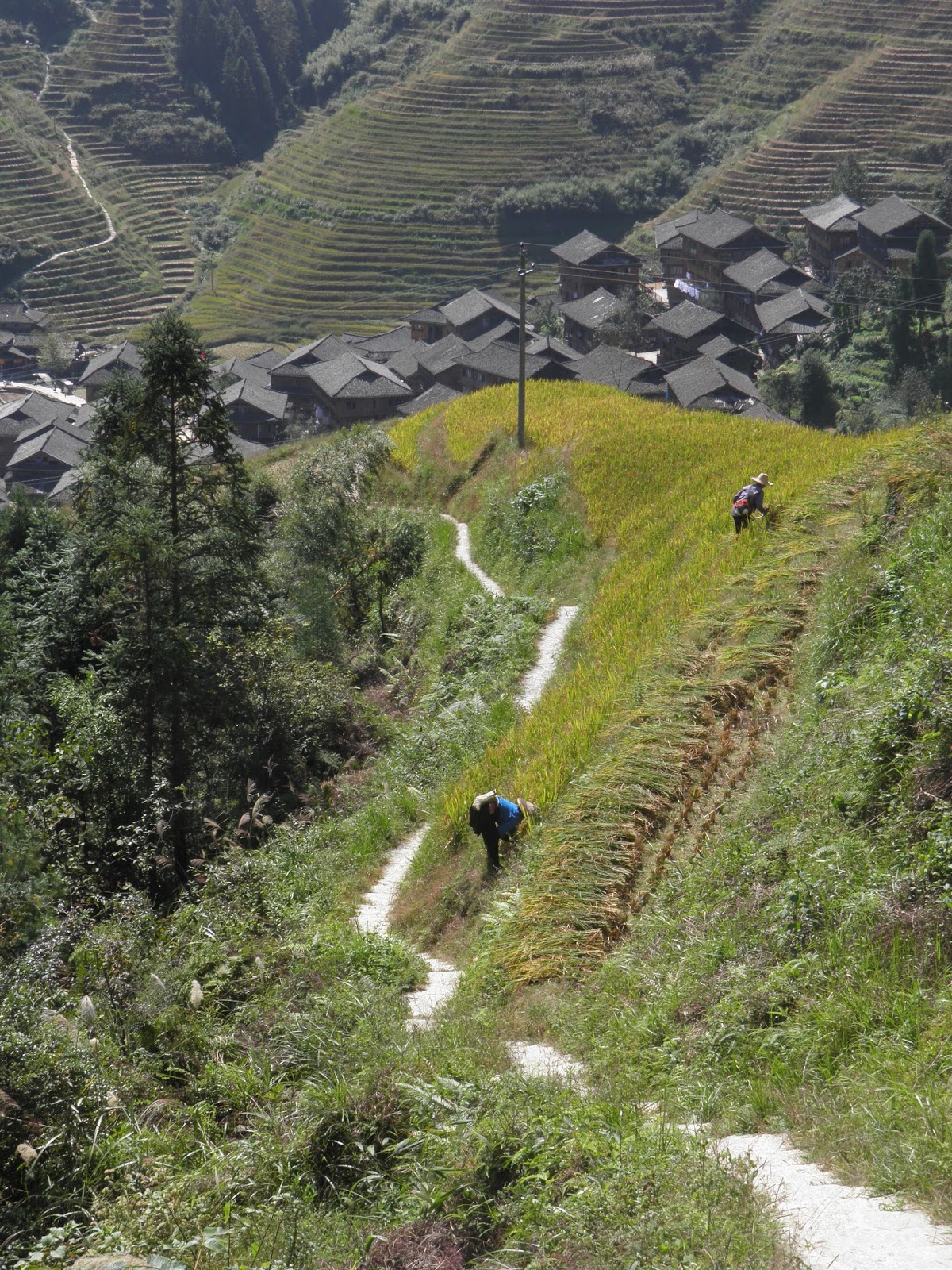
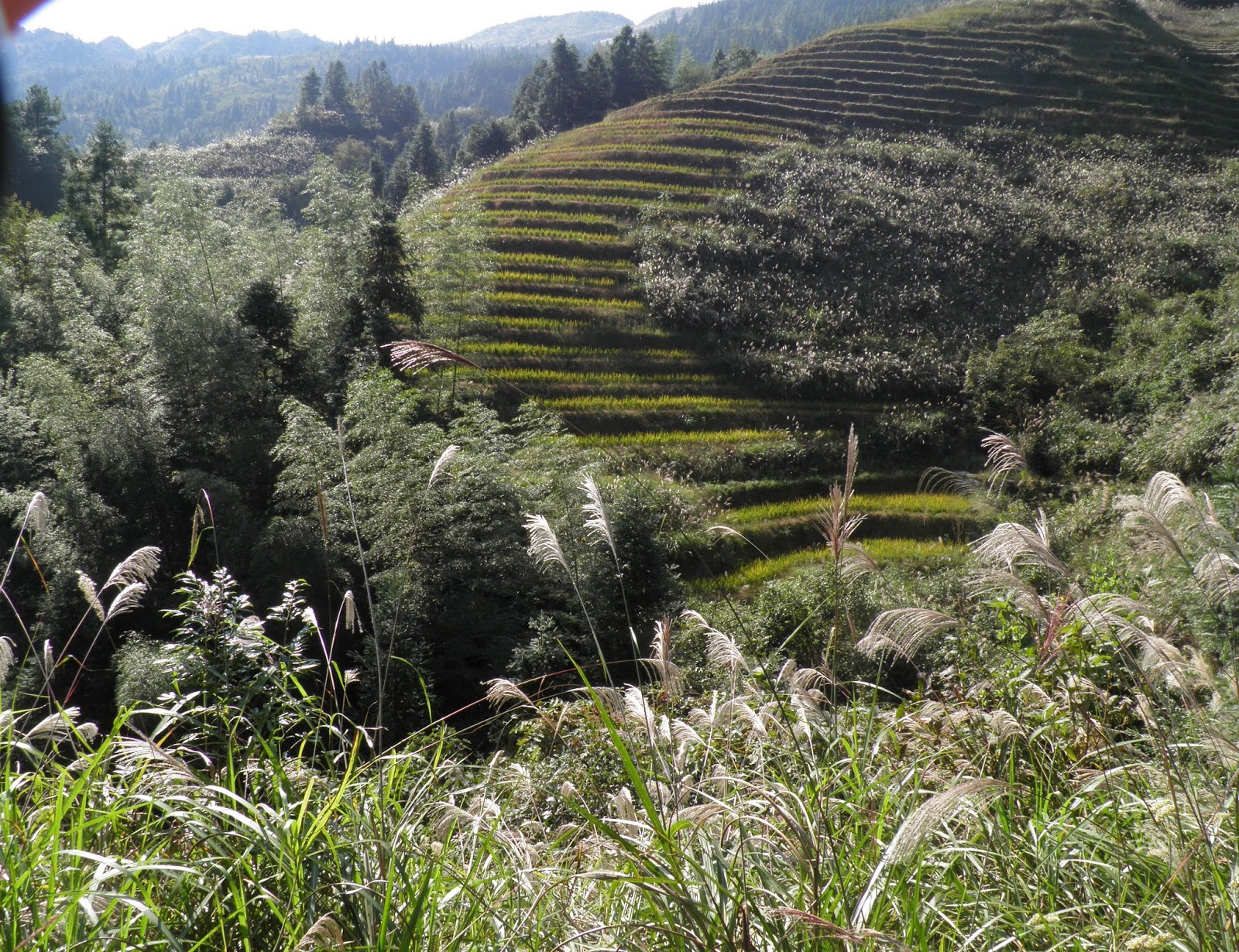
Rice Terraces in the fall in Southern China

I've been wanted to post these photos from my visit to the Longji (Dragon Spine) rice terraces in Guangxi Province three weeks ago, but had logistical problems.  Anyway, the place was amazing!  But take a look and see.   

Hiking up the mountain from the village where I stayed.  This is nearly the last of
the fall rice harvest. 

Isn't this bewitching?  High on the mountain, the rice terraces march down into a fairy land of bamboos
and autumnal grasses.  The steepest parts of the slope are given over to grasses. 

The wooden (fir, I think) homes are
constructed with pegs rather than
nails.  I rented a room for $13 a night.  
Smelled nice inside, but there was a huge
spider in the passage to the bathroom.
I stayed in a hotel much like these houses, to the right.  This field was being harvested the day I left.


Monday, July 13, 2015

Be with you shortly . . . First, these flowers from our Sponsor.

I flew into Seattle from Changsha, China three days ago.  Lots of things to say on my blog have occurred to me since I last posted here directly (rather than sending the article to James, and asking him to post).  So I'm hoping to post a bunch of stuff this summer -- there's so much to talk about. 

The first day after my return, therefore, I posted a long critique of an attack on the gospels by a young Classics scholar named Matthew Ferguson.  Quite a few people read the thing, though there were no comments yet. 


Looking it over this afternoon, I felt a twinge of embarrassment.  The post was too disorganized, too rambling, and lacked some crucial empirical evidence.  In some places my wording was a little too strident, as well.  So much for writing epics with jet lag. 

So I've moved that article temporarily back to "draft" mode.  I'll fix it up, offer a more thorough analysis of some of the works Ferguson cites, and hopefully post it again within a few days.  If my head weren't starting to swim a bit again, I might even promise later this evening.  But there's a good chance I'll be asleep by then. 

In the meanwhile, as they say, a picture is worth a thousand words.  These might be worth more than that. Here are some photos I took in the past few days, in some cases hours before my flight on Friday morning.  The flowers grow in the lotus fields just over the little hill from our school. 


Friday, March 27, 2015

Why did God create the World?

I've had a good day today.  

I'm stuck in Hong Kong trying to renew my Chinese visa.  My first day was not so good.  My partner kindly bought me a first-class ticket to Shenzhen, the ultra-modern city across the border, a few days ago.  Unfortunately that seat was set against a support and couldn't retract, which meant, with my bad back, I had to stand most of the way down.  I stayed in a run-down hotel that night, crossed the border with some hassles, and then was berated by the woman at the visa office, after a long wait, for not providing all sorts of details that they never asked for before.  Even the librarian in Wan Chai was mean (or maybe I was tired).  Then as I got into the subway, the door closed first on my backpack, which I had been lugging around all day, then on my arm.  An Australian lent me a hand (his only one, as it happened.  What is the prior probability of that, Richard Carrier?)  I started laughing, finally, and told him, "This has been such a strange day, it's only fitting that the subway would attack me."  

Today was very different. 

Monday, August 18, 2014

John's Cool Photos from China

My son is spending a month or two with me in China.  He's a pretty good young amateur photographer, in the Marshall tradition.   We haven't visited many places yet, but here are a few of his shots.

A temple about half-way up Song Mountain in central
China, against the cliffs.  One of  5 ancient sacred peaks.


This cypress was already more than 2000 years old when the famous Han Wudi emperor visited a hundred years
before Christ, and gave it an official title.  The needles look just the same as the ones in the Altar of Heaven grounds
in Beijing.  Marvelous photo, no?  Marvelous tree.  

And here's an interesting look at the Altar of Heaven itself, which we also visited. 


Friday, May 16, 2014

Beijing and Hunan: photos from China

A couple pictures from China.  Here on the right is a surprisingly deep lake in Zhangjiajie, western Hunan Province.  (Which is in the south of China, two thirds of the way to Hong Kong.)  Imagine being at sea in waves that choppy. 


Below is the Summer Palace in Beijing, last winter.  (You may notice a few open leads in the water; shortly after this, one could walk on the ice, and this one did.)  Here the emperors of Qing China would come to "get away from it all."


Don't be fooled: this is merely an oasis in a desert, an island of peace in a sea of buildings.  In all directions just past that hill, or to my right or to a lesser extent behind me (it is not far in that direction to the Fragrant Hills), spreads a vast city of some 20 million people.  And when the ice was frozen more solidly, it acquired a layer of precipitated smog, grit and grime, that kept one from slipping on the ice.  But still, it was nice to visit such islands, which I would do before work in the morning, the front gate of the Summer Palace just past that hill, being just five or so subway stops from the high-tech mecca in northern Beijing where my company was based.  Beijing University is about halfway between the two, and with its traditional architecture and landscaped lake (used as a skating rink in winter), was also a good place to stroll in the morning. 

After a month and a half in Beijing, I was sent to work in Changsha, the capital of Hunan Province.  Zhangjiajia is several hours by train to the west of the provincial capital. 


Wednesday, November 27, 2013

How Smart People Lie

I'm presently researching how the Gospel has changed the world for women, as you may know.  One comes across all kinds of interesting phenomena on such a journey. 

One thing I've noticed is a difference between some Indian scholars, and some American scholars.  Even in an anthology dedicated to a professor, I find that not all of the Indian scholarship would meet American standards.  There are lots of misspellings, poor grammar, and worse yet, the unabashed expression of horror when confronting evil:

"It passes our comprehension how the great Buddha could reconcile himself to the transparent injustice implied by the first regulation."
 
Door of Hope doll: are we
"white and wholesome," yet?
"To dub women as perpetual minors is the worst form of coercion that man can perpetrate on the womanhood.  That the Buddha with all his solicitousness for women could not help sanctioning this abominable tyranny on them is a sad commentary on his otherwise catholic vision and keen intelligence." Shalini Dixit, Patriarchy and Feminine Spaces: A Study of Women in Early Buddhism
 
Similarly, in Women of Disadvantaged Groups: Status and Empowerment, the author of a piece on the sexual exploitation of non-Brahman women in South India rages against various bizarre sexual practices and scams inflicted on women. 
 
Bad form, ladies.  Let your female American colleagues teach you how to be appropriately scholarly -- which means, finding evil in good, and good in evil, and being patronizing and especially suspicious of virtue.  (Except your own, which can be tacitly assumed.)
 
Here, for instance, from a book entitled Competing Kingdoms: Women, Mission, Nation, and the American Protestant Empire, 1812-1960.  Sue Gronewold writes a chapter in that book about the Door of Hope Mission, a rescue mission run by Anglo-American missionaries in Shanghai, later mostly of the China Inland Mission.  (Hudson Taylor's outfit.)  As Gronewold admits, Taylor was very open-minded when it came to giving women a strong role in his mission.  Indeed, he was known to say his female missionaries were better evangelists than his male missionaries, at least in one region. 
 
Since 1902, to make money for rescued women, the mission sold China dolls.  These were painstaking objects of art, one of which would take a month of work to produce.  In 1929 these dolls were updated to more modern outfits. 
 
Here's how Gronewold writes up the story.  Sisters in that part of the world in which sneering still lags in its developmental infancy, please take note:

"CIM views of Chinese women added racism and imperialism to the already complicated patriarchy.  For evangelicals, the main attribute of Chinese women was their supposed heathenness and idolatrous ways.   In their view, women were far more susceptible to and responsible for perpetuating popular religion, for prostrating themselves before the 'gilded Goddess of Mercy.'  CIM literature, like much missionary writing, constantly portrayed Chinese women as downtrodden, dark, and limited in mobility, education, and esteem.  The kingdom of Christ literally lightened and whitened them.  'Woman's work for women' was necessary to reach the women and children of China and 'bring them into the light.  Victimized 'girls' represented more that the CIM's best test case; they represented China itself, a China that had been feminized and infantilized at the Door of Hope, born again, and transformed.  The girls who produced new Chinese women and girl dolls in this period reinforced the image of remade and reborn China and Chinese womanhood." (199)
 
Notice the dexterity with which Gronewold moves the conversation away from anything in the real world, any facts about how life is lived and what might make it better, any true picture of the state of affairs in early 20th Century China, any virtues or good deeds or kindnesses or sacrifices that her target villains (the missionaries) might achieve, to wholly imaginary and unreal crimes. 
 
To begin with, one must take care not to ask any questions about objective reality. 
 
* Are most of the worshippers of Guan Yin, the goddess of mercy, female?  (Answer: of course they are, as anyone who has actually been to a Chinese temple, to this day, knows.) 
 
* Did women disproportionately prostrate themselves before religious figures?   (Again, the answer is "Of course."  I have photos, I have interviews, and stats are not hard to find.) 
 
* Were Chinese women "downtrodden," uneducated, and limited in mobility in the 1920s?  (Of course they were.  The bones in girls' feet were broken at about the age of six, which very literally limited their mobility.  Did you ever try walking on broken, bound feet, Ms. Gronewold?  And almost no women were, in fact, educated or literate, until the missionaries arrived.)
 
* In what sense were the missionaries "racist?"  What does Gronewold mean by that accusation?  What is her evidence?  To what degree, compared with other westerners in the 1920s?  (No answer.)
 
* How were they implicit in "imperialism?"  What evidence does she have that the women who served at Door of Hope wished their governments to push around China?  (No answer.)
 
* Did the missionaries in fact change things?  (Well yes they did, in a big way.  Gronewold tells the story of how Door of Hope does this later in the chapter.  It is also a fact that missions in general introduced education for women, and helped launch the war against foot-binding, and in other ways did much to raise the status of women in China.)
 
* Has Ms. Gronewold ever served in a rescue mission, or tried to help girls forced into prostitution?  How many young women has she "rescued?  (No answer.)
 
But Gronewold doesn't need to answer such questions: guilt is implicit in the accusation.  If it weren't, it would be proven by the fact that the missionaries saw what everyone else with open eyes recognized -- that Chinese women, not excluding girls sold into prostitution (!), were in a bad way, and could benefit from a helping hand.  What else can one call that, but patronizing?  And thinking of oneself as better off than others -- isn't that the sin of the Good Samaritan?  After all, didn't he view the person who had been mugged and left for dead as "downtrodden, dark (dried blood will do that), and limited in mobility?"
 
Now it is probably unfair to be too harsh on Ms. Gronewold.  Maybe this paragraph, and other comments like it, are mainly a scholarly affectation.  (She may also have imbibed some Marxism, with all her vague talk about imperialism.)  She does, as I said, detail much of the good that Door of Hope accomplished, later in the chapter:

"The fruits of their labors benefited the Chinese nation as much as or more than they did either Western imperialists or the kingdom of God . . . From the vantage point of poor Chinese women in Shanghai who lived life on the edge and whose possibilities were limited to relatively unskilled factory work, abusive marriages, brothel work, begging, and hunger at home, the mission did indeed offer a 'door of hope.'"
 
But isn't the need to work to this conclusion by way of so many unsupported insinuations in itself, rather telling?  Because what Gronewold is affecting, is indeed a common and accepted style.  It is a style of lying, lying by insinuation. 
 
Give me bad spelling and honest emotion, any day. 
 
(Note: I posted another article yesterday that might just as well be called "How Dumb People Lie," then recalled it.  I don't know how much stupidity my good readers want to put  up with, around the holidays -- or me either, I'm grumpy enough as it is.   So Happy Thanksgiving!) 

Wednesday, May 22, 2013

Not all Control Freaks live in China . . .

"You have to break a lot of eggs to
make an omelette."
This morning, Carson Weitnauer, a Christian who works with students on East Coast campuses, pointed out an article in the New York Times about the cruelty and now uselessness of China's one-child policy.  It described how millions of women were forced to have abortions, even at eight months, and treated with extreme savagery.  (As, of course, were the babies.)  It told of intrusive government checkups (a mild way to put it), and how women flee to remote, unsanitary barges to give birth away from the government's prying eye.  The article also referred to infanticide, which is often also carried out, skewing the sex ratio and (though they didn't point this out) leaving tens of millions of men without the chance to marry.  (China's future warriors, one might guess.) 

And yet all this has now apparently become unnecessary. The birth rate in China, as in most of East Asia and the world, has fallen dramatically, and is now well below replacement level. 

The callousness and fanaticism (also sheer stupidity) of some of the comments New York Times readers, liberal and no doubt mostly secular Americans and Canadians, concerned over "the Environment" (a god to which we must sacrifice our children, now) were almost as disheartening as the article itself.

Seven of the first 13 comments took that tone.  I've copied them here, with a slightly lengthened version of my reply, following. 

Wednesday, March 20, 2013

What are the best cities?

Lijiang: honorable mention.  If they hadn't busted me here for Bible
smuggling, maybe higher. 
The Mercer Quality of Living Survey rated the best cities on earth in which to live. It turns out most of them are German, if you believe Mercer. Aside from Vancouver, Aukland, Singapore, and Copenhagen, 6 or the top 10 are German-speaking cities in Germany, Austria, or Switzerland. 

It occurred to me the first time I saw one of their surveys, in which six German towns also won top honors, that Mercer is wrong, and it might be a nice break from serious subjects to post an alternative way of judging cities here. 

First of all, you probably shouldn't begin with a set of criteria. Begin by getting to know great cities on their own terms. Walk.  Smell.  Taste.  Chat.  Get lost on the boulevards and in the parks. 

But if you really need some criteria, say because you want to be "scientific" or have some other neurosis, here are a few ideas, in more or less random order:

(1) Did God make this the right place for a city? Its amazing how often people put cities in the wrong places. Why Phoenix? Can anyone explain?

(2) A good city needs beautiful buildings. It's nice if some of them are old, but it's not absolutely necessary. Gargoyles, bright lights, reflections, are all pluses. All major Japanese cities lose points; small towns where only old people live gain points.

(3) Of course beautiful women also make a city beautiful.

(4) A great city needs great food. Of course every large city nowadays has an infinite variety of ethnic cuisines -- the key here is good CHEAP food, served by real human beings, if possible, and with some flare.

(5) Do the people here have a sense of humor?

(6) Are there lots of kids? A city without children is a museum.

(7) Are kids allowed to light firecrackers, make noise, splash in pools, and play at the beach with their dogs?

(8) How many generations helped build the city? Are there ghosts of great writers and statesmen and scientists about? Take off points for famous tyrants and totalitarians, present of course but also past. Such boring ghosts they make. 

(9) Give points for top universities, multiply by the inverse square of the metropolitan population, or something like that.

(10) Takes points away for high taxes, add points for low taxes. Sorry, Berlin, Stockholm, Oslo.

(11) Add 50 points if the city is by the sea, 20 for a large (clean) lake, 10 for a (beautiful) river.

(12) A good city needs mountains nearby, with old trees. Extra points if you ski. 
Seattle: forget coffee!  This is a day-trip away.

(13) Add lots of points if you can drive three hours to (a) broadleaf woodlands that turn color in fall; (b) coniferous forests where they let you cut Christmas trees; (c) farms (1 hour or less); (d) ocean beaches; (e) glaciers; (f) desert.

(14) Does the city have a beautiful skyline at night?

(15) How many languages is worship conducted on the weekend here?  The more, the closer it is to the vision of heaven in Revelations. 

(16) Who do the sports fans hate? Add points if everyone hates the Yankees, Tokyo Giants, Manchester United, or some such placebo. Subtract points if you have one of these vile teams in your city.

(17) Yeah, take a few points off for unemployment, high murder rate, blight, smog, earthquakes, terrorism, and the like if you must.

(18) Now throw your scoring system out the window. If a cop or a nag comes up to you and gives you a scolding, burn all your bridges, shake the dust off your feet, and never come back. If someone politely throws it in the garbage can, smile once, get out of the car, walk for an hour, talk to a few people, and make the call exclusively on the mood you now find yourself in.

Someone suggested Budapest.  Someone else, Montreal.  A frequent poster here, Brian Barrington, suggested Australia, then France (which of course are not cities, but do contain some):

I'd agree with David that the best way to judge a place is to go and walk around a have a look. The place I have been to with the highest quality of life, if you just look at the overall country rather than specific city, is Australia. It's sunny, it's rich, it's safe, it's friendly, everything works, it's optimistic, the cost of living is not outrageous, the restaurants are good, healthcare is good. If you like beach life and outdoor activities you are sorted. One disadvantage is that it's very far away from everywhere and it doesn't have much in the way of history or culture.

If you take all that into consideration as well, then the place with the best quality of life is France, because it is a country with EVERYTHING.

So those would be my personal observations, and I get support for them from another Quality of Life survey:

http://www.internationalliving.com/Internal-Components/Further-Resources/quality-of-life-2010

http://www1.internationalliving.com/qofl2010/

Well, I haven't been to Australia.  They don't have much snow, anyway, or enough mountains, and too many snakes and deadly spiders. Plus it takes forever to get anywhere else. 

I have been to France, and much of it is gorgeous, without too many snakes.  If I knew the city better, I might include Nice, which is nice, from the mountain looking down on the city and the Mediterranean sea in the morning.  But judging a city by its looks alone is too superficial: I don't know any French cities well enough to evaluate them fairly.  (I did have some delicious peaches in Cannes, which helps. but doesn't quite get us there.)

So the following list is admittedly limited by my very limited travels or sense of a few places I have not been. 

Drum roll .  . . .

(1) Hong Kong -- even if you do have to live in a rabbit hutch, there's no place like it. The world's most spectacular skyline.  Everything moves -- water, people, trams, double-decker buses, hovercraft, subways.  Islands. Hills.  Monkeys.  Cantonese food.  Brilliant new architecture.  700 year old villages.  (Downside: so humid in long summer.  Dirty beaches.) 

(2) Vancouver Good, cheap Chinese and Indian food (among others) everywhere.  Beautiful views in every direction.  Community feel.  Nice houses, lots of trees.  Better recent architecture than Seattle.  Skytrain works. 

(3) San Clemente, CA -- no wonder Richard Nixon got tanned, rested and ready here -- it's a gorgeous little town with red-tile rooves, clinging to the hill above the ocean.  After speaking at the also very attractive Presbyterian church in town, walked down to the pier for some fish and chips. 

(4) Black River, Kyushu, Japan -- really just a hot springs resort, you can walk up and down the creek and sample the best hot springs by lantern, then drive up to the world's biggest caldera the next day.
A couple random kids at Nugget Creek falls, just north
of Juneau. 
(5) Juneau, Alaska.  Maybe the most beautiful natural setting for any capital in the world, when it's not drizzling.  Avalanches twisting down Mount Roberts in the snow.  Bald eagles.  Glaciers you can walk to, and pick semi-precious stones. Echo Ranch Bible Camp.  But prepare to be depressed in the fall.
 
(6) Shanghai Why Shanghai?  I don't know, ask the students at Nanjing University -- they all want to move there.  Renao, "hot and sweaty," in a good way.  Electricity in the air.  Spectacular skyline, but some old buildings, too.  Come at October 1st, and get bopped on the head with big air-filled hammer-balloons. 
(7) Oxford You can walk everywhere.  Hike through the trees above C. S. Lewis' house on a windy autumn day, and watch the oaks and maples turn into Dryads and Naiads.  Walk along the Cherwell, and look for Alice punting.  Listen for echoes of the debate between Sam Wilberforce and Thomas Huxley at the Pitts River Museum. 

(8) Honolulu -- I'd say Kona, but need the Asian stimulation.

(9) Seattle  You can see the mountains of three national parks from the city on a moderately clear day -- and three snow-crested volcanoes, including Mount Rainier.  (Mount Saint Helens used to be visible.)  Every day the Olympics look different across Puget Sound from my parents' house in West Seattle.  Salt water borders the city on the west, glacier-scoured Lake Washington on the east.  Coffee may not taste like much, but it smells good.  Some cool buildings.  Not too many muggings. (Well, one is too many, but you get my drift.)  Some decent Asian food.  (Seattle loses points for its great phobias against dogs on beaches, plastic bags, and firecrackers.  Never mind the rain, or Vancouver and Oxford are sunk, too, not to mention Juneau.) 

(10) Toss-up and honorable mention: Bath, Beijing, Hangzhou, Lijiang, Madison, Wenzhou, York, Petropavolovsk for all the volcanoes. 

Friday, December 28, 2012

Perspectives: Dai village


This village was just a few miles from the Vietnamese border inside China. Getting there involved buses up and down spectacular mountains, whose lower slopes were covered with banana trees or rice terraces, and winding through villages of several different minorities.  The people in this village belonged to a minority within a minority, a non-Buddhist subgroup of the Dai.  (The Dai are closely related to Thais, especially northern Thais. Some of them used a strange old written language with hundreds of letters, that I tried to learn.)  You might round a corner in this village and find a little water mill, or a girl with a flower in her hair.  Hot water ran out of the ground and into a large bathing pool just around the corner.  I'm afraid to think how this little bit of Shang La has changed since. 

Tuesday, August 28, 2012

Perspectives: Tibetan monastery

My plane was to leave early that afternoon -- I had taken a bus up onto the Tibetan plateau from Lijiang -- and then it snowed that morning.  I had visited this monastery up on the hill the day before, and thought, "Here's my chance for some very special photos."  I wish the resolution were a wee bit clearer.  Up the hill I raced before the clouds blew away: there's the spot, with horses in the fields below the monastery.  A once-in-a-lifetime shot.

The town (at my back as I take this picture) is Zhongdian, in Yunnan Province.  It's largely Tibetan, but looks typically Chinese, unlike this monastery.  I drank Tibetan tea here for the first and hopefully last time -- foul stuff -- and also got some pictures of young monks in red having a snowball fight.  Kids are kids, everywhere.  I also tried yak meat in Zhongdian, with an American who lived here, before heading across the high plateau and down into the Salween River canyon, a few days before. 

Wednesday, August 22, 2012

A Stoic and a Taoist limp into the Church

by David Marshall

Note:  This article first appeared in the May / June issue of Touchstone, a Journal of Mere Christianity (www.touchstonemag.com), under the title "Mars Hill Travelers."  I hope you find the parallels and surprising suggestions of general revelation as interesting as I do. The new  September - October issue, which was just mailed -- I haven't received my copy yet -- also includes one of my articles, this one on "Lin Yutang and the New China."  Another article on John Loftus and the "Outsider Test for Faith" should appear in a later edition, perhaps later this year.  Fun to be writing about China again, and of course always great fun to see stuff in print.-- DM

Wednesday, March 28, 2012

Richard Carrier Proves the Gospel, by Accident

With a little Help from Chinese Tradition . . .

Proof that St. Mark
traveled in China.
Internet Gnu sensation, Richard Carrier, recently had a falling-out with academic historians who study the historical Jesus.  Carrier maintains that, after all, there may be no Jesus to study -- the man likely never lived.  This makes him a "mythicist," and therefore one of the targets of a new book by the yet more influential skeptic, Bart Ehrman: Did Jesus Exist?  The Historical Argument for Jesus of Nazareth.

Wednesday, January 04, 2012

Atheism in China: Is it Doomed?

The debate over religion in the West is dominated by Christians, on the one side, and atheists or secularists, on the other, with some input from New Agers.  Atheist values are often conflated with those of secular humanism, the dominent atheist "religion" in the democratic world.  Secularists also often glibly take a triumphalist posture: "Christianity is dying," they say, pointing to slight downward trends in church-going or faith in God in America, and a larger slides in Europe.  (Seldom, however, recalling how often Christianity has ebbed and flowed in the West before.)

What is often forgotten is that most atheists over the past century have not been secular humanists, but Marxists and communists.  This may even have been true in Western countries, in some of which (such as Italy and France) communist parties polled 20 or 30% of the electorate during the 1970s. 

Today, about two thirds of the people in China deny holding any religious beliefs.  This means that MOST "unbelievers" in the world probably live in China, including most atheists. 

Over three weeks in October through December, I surveyed about 124 Mainland Chinese intellectuals.  (Most in Mainland China, but including 19 near the University of Washington in Seattle.)  I learned many interesting things.  What I would like to share in this post is what I learned about the precarious position of atheism in modern China.

More than 70 respondents were college students at a major university in northern China.  About a dozen other college students answered my survey in other cities.  Most of the other respondents had graduated from college, in some cases with MA or Phd degrees.  Some were themselves college teachers, including in an Institute of Marxist Studies.

I was curious to see what undergraduates and graduates would say, first about Marxism, then about atheism.  Here are some results: 

* 23 out of 81 undergraduates who answered the survey as a whole defined their faith as "Marxism."  The most popular alternatives were (collectively) "unsure" (15), "other" (9), and "agnosticism" (6), for 30 total votes, various forms of Buddhism (8), Confucianism (8), Lao-Zhuang thought (5), Daoist religion (4), Christian (3), and Islam (1 -- a Uighur from the Northwest).  So about 42% of those who defined their faith, chose Marxism. 

* Asked what they thought about God, the most common answer was that He does not exist (47), followed by the Pantheistic belief that He is in all things (12), "Other" (12; in practice this often means something like "God is a belief in the heart," monolatry (4), monotheism (4), and polytheism (3).  So of those who gave a clear answer, about 67% opted for atheism.

* Among older intellectuals who had already graduated from college, only 7 self-identified as Marxists.  The Agnostic (6)/ Unsure (9) / Other (1) block in this case more than doubled the number of Marxists (16), followed by Confucianists (6), Buddhists (5), Christians (5), Lao-Zhuang thinkers (3), Daoist religion (2), and 1 Muslim.  So only about 24% of graduates who identified with a belief system, chose Marxism. 
 
*The drop-off was even stronger when it comes to atheism.  11 chose an atheist answer, 6 "don't know," 7 theism (including 3 non-Christians), 6 polytheism, 6 pantheism, and 2 monolatry.  Again discounting the uncommitted, 31% opted for atheism. 

So the percent of intellectuals who denied that God exists, seemed to be more than cut in half, after graduation. 

This is admittedly a small poll, and skewed geographically and by other variables.  For one thing, I found that Christian students at the university where I conducted this survey were being suppressed.  We cannot automatically assume a larger survey of Chinese intellectuals would follow these figures too closely. 

From prior experience surveying Chinese intellectuals, however, I believe this at least roughly reflects the general trend. 

One of the Christian graduates, from Mao Zedong's home county, told me she had only become a Christian after graduation.  This seems to be a fairly common pattern, evidently not just to Christianity, but to greater openness towards religious beliefs. 

Should Christians in America panic because some of our young people lose their faith when they go to college?  Does this spell doom for the Christian faith, as many skeptics fervently hope? 

Should atheists in China likewise panic at the flight from atheism after graduation? 

Here I return to my core conviction about the future: God alone knows what will happen next.  Perhaps in both countries, a secularist college education will seem at first to "catch," but will ultimately prove ephemeral, as graduates move out into the "real world" and seek to make their ways in it.