Pages

Showing posts with label photos. Show all posts

Wednesday, March 20, 2013

What are the best cities?

Lijiang: honorable mention.  If they hadn't busted me here for Bible
smuggling, maybe higher. 
The Mercer Quality of Living Survey rated the best cities on earth in which to live. It turns out most of them are German, if you believe Mercer. Aside from Vancouver, Aukland, Singapore, and Copenhagen, 6 or the top 10 are German-speaking cities in Germany, Austria, or Switzerland. 

It occurred to me the first time I saw one of their surveys, in which six German towns also won top honors, that Mercer is wrong, and it might be a nice break from serious subjects to post an alternative way of judging cities here. 

First of all, you probably shouldn't begin with a set of criteria. Begin by getting to know great cities on their own terms. Walk.  Smell.  Taste.  Chat.  Get lost on the boulevards and in the parks. 

But if you really need some criteria, say because you want to be "scientific" or have some other neurosis, here are a few ideas, in more or less random order:

(1) Did God make this the right place for a city? Its amazing how often people put cities in the wrong places. Why Phoenix? Can anyone explain?

(2) A good city needs beautiful buildings. It's nice if some of them are old, but it's not absolutely necessary. Gargoyles, bright lights, reflections, are all pluses. All major Japanese cities lose points; small towns where only old people live gain points.

(3) Of course beautiful women also make a city beautiful.

(4) A great city needs great food. Of course every large city nowadays has an infinite variety of ethnic cuisines -- the key here is good CHEAP food, served by real human beings, if possible, and with some flare.

(5) Do the people here have a sense of humor?

(6) Are there lots of kids? A city without children is a museum.

(7) Are kids allowed to light firecrackers, make noise, splash in pools, and play at the beach with their dogs?

(8) How many generations helped build the city? Are there ghosts of great writers and statesmen and scientists about? Take off points for famous tyrants and totalitarians, present of course but also past. Such boring ghosts they make. 

(9) Give points for top universities, multiply by the inverse square of the metropolitan population, or something like that.

(10) Takes points away for high taxes, add points for low taxes. Sorry, Berlin, Stockholm, Oslo.

(11) Add 50 points if the city is by the sea, 20 for a large (clean) lake, 10 for a (beautiful) river.

(12) A good city needs mountains nearby, with old trees. Extra points if you ski. 
Seattle: forget coffee!  This is a day-trip away.

(13) Add lots of points if you can drive three hours to (a) broadleaf woodlands that turn color in fall; (b) coniferous forests where they let you cut Christmas trees; (c) farms (1 hour or less); (d) ocean beaches; (e) glaciers; (f) desert.

(14) Does the city have a beautiful skyline at night?

(15) How many languages is worship conducted on the weekend here?  The more, the closer it is to the vision of heaven in Revelations. 

(16) Who do the sports fans hate? Add points if everyone hates the Yankees, Tokyo Giants, Manchester United, or some such placebo. Subtract points if you have one of these vile teams in your city.

(17) Yeah, take a few points off for unemployment, high murder rate, blight, smog, earthquakes, terrorism, and the like if you must.

(18) Now throw your scoring system out the window. If a cop or a nag comes up to you and gives you a scolding, burn all your bridges, shake the dust off your feet, and never come back. If someone politely throws it in the garbage can, smile once, get out of the car, walk for an hour, talk to a few people, and make the call exclusively on the mood you now find yourself in.

Someone suggested Budapest.  Someone else, Montreal.  A frequent poster here, Brian Barrington, suggested Australia, then France (which of course are not cities, but do contain some):

I'd agree with David that the best way to judge a place is to go and walk around a have a look. The place I have been to with the highest quality of life, if you just look at the overall country rather than specific city, is Australia. It's sunny, it's rich, it's safe, it's friendly, everything works, it's optimistic, the cost of living is not outrageous, the restaurants are good, healthcare is good. If you like beach life and outdoor activities you are sorted. One disadvantage is that it's very far away from everywhere and it doesn't have much in the way of history or culture.

If you take all that into consideration as well, then the place with the best quality of life is France, because it is a country with EVERYTHING.

So those would be my personal observations, and I get support for them from another Quality of Life survey:

http://www.internationalliving.com/Internal-Components/Further-Resources/quality-of-life-2010

http://www1.internationalliving.com/qofl2010/

Well, I haven't been to Australia.  They don't have much snow, anyway, or enough mountains, and too many snakes and deadly spiders. Plus it takes forever to get anywhere else. 

I have been to France, and much of it is gorgeous, without too many snakes.  If I knew the city better, I might include Nice, which is nice, from the mountain looking down on the city and the Mediterranean sea in the morning.  But judging a city by its looks alone is too superficial: I don't know any French cities well enough to evaluate them fairly.  (I did have some delicious peaches in Cannes, which helps. but doesn't quite get us there.)

So the following list is admittedly limited by my very limited travels or sense of a few places I have not been. 

Drum roll .  . . .

(1) Hong Kong -- even if you do have to live in a rabbit hutch, there's no place like it. The world's most spectacular skyline.  Everything moves -- water, people, trams, double-decker buses, hovercraft, subways.  Islands. Hills.  Monkeys.  Cantonese food.  Brilliant new architecture.  700 year old villages.  (Downside: so humid in long summer.  Dirty beaches.) 

(2) Vancouver Good, cheap Chinese and Indian food (among others) everywhere.  Beautiful views in every direction.  Community feel.  Nice houses, lots of trees.  Better recent architecture than Seattle.  Skytrain works. 

(3) San Clemente, CA -- no wonder Richard Nixon got tanned, rested and ready here -- it's a gorgeous little town with red-tile rooves, clinging to the hill above the ocean.  After speaking at the also very attractive Presbyterian church in town, walked down to the pier for some fish and chips. 

(4) Black River, Kyushu, Japan -- really just a hot springs resort, you can walk up and down the creek and sample the best hot springs by lantern, then drive up to the world's biggest caldera the next day.
A couple random kids at Nugget Creek falls, just north
of Juneau. 
(5) Juneau, Alaska.  Maybe the most beautiful natural setting for any capital in the world, when it's not drizzling.  Avalanches twisting down Mount Roberts in the snow.  Bald eagles.  Glaciers you can walk to, and pick semi-precious stones. Echo Ranch Bible Camp.  But prepare to be depressed in the fall.
 
(6) Shanghai Why Shanghai?  I don't know, ask the students at Nanjing University -- they all want to move there.  Renao, "hot and sweaty," in a good way.  Electricity in the air.  Spectacular skyline, but some old buildings, too.  Come at October 1st, and get bopped on the head with big air-filled hammer-balloons. 
(7) Oxford You can walk everywhere.  Hike through the trees above C. S. Lewis' house on a windy autumn day, and watch the oaks and maples turn into Dryads and Naiads.  Walk along the Cherwell, and look for Alice punting.  Listen for echoes of the debate between Sam Wilberforce and Thomas Huxley at the Pitts River Museum. 

(8) Honolulu -- I'd say Kona, but need the Asian stimulation.

(9) Seattle  You can see the mountains of three national parks from the city on a moderately clear day -- and three snow-crested volcanoes, including Mount Rainier.  (Mount Saint Helens used to be visible.)  Every day the Olympics look different across Puget Sound from my parents' house in West Seattle.  Salt water borders the city on the west, glacier-scoured Lake Washington on the east.  Coffee may not taste like much, but it smells good.  Some cool buildings.  Not too many muggings. (Well, one is too many, but you get my drift.)  Some decent Asian food.  (Seattle loses points for its great phobias against dogs on beaches, plastic bags, and firecrackers.  Never mind the rain, or Vancouver and Oxford are sunk, too, not to mention Juneau.) 

(10) Toss-up and honorable mention: Bath, Beijing, Hangzhou, Lijiang, Madison, Wenzhou, York, Petropavolovsk for all the volcanoes. 

Wednesday, June 27, 2012

Perspectives: Bombay Flip-Flops

From time to time, I think I'll post some of my favorite photographs, and tell readers of this blog a little about them.  Some are full of spiritual or other significance, others are just fun, and some may be both. 

I took this picture in 1984, at Church of the Good Shepherd, in a slum in or near Bombay, India.  (Now called Mumbai.)  What struck me about the church -- in which I think spoke briefly -- was how clean it was, an island of beauty and order in a sea of ugliness. 

We had parked several blocks away, and walked into the sprawling slum on foot.  One had to watch one's step, as the streets were full of garbage.  I took another photo of an old woman sitting crunched up under an umbrella in the hot sun, by the side of a concrete culvert / river / open sewer.  I remember the smell.  Later that day, we also visited a school that was heartbreaking to me: large rats ran along the tops of partitions between classrooms during the middle of the schoolday, with classes full of children. 

But this church was, as I said, living proof that cleanliness often is next to godliness.  Good to pile one's sandals outside: Heaven knows where they had been that day. 

And notice how nicely the child is dressed -- much better, let me add, than is the standard in comfortable America.

Ugly as the slum was, two of my other favorite photographs were also taken here, which I may share some time: a beautifully-dressed woman carrying an idol on her head, and a small girl standing by drapes and a rusty old can -- the beauty of which scene is best shown, rather than described.

Saturday, July 23, 2011

Mount Rainier in July

Yesterday I went for a thirteen-mile hike into an area on the western slopes of Mount Rainier that I hadn't visited for more than thirty years.  Why did I wait so long?

Mystery flowers.
You begin by driving three miles up the Westside Road from Longview, near the park's western entrance.  You park just before crossing a bridge, and hike about 2 1/2 miles to the trailhead.  (The sign implies it is almost 5 miles, but I hiked it back in 40 minutes, so the sign must be wrong.)  This is no hardship, since there are spectacular waterfalls, mysterious areas in the riverbed of tall denuded trees, numerous flower beds, and views of the mountains, along the way.  
Most black bears in
Washington State are
jet black, but some are
cinnamon-colored, like
this one across the Puyallup
"River."

Another 1.6 miles and I came to the campsite where the three of us camped our last night on a 40 mile jaunt around the western side of the Wonderland Trail, when I was in high school.  My sister's boyfriend in college had taken me along as a favor to her, so I did my best to keep up on 12-16 mile treks each day.  The other two guys kept up a Sound of Music theme along the way that fit in wonderfully -- "Doe, a deer, a female deer!" (I saw one yesterday, too, along with the crimson-colored black bear-- see left and below); "Climb every mountain! Ford every stream!" (the Wonderland Trail climbs every ridge -- up 3000 feet, down 3000 feet) "The hills are alive with the Sound of Music" -- and so they were. 

After sitting on a log on our old site and snacking up on peanut butter cookies and nostalgia, I began a steaper ascent.  A few hundred yards up the trail, a fairly large cinnamon-phase black bear was looking for eats, meager as it appeared (alder leaves?  grass?  roots?) on the far bank of the little river.  It's been a long, hard winter, with lots of snow left on higher slopes, and he no doubt needs to do a lot of eating to catch up.  I saw him before he saw me, and took four photos.  He was ambling across the creek roughly in my direction, and I was holding still for a good picture, when he apparently caught wind of me, and ran up the far bank into the trees.  So he didn't get a cheap meal, and I didn't get a cheap photograph.  Fair trade, I guess. 

Soon afterwards, the trail led into snow.  In some places it was bare, but under the trees, I lost the trail entirely.  Only two other sets of footprints had tresspassed the while, one up, the other down.  Suddenly I heard rocks falling, as if some animal just ahead of me were running off quickly.  A little further up the hill, I found the trail again, then, to my surprise, two park rangers, young women who had climbed up another trail, and were the first hikers this year to attain Emerald Ridge -- and I, a few minutes late, came third, a trajedy that has befallen greater explorers as well. 

But there was nothing tragic about the scenes along the way, which as you can see were truly magestic. I hadn't seen the crest of Mount Rainier all day, or even any of its glaciers, but I was enjoying every minute of the hike, anyway -- a respite from writing and from computers.   

The last slopes leading to the Ridge were again covered with deep snow, with a definite flow visible in the debris on top, like little glaciers, but without the crevices.  Then there was some bare slope, a copse of trees, some light blue flox (one of my favorite wild flowers) and a few anonymous but hardy yellow flowers dotted on the slope.  The clouds parted enough for glaciers high above to show their twisted masses, and higher slopes of the mountain, to make themselves manifest, covered I think at about 10-12000 feet by more fresh snow! 

The rangers had set a good example by not trampling on the poor vegetation, hiking over snow when the trail was covered, and I tried to be conscientious as well.  But after a few more cookies and cherries, and some water, I lay back on the grass, with a faint sweet smell from the flowers, and watched the valley below. 

Sunday, April 10, 2011

Phase Changes (H20)

Phase Changes

Our universe may be defined as one in which, in the space of possible universes, water is possible -- that fortuitous bond of three small atoms that floats ships, makes blood flow, soup congeal, glaciers grind mountains, and penguins emerge from the deep blue onto an ice flow.
My town (all but one photos taken within a mile of home) may be defined as one in the space of all towns where water cycles through its phases with particular exuberance. We are surrounded by water in all three phases, and changing from one to another. Pacific storms strike the Cascade range, which begins about ten miles to the east, pile up as mists against Mount Si, stack up dozens of feet high as winter snow, then run down the Snoqualmie River a block from my house.
The story of the water that flows in that river is much longer than the river itself, of course. It begins at the moment of creation, when intense radiation ("Let there be light!") kept most of our universe's hydrogen from "cooking" into heavier elements. The oxygen that would join it, was later baked in the explosions of supernovas. The two elements having been coupled, water splashed down on Earth in comets from the outer reaches of the solar system. During the last Ice Age, glaciers from Canada piled Cascade runoff into a deep lake where the town of North Bend ("Twin Peaks") is today. When the river ran free, Indians set up a village where my town now is, to dry salmon on the bank, and launch canoes in raids towards Puget Sound (the Snoqualmies were a force under the wily Chief Patkanim).
The winter now ending may be defined as the winter, in the space of all winters, one I'm among the happiest to see the end of. We had a little snow in five months -- November, December, January, February and April -- a little sun, and a whole lot of rain. Enough, already! In History of Grace, I wrote optimistically:
"Water is an elegant but enduring compound . . . Look across a pond on the snow on a fog-wreathed mountain on an April day, and you see the rare sight of a single compound in three states. When it freezes, it doesn't contract like most compounds, but expands, creating the doom of the Titanic, but hope for anything that wishes to inhabit the Earth: ice that floats, rather than sinking and clogging the oceans.
"That layer of ice also insulates lakes like snow used for an igloo. When the atmosphere . . . turned blue, the frozen form of this ingenious compound would alone be worth crossing the galaxy to see as it precipitated from clouds. Billions of six-sided crystals flutter down, each a unique shape, delicate and white lattices. Even her stores of inorganic crystals thus marked her as a planet of mesmerizing beauty."

That is how I like to think of it, and I did enjoy the heavy flakes of early April snow we saw last week. But scary as it may seem at first, as if a robin's egg were imprisoning the Earth, and grateful as I am for the anthropic wonder of water, which humanity took for granted for so long, and now begins to recognize for the miracle that it is, it's nice, finally, to see a little of that blue poking through the mists again.

Wednesday, December 08, 2010

Iceland


The flight from Seattle was reasonably short if not sweet. We landed in the pre-dawn dark on a peninsula in southern Iceland -- at a cute little airport that has been voted Europe's best.
.
Not wanting to waste my one full day in country, I rented a little car, fumbled around in the dark -- couldn't find the lights -- and found myself heading south, by fits and jerks, in the first stickshift I've driven in several years.
.
Fiddling with the car radio, I quickly found a Christian station that played a wide variety of music -- including Bob Dylan and Johnny Cash, also Nordic musicians. The preaching was in Icelandic, but what the heck -- the station played some great music, and proved a good companion.
.
Dawn slowly broke over a black landscape, looking as if it had been indifferently paved centuries before by a giant with crude asphalt and working under union contract. Lichens and mosses had hence taken cautious root on the roughly horizontal but cracked and fissured surface. Not a tree could be seen until I neared Reykjavik, Iceland's little capital -- not one. (Coming back, I'd see what looked like a tree up ahead, and approaching, it would turn into a pile of rocks. Though the next day, walking across the same landscape from the airport, I did find some natural bonsai: dwarf birches, aspen, spruce and pine, about a foot tall, along with a dark blue berry on the ground, among a predominant patchwork of mosses and lichens.)

I stopped at a convenience store for pastries, water, and fruit -- expensive, but nothing horrendous, and the girl spoke English -- and headed south. The heck with jet lag! Let's see the country!

In ten miles or so, I came to an area in which mosses so deep your tennis shoes sink into them, lay over a harshly fissured ignious landscape. In the distance to left, steam rose from some of the island's many geothermal vents. The land is new: as lava boils out and forms Iceland, the newly laid pavement pushes two great tectonic plates -- apart: Europe and North America, Iceland belonging geologically to both. Iceland is to blame for divisions in NATO! They're litterally pushing us apart!
.
After passing a town with a stone bridge over a rushing, glacial-fed river (though I had yet to see any ice!), also a KFC and the usual modern conveniences, there was some 80 miles of open country, with mountains and sea both distantly in sight. Aside from small towns -- informal in architecture, with metal roofs built apparently to shed snow (or volcanic ash?) -- this area was partly agricultural. Here and there were bands of long-haired sheep, and frisky little horses with haircuts like the Beetles (bred for a thousand years in Iceland). Pity I didn't take any pictures of the horses. Sometimes the sheep had been allowed into what looked like pea fields, and there was some hay. But Iceland's cool summers seem to keep most vegetables at bay, aside from a few hothouses.
Finally I crossed a plain, with a volcano or two in the distance, to an area where numerous waterfalls fell from a higher tableland, with glaciers visible between the clouds that cover some upper reaches.

After hiking above a large waterfall, and trying to reach a glacier by car -- the road was too rough to get far -- I started heading back. It would have been nice to check out the place where the world's oldest democratic congress was held, or some of Iceland's geisers, but they were a bit off course. I also learned that Iceland has lots of blueberrys a bit earlier in the fall.

But I needed sleep, and badly needed a hot spring. I headed back towards the capital, looking for a bath along the way, stopping by the road once, and once in the KFC parking lot, to nap with the car seat pushed back.
.
People were friendly and spoke English, but sometimes gave confusing directions to the most famous hot spring, the Blue Lagoon, near the airport. Someone said a sign would tell me where to turn, forgetting to mention the sign was in Icelandic. (Not a language I speak: but "utganger" means "exit," I did get that. "Ut" for "out," "gang" for "opening," as in "To walk the Gangplank!" Very useful, if you're ever boarded by Norse pirates!)

Finally I found the Blue Lagoon, a huge pool of warm water with some hot spots, steam rising through the spa's foggy lights. I spent the night then at a reasonably-priced and comfortable little inn in a town nearby. The next day I studied at the airport -- only nine flights out that day, so I had the place almost to myself after the earliest. For lunch, I walked across the tundra to the nearest town for a hotdog, and discovered Iceland bonsai.
.
So where is the ice in Iceland? It was the middle of October, (and late November on the way back) -- but lowlands were bare. Reykjavik is almost even with Fairbanks, Alaska. Surprising what the Atlantic Current can do! Even in winter, the temperature is above freezing about as often as below. One tenth of the country is covered with ice, but that is only because of mountains -- the highest just some 7000 feet -- and almost equally cool summers. (The temperature seldom tops 60, even in summer.)
.
Nor could one call all the country "green." A more fitting name might be Leprechaunland. That is, if leprechauns to enjoy hotsprings as much as the monkeys in Hokkaido.
.
A phrase I heard at Kilauea volcano on the Big Island of Hawaii came to mind:
.
"God is still creating."

Friday, November 12, 2010

From Oxford

From Oxford

My life these past few years has been divided into two realms, not as distinct as Augustine's City of Man and City of God, but sometimes it does seem odd that they're on the same planet. In Fall City, I write, do research, hike, garden, and relax with family, and unless I'm speaking or teaching, lead a fairly cloistered existence.

Oxford is quite different. I can't walk across the Cornmarket street, or jog around Christ Church meadow (scenes from which above center, and to left, my jogging path around it.) -- both within a minute of my front door -- without hearing a babble of tongues. (Above right is Broad Street in the morning fog, with Balliol College -- where John Wycliffe was master, before he translated the Bible.)
.
Last night at a church fellowship across the alley, the tall French girl sitting on one side of me was a biologist studying the three-dimensional shape of proteins, the Koreans to the right were studying English. Over breakfast, a slim Chinese lawyer in glasses told me about her research on the legality of Christian NGOs like the Salvation Army bringing drug addicts in the Southwest to faith. (I know the place -- the Dehong region of Yunnan, where minorities like the Jingpo suffer a high incidence of AIDS.) The day before, I found myself praying with a man who helped write the new Constitution of Zambia. Monday I spent an hour with Alan Chapman, the historian of science who plans to write a chapter for my coming book. The guy I eat popcorn with in the evenings does international finance every morning in China, India, and Brazil. I stop to talk with a guy who helps run the place -- a former imam and present lawyer from Uganda, who became a Christian when God spoke verbally to him in the mosque.

And so it goes.

Fascinating as it is, one can get networking-overload. (Which is why it is nice to relax with a few old-time friends who provide some continuity to these trips, also the popcorn.) But the conversation with the Zambian was particularly interesting, and I thought I'd share a little of what he said.

Zambia is an overwhelmingly ¨Christian¨ country of about 13 million. It has managed to avoid the tribal warfare that has engulfed its neighbors -- Angola, Congo, Zimbabwe, Mozambique.

The new Constitution acknowledges that ¨Zambia is a Christian country,¨ but also makes it clear that non-Christians have freedom. My colleague told me there are few Muslims in Zambia (Wikipedia says 5%), but even the Muslim in the committee he headed agreed that Zambia is a Christian country. ¨We want to show Muslim countries that we can be Christian, and also tolerant,¨ he told me. (Not an exact quote.)

The method by which Zambia is putting its constitution together also interested me: three stages: (1) Consulting the people in general on goals; (2) Leaders drawn from different areas of life then discuss philosophy of government (this is where he played a role) and then (3) The resulting materials go to Parliament to edit and mold into a formal document.

When I need a break from the books (one common thread between my two worlds) I also go for long walks through Port Meadow (right -->), where animals have grazed for thousands of years. (On the other side of the meadow are ruins of a nunnery, near which the Royalists and the Roundheads fought part of the Battle of Oxford.)
,
(<- Here is St. Aldates -- I live in the apartment to the left; we often hear people practicing music. It's a charismatic Anglican congregation, the largest in Oxford.)

.
Oxford can, no doubt, be a great place to study. For me, though, as much as I have enjoyed my annual visits to the UK, and hope to keep in touch with friends there, home is where most of the work has to get done.

Wednesday, October 13, 2010

Alpine Paradise

I'm flying to Iceland tomorrow. Yesterday I took one last hike -- a hike I've been wanting to try for years. It's a thirteen-mile loop trail that passes six gorgeous mountain lakes, three miles over especially rugged territory with no real trail. How beautiful they are on a sunny day in mid-October!

Not all were named well, though -- Chair Peak Lake (right), what a clunker of a title, what an enchanting pond, rounded rocks, surrounded by steep cliffs 1500 feet up on both sides, snow still clinging to upper slopes, a waterfall cascading down to Snow Lake a thousand feet below.
I stopped to have a quick dip in another beauty, Gem Lake (below) -- green and lush and autumnal as Chair Peak Lake is rugged and wintry.

Coming down towards the always magnificent Snow Lake (left), I met two ladies who were carrying mushrooms I think they called Panchini, and recommended for eating -- I found their source and brought one back myself. Dare I risk it?

But enough talk. Photos say what needs saying best.


Saturday, August 28, 2010

Alpine Lakes Wilderness
The stated goal of this blog is to "map the universe from a Christian perspective, one blog at a time." I hope to touch on such topics in the coming months as cosmic and biological origins, how the Gospel fits in with world religions and ancient traditions, and the influence of Christianity. (The first three blogs were on this latter subject, and I do plan to get back to my clash over slavery with Dr. Avalos before too long.)

But if we're mapping the universe, why leave out the Alpine Lakes Wilderness?

Most famous Cascades woods stand in the shadow of tall, glacier-covered volcanoes: Mount Rainier, the North Cascades, Mount St. Helens National Volcanic monument, Crater Lake, the lesser-known but brilliant Glacier Peak Wilderness. Closer to home, though, chains of hundreds of lakes high in the Central Cascades beckon. This year I've mostly stayed home and pounded keys -- a yet-unpublished book on origins, and two chapters of my dissertation -- escaping however to the wilderness whenever possible, alone while the family was in Japan, with my brother Peter to Surprise Lake, sometimes with my boys. The dog often tags along.
The pond in Arctic pose is Silver Lake, up a steep mile and a half from the old Monte Cristo mining area, where gold, silver, and copper were among the extractions. This picture was actually taken in July; hard to believe that was last month.

Here John, James & Jake pose by a waterfall in late spring, making our way towards Melakwa Lake. We also hiked to Talapus and Ollalie lakes a bit in towards Seattle.
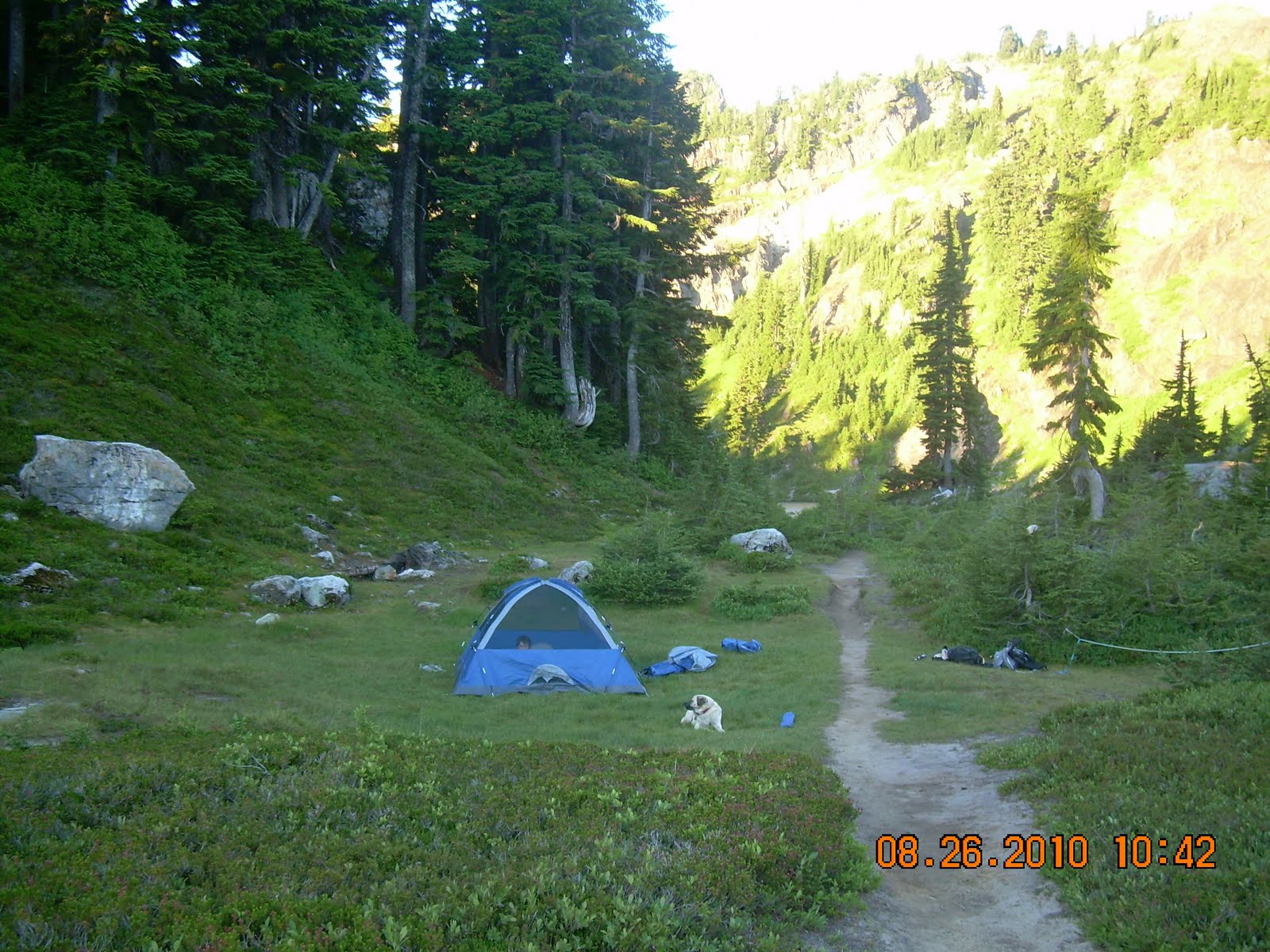
Our overnight hike for the summer this week was to the Rampart Lakes. This is a series of ponds scoured out by some ancient glacier at an elevation of about 5,000 feet. Within two hundred yards of the campsite to right, four different lakes, cool and clear, waited for us to swim, jump off the rounded rocks, and catch hungry rainbow trout. The little creek above flowed from a lake by our campsite to one just below, where we jumped off a little cliff into a deep chasm, and emerged from the baptism restored.

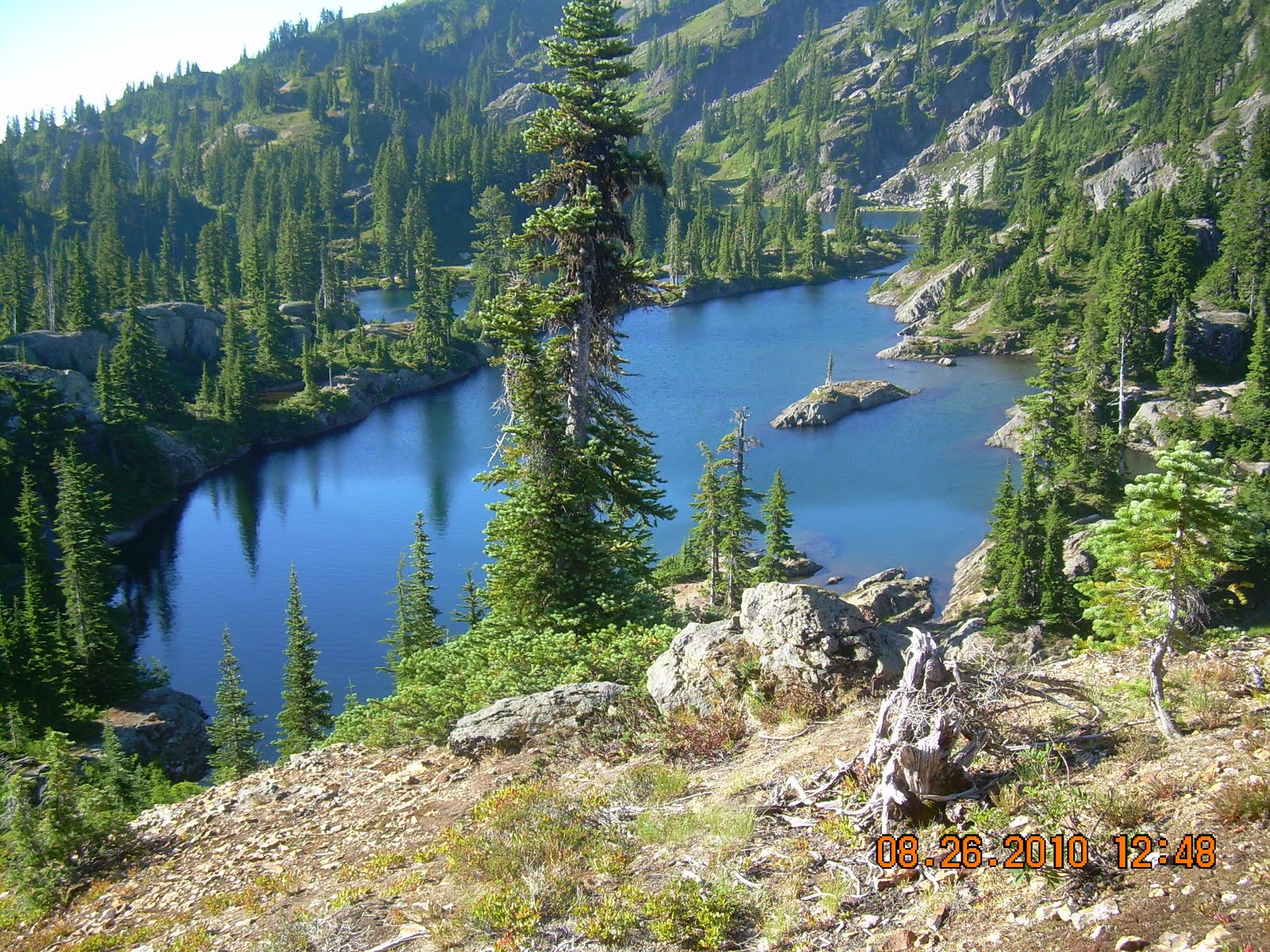
Here's the view of one of these little lakes from a hill behind it. The moon was bright, and we didn't see more than 7 dozen stars or so, including the Big Dipper shining into the front entry of the tent. The dog frightened about midnight and barked at some animal behind us. All I could find in the morning were human, dog, deer or elk, and mule or horse prints. (Hard so see how a horse could get up the steep trails to this little paradise.)
James caught a couple trout, and fried one in blueberries that were coming ripe, for want of other seasoning.

Next time, we'll have to bring some salt and pepper, if not barbecue sauce. No doubt the fish Jesus prepared for the disciples was seasoned: if his wine was the best (John 2:10), why not his barbecue (John 6:12, 21:13)?