Pages

Showing posts with label my life. Show all posts

Thursday, September 22, 2016

October Speaking Schedule

Lots of speaking coming up!  Come if you can!  Bring along those who have doubts about the truth of the gospels, who have swallowed bilge from the likes of Bart Ehrman, Richard Carrier, or Reza Aslan, or friends who would like to hear something important from a novel perspective. 

The initial tour for my new book, Jesus is No Myth: The Fingerprints of God on the Gospels, is set to kick off in full fury early next month. I'm planning to travel to some 20 states during October, speaking in (at least) Washington, North Dakota, Minnesota (probably), Ohio, Pennsylvania, New Jersey, and South Carolina.  (Then into the South in November.)  Almost all of these events are open to the public!  I'll be pleased to meet some of you before or after, get a bite to eat, sign books, and chat.   

I'm also planning to visit top universities along the way, which I'll list below the schedule.  Since I'm going to these schools anyway to conduct research, I'd also love to share on campus, even to small groups on a last-minute basis, regardless of funds.  I probably won't pass up a meal if invited!  (I am also looking for places to stay some nights.) 


"Jesus is No Myth" Tour, October, 2016


October 2  (Sunday, 9 AM + 11 AM sermons)
        
             Washington State, Snoqualmie Valley Alliance (Fall City): "Understanding Taoism"


October 8 (Sat, 5:30 PM sermon)


              North Dakota, First Lutheran (Minot): "Jesus is No Myth!"


October 9 (Sunday, 8:30 + 11 AM sermons)

               North Dakota, First Lutheran: "Jesus is No Myth!"


                  (9:45 Adult Ed)


                ND, Minot First Lutheran:   "The Fingerprints of God on the Gospels"


                  (7-8:30?)                             
      
                 ND, Minot First Lutheran:   "How Jesus Passes the Outsider Test"


October 10 (Monday class)


                  Minnesota (tentative, private)


October 12 (Wed, 6-7:40 PM)   


                  Ohio, Maumee Presbyterian: "The Fingerprints of God on the Gospels"


October 16 (Sunday, 9 + 10:30 AM sermons)


                  Pennsylvania, Christian Life Center (New London): "Is Jesus a Myth?"


October 17 (Mon, PM)


                  New Jersey (Randolf): Perspectives


October 19  (Wed, PM)


                   Pennsylvania, Christian Life Center (New London): "How Jesus Passes the Outsider
                      Test"


October 22 (Sat, 9 AM)


                   Pennsylvania, Christian Life Center (New London): "Jesus for Skeptics"


                    (Sat, 10:30 AM)


                                                                                              "Apologetics in the 21st Century"


October 23 (Sunday, 9 + 10:30 AM)


                    Pennsylvania, Levittown Presbyterian: "Jesus is No Myth!"


                    (Sunday, after second service)


                     Pennsylvania, Levittown Presbyterian: Q & A


October 30 (Sunday, 9:30-10:15)


                     South Carolina, St. Philips Church (Charleston): "Is Jesus a Myth?"


                    (Sunday, 4-5:30)


                      South Carolina, Reasonable Faith, "Is Jesus a Myth?"


Schools to Visit Along the Way


(speak, chat, survey, meet, photograph):


Amherst, Boston, Brown, Carleton, Chicago, Colgate, Columbia, Cornell, Dartmouth, Duke, Emory, Georgetown, Georgia Tech, Harvard, Haverford, Illinois, Lafayette, Lehigh, Michigan, MIT, Northwestern, Notre Dame, Ohio State, Penn State, Princeton, Purdue, Tufts, Vanderbilt, Washington and Lee, Whitman, Williams, Wisconsin, Yale.


Hope to see many of you in one or another of these locations! 

Friday, November 22, 2013

Happy Homecoming Day, C. S. Lewis!

In college some time during the last century, I reviewed a clever book for a student newspaper by Catholic philosopher Peter Kreeft called Between Heaven and Hell.  Noting that Lewis, JFK, and Aldous Huxley all passed away on the same day, Kreeft proposed that the three men met somewhere in another world after their deaths for a conversation about ultimate truths, which he then records.  Of course Lewis got the best of the debate, as he normally did in this life. 

I was two when Lewis passed away, so I never had the chance for that long conversation with him that I have often wished for since. 

Wednesday, September 04, 2013

Tristan Vick: "Marshall, Go Kill Yourself!"

A zombie author (well, an author about zombies) named Tristan Vick earlier this year apparently told me to "go kill myself."  In one way this makes perfect sense, since it is no doubt in his best commercial interest to have as many dead people out and about as possible.  This came as the punch-line in what he apparently regarded as an argument (more a ghost than a zombie in terms of its visibility to mortals), or else perhaps a joke. 

But silly me, I can't find much of either.  Just to make sure, I'll quote almost the whole thing, and let you tell me whether I should laugh or cry at where the minds of foolish young atheists have gone, since that Zombie Apocalypse known as the New Atheism first dawned:

Tuesday, August 06, 2013

On the Road Again

Salem Methodist, St. Louis


Bonhomme Pres, St. Louis
Well, it doesn't look like I'll have time to finish deconstructing Reza Aslan's new best-seller, Zealot.  You get the picture, anyway.  The house of cards was collapsing by the moment.  Even if you lay the most solid granite on top, the structure will collapse from the weakness below.  And the book does not improve in the final chapters . . . Aslan attacks Paul fervently, he creates a Manichean dichotomy between this pernicious thing called Christianity that Paul founded, and the likeable fanaticism of Jesus . . . Maybe he is recreating Jesus in his own image of Mohammed.  I didn't feel the faintest tingle of a twitch of belief. 

Early tomorrow morning, though, I'm hitting the road.  Here's the schedule.   Come if you can.  I also welcome invitations -- for conversation, for talk, debate, lunch, dinner, a hike.  This is going to be a long, long trip.  Go, Big Oil!  Bring me that sweet, cheap gasoline. 

August 11 St Louis: Salem United Methodist, 9:30 AM, "Christianity and World Religions"

August 11 Chesterfield, MO: Bonhomme Presbyterian, 7 PM, "Jesus for Skeptics"

August 14 Marshall, MI: Marshall UMC, 7 PM (?), topic yet to be announced

August 18, Garfield Memorial UMC, Pepper Pike (Cleveland), Ohio: 9:30 AM sermon, plus Q and A afterwards

August 20, Kirk of the Hills Pres, Bloomfield Hills: 7 PM

August 28 (?) First Pres, Jackson, Wyoming (evening)

Saturday, July 21, 2012

David in the Lion's Den

Thursday morning, I was called into the conference room at the Oxford Centre for Missions Studies, to take my Viva Voce, "Live Voice," the traditional oral defense of a doctoral thesis in the British system.  Three men were waiting for me inside, none, as it happens, Chinese: Tom Harvey, a Duke-educated theologian and Dean of OCMS, who has studied Chinese thought for many years, and acted as Internal Examiner; Gavin D'Costa, Bristol University professor and a leading Catholic authority on "theology of religions," (and advisor to the Pontifical Council for Other Faiths), acting as External Examiner; and David Singh, the Chair, a specialist in Indian Islam.  (The last name "Singh," common among Sikhs in India, is Sanskrit for "lion.")

Wrecklessly passing over my cute panda tie, I had put on a yellow tie with dragons, a power tie if ever there were one.  So I was distressed to see D'Costa wearing a bright pink tie, that outshone mine by half an order of magnitude. 

And here Daniel Dennett would number us both among the "dims." 

Neither examiner asked any of the questions I prepared for, of course.  One cannot predict what will occur to a scholar who has been developing his thoughts on a given subject for decades. One of them told me at the beginning of the exam to "Relax and enjoy the conversation," advise perhaps calculated to make an examinee feel more nervous.  Anyway, I did "flub" some of the questions.  My explanation for why I had not critiqued the inclusivist model of religions as thoroughly as the other two traditional models, seemed weak even to me.  When asked the opposite of teleological, I invented a word, which is probably not a good strategy even for someone with jet lag.  (Fortunately adding a verbal question mark at the end of my lame answer.)  Nor, it turns out, had I included much of an explanation for the key Taoist concept of wuwei in the thesis ("without striving," "going with the flow"), like the detailed historical studies of other key words I'd developed from ancient Chinese sources. 

But overall, they seemed to like my thesis, and found some of my answers coherent enough.  After an hour and a half, they asked me to leave.  I paced back and forth for a while, like a father outside the maternity room -- then they delivered.  A few amendments were needed (more on wuwei, more on inclusivism, more on John Farquhar's ideas relate to my own, etc) -- congratulations, Dr. Marshall, and handshakes all around. 

So what should I say? 

"I came, I spoke, I conquered?"

Or perhaps:

"This too is vanity and striving after wind . . . As he had come naked from his mother's womb, so will he return as he came . . . exactly as a man is born, thus will he die . So, what advantage to him who toils for the wind?  . . . Here is what I have seen to be good and fitting: to eat, to drink and to enjoy oneself in all one's labor in which he toils under the sun . . . (God) has also empowered him to eat from them and to receive his reward and rejoice in his labor: this is the gift of God.  For he will not often consider the years of his life, because God keeps him occupied with the gladness of his heart." 

Praise God.  A little pile of straw it may be, but this long-toiled over stack has finally (aside from a few tweaks, and academic bureaucracy) been gathered into the barn.

Sunday, July 15, 2012

Into the Arena.

I'm flying to London tomorrow for my Viva, held Thursday at Oxford Centre for Missions Studies. This is the "oral exam" part of my doctoral work. I ignored advice to do something "managable" in my thesis, threw caution to the wind, and attempted to construct a "map" of world religions from an orthodox, biblical perspective, internally consistent and of sweeping explanatory power. The dissertation focuses on the work of one of the leaders of the Democracy Movement back in 1989, a young philosopher named Yuan Zhiming, who later became a Christian and tried to interpret Chinese tradition from the perspective of the Gospel -- much as some early Christians did with schools of Greco-Roman thought. Along the way, I carefully examine two great sermons (by Jesus, on the Mount, and by Paul, on Mars Hill) to develop a model of religions called Fulfillment Theology.  (Though I'm only allowed to use one "l" in the first word, this being a British thesis).  Then I retell the story of Chinese Christianity from this (to me very exciting) perspective, touching on such great figures as Jing Jing, the Nestorian priest, Mateo Ricci and lesser-known colleagues, and some of the most thoughtful Christians in China, Western and Chinese, during the 19th and 20th Century.  Since people who think this way have usually focused on the theism of the ancient Chinese classics, and what classical sages like Confucius and Lao Zi said about a Savior, this also allowed me to study the Chinese classics.  Getting back to Chinese culture, and its relationship to Christianity, felt like being a kid in a candy store. 

The External Examiner is an eminent Catholic theologian of religions, who is also one of my dialogue partners in the thesis.  It should be an exciting day. 

This is the most ambitious work I have attempted, to date: I feel (to speak subjectively, not to compare myself) much as Kepler must have felt, when he discovered how planets orbit the sun.  Great pieces of an enormous puzzle seem to have come together over the past five (really thirty) years.  I also feel a little like Kepler's mother must have, just before she was hauled into court on a charge of witchcraft.  

Thursday, May 31, 2012

Am I not a Christian?


Ma Yuan: Visiting Plum
Blossoms by Moonlight
The confusion began, or reached a noticable level, in my last year of high school.  The ruling potentates at West Seattle High allowed me to take two classes at the same time during the last period of the day -- second year Russian, and writing for the school newspaper, the Chinook, across the hall and down a door or two.  Plus our Russian teacher was actually German.  The initial phase of a life-long identity crisis peaked in my last year of college, when I read Kak Mui Porteem Ruskii Yazik, "How We Ruin Russian," which combined language and politics in an indictment of communism. 

Nor was Russian the only language that had apparently gone bad: George Orwell's "Politics and the English Language" demonstrated that sloppy wording threatened clarity of thought and human freedom in the Angloshere as well.  If everything relates to everything else, as apparently it did, why stick to one field for my BA?  So I mixed religion, philosophy, history and anthropology, and got a BA in "The Russian and Chinese Languages and Marxism."  That didn't get me a job, so I studied Chinese religions in Taiwan, then got an MA in "China Studies," which tempted me to pretend to know something about Chinese art -- about as much as the information content as one can find in the empty corners of "One Corner Ma's" paintings from the Song Dynasty.  Use the empty spaces on the edge of the page to evoke more truth than you actually possess -- was Ma Yuan the world's first blogger?


Sunday, March 11, 2012

"How do you test the hypothesis of God?"

A gentleman named Harry Marks asked me this morning:

"David Marshall, How would you test the hypothesis of God?"

Monday, February 06, 2012

Oxford diary.

* I'm staying at Wycliffe Hall, only about three or four blocks from my studies.  College Park is even closer, so I did manage to get in one run so far, down to the Cherwell, around where the ducks mill before a small waterfall, then around again.  But it was starting to snow -- yeah, that's my excuse -- so I didn't go more than one round.

* Each night it would get colder.  One morning, the pond by the river was frozen, with a little skirting of ice where the water intruded into land a few inches.  The next morning, chunks of ice were floating free.  The next morning, the river was almost frozen over, as was the quarter-mile long, shallow pond or lake in Port Meadow.  The ice was only about an inch and a half thick, but lots of people were walking on it with their kids on Saturday, and some grown men had out hockey sticks and were going at it.  As I walked across the ice, though, it snappy, crackled, and popped -- not thick enough for me, yet. 

* Then that night it snowed, turned to rain, clouds, then fog, and the ice was ruined. 

* I've been reading Alvin Plantinga lately.  I had planned to buy a book or two before leaving for the UK, but had to print off a few chapters, instead.  Some brilliant stuff. 

Last night chatted with a Chinese fellow (Mr. Chen) studying "math, physics, and philosophy."  I asked him a bit about it -- the philosophy seemed a bit too mathematical for my taste -- then asked if he'd read Plantinga.  "He's my teacher!"  He replied.  "Warranted Christian Belief is the book that led me to become a Christian!"

Who says arguments don't convince people? 

Plantinga is, indeed, lucidity on skates: the air crackles, the ice beneath does not, his humor is fatal, killing you with the friendly absuridity to which your argument has just been reduced,

* Tim Keller is rumored to be speaking at Oxford Town Hall this week.  May have to go. 

* Wycliffe Hall is a nice place to stay: the room is warm enough, things generally work, people are helpful.  I prefer Commonwealth House, though, because there are more internationals, and people are coming and going more -- you don't feel at all like you're butting in on a group of colleagues, as sometimes I do at Wycliffe. 

* They're building a museum across the alley from Commonwealth, or trying to (it'll take ten million pounds!) called "Story Museum," or something like that.  It'll be a museum to remember all the great stories created in Oxford: Alice in Wonderland, Middle Earth, Narnia, Pullman's Dark Materials, or whatever they're called.  For the first time, I almost wish my dissertation were not nearing completion . . . A wonderful idea.   And in a great location!  (It'll also be across the street from Christ Church College, where Lewis Carroll was math teacher.  And heck, while we're mentioning it, Lawrence of Arabia went to St. Aldates, behind Commonwealth -- that's almost a fairy tale.  No comment on Mr. Of Arabia's romantic proclivities intended.) 

* Meanwhile, back in the real world, the snow has turned to mush, and walking become difficult.  It's supposed to freeze again the next few nights. 

* My seminar seems to have been a success.  Dr. Farr led it.  During the seminar, he went around the room and asked each scholar whether he subscribed to exclusivism, inclusivism, or pluralism, the three usual choices.  (Which I had just been explaining, also berating.)  No one chose pluralism, which is good -- I'd been dumping on it most of all -- but maybe half chose exclusivism, despite my objections, and one or two volunteered that he agreed with me that the game was rigged wrongly. 

Dr. Farr studied with John Hick, the pre-eminent pluralist.  I asked him to say which he favored; his reply seemed surprisingly mumbled -- or is that nuanced -- but I gathered he saw something to Hick's position, anyway. 

*

Friday, November 18, 2011

Fulfillment thinking in Chinese history, Lin Yutang.

Morning meeting at ORTV.  Doris Brougham is
playing the trumpet to the right of the leader.
I spoke on that subject yesterday morning to about 170 staff at Overseas Radio and Television (ORTV).  I began with a joke about the competition.  Traveling around Taiwan, I noticed not only the old cram schools that teach the "American language," but advertisements for what I took to be a new cram school staffed by overseas Chinese, called "Cai English."  Indeed, as the staff no doubt knew, large banners for this "school" can be seen draped over buildings all over the island, with pictures of a pleasant-looking Chinese lady and then another Chinese man or woman by her side.  But in fact, she's the presidential candidate in the upcoming election for the Peoples' Progressive Party.  The people by her side are not fellow teachers, but local candidates in the same election.  Her name happens to be "Cai English." 

People laughed at the joke.  Good, because I needed encouragement to go 45 minutes in Chinese.  If I can judge by my own experience as a public speaker, I want an audience to laugh so as to establish community, the feeling that we're all in it together, it's not just me up their talking, but that they're part of the experience, too.  Asuccessful pun is also a good indication that a talk in another language is going well, since often, Chinese assume that if the meanings don't click, you've simply screwed up and / or are totally incoherent in their difficult language. 

What was a little unique about yesterday morning's talk, besides the longest talk I've given in Chinese for many years, was its focus on leading Christian thinkers in the fulfillment tradition.  I wanted people to know who they were, and what they'd accomplished, and encourage creative Chinese Christians to recognize that their own work also belongs in some sense to that tradition. 

Doris Brougham was the only person in the audience who knew who John Ross was.  She also not only knew who the great writer Lin Yutang was, as do Chinese around the world, but called him "a good friend."  It turned out they'd collaborated on some work.
 
(I visited his old house on Yangmingshan later in the morning -- which reflects his own style and love of Chinese culture (note the fish pond, where he liked to pretend to fish in the morning), combined with interest in traditional European styles and science.  More on that, later.) 

I also joked that, ten years after the typhoon that accompanied me to the island on my last visit, ten years ago, "It's still raining!"  I recognized the laugh, that time -- it's the same laugh we Seattlites sometimes give to comments about our weather, after a particularly bad spell.  But I think the weather in Seattle is better than in Taipei.  Aside from the fact that it probably doesn't rain as much in Seattle, we don't often get a rain that encourages snakes to waylay strangers.  One can walk in our rain without water dripping down our bodies from the inside, even if it doesn't reach us from the outside.

ORTV is a remarkable organization, and Doris Brougham is an amazing person.  I think I'll also introduce her and the work they do in a later blog.  She is an institution in Taiwan (the president of Taiwan is honoring her this week for her work), and somewhat known in other parts of Asia, but probably not so many people in other parts of the world are familiar with this remarkable missionary / trumpet player / educator / HONEST televangelist / successful CEO.

Thursday, November 17, 2011

Notes from Taiwan

Water makes Taiwan beautiful, though. 
My last visit to Taiwan came ten years ago, the day after 9/11, as a matter of fact.  It was loads of fun getting on an airplane right when air travel had become a weapon in worldwide jihad, also having to fly around a hurricane between Japan and Taiwan.  It turned out another hurricane was bearing down on Formosa as well, which helps explain why the island is so green.  This hurricane didn't pack particularly strong winds, but it came in (unusually) from the north and kind of settled over Taiwan, creating torrential rains for some time, and flooding parts of Taipei. 

Ten years later -- it was still raining, when we arrived.  Did the sun ever come out? 

Doris Brougham and Overseas Radio and Television (ORTV) sent a car to pick me up, and helped me find a place to stay, with a kind Presbyterian dentist. (Also mountain climber and fervent supporter of Cai Yingwen in her bid for the presidency next year.) I'll be speaking to the ORTV staff, tomorrow morning.  I attended their meeting this morning, which was kind of like a cross between a TV music special, and a campfire revival.  These people are professionals, and you could easily have filmed the whole thing and made a creditable show out of it, but they also seem quite sincere in their worship.  I certainly enjoyed singing a cheerful old aboriginal song about "my help being from the Lord." 

Other notes from the trip to Taiwan so far:

* Lots of new superhighways, some under construction.  The famous 101 building, once the tallest in the world, now dominates the Taipei skyline, with nothing even close for miles around. 

* The train system is efficient, with about 5 lines in Taipei, even though it caused me to miss an important appointment today.  (One line splits and goes in two directions, and I got on the wrong train.)  Stations are decorated in a lively, friendly, and clever way.  Prices are reasonable, as with most things (except housing) in Taiwan -- far cheaper than Japan, a little cheaper than the US, about the same as Korea.

* The Japanese hamburger chain Mossburger is all over the place, now. 

* Otherwise things don't seem to have changed that much.  They still sell betel nut, the mildly narcotic nut that turns teeth purple or black.  Almost all my old favorite Taiwanese foods seem to still be available: I had a wonderful Papaya shake last night after dinner. 

* How polite and mellow everyone seems, compared to mainland China!  They even say "thank you" and "please!" 

* In some cases this has run almost to political correctness, gentrification, even chicification.  Baby changing areas are provided at train stops.  Tourists are told not to swim in the river in Wulai, for fear of being swept downstream.  In some places you have to pay for plastic bags.

* The worst is the garbage collecting system.  It used to be that people piled their refuge in plastic bags at central collection areas.  Cats used to hang and look for goods to grab.  Now when the garbage truck comes, it makes music, and everyone comes running with their trash.  This is harder if you live on the fifth floor.  (My driver on the way into town claimed they were building all 30 story buildings, now, but in fact most of the apartments seem to still be 5 floors.)  My host tells me love stories are sometimes told about people waiting to unload their trash. 

* So maybe entropy won't have the last laugh, after all.

Friendship Presbyterian
church (mainlanders) and
Taiwan Presbyterian
headquarters:
heathy competition?
* I was walking along Roosevelt Road, trying to find a Friendship Presbyterian Church on Sunday.  I felt someone tugging on my day pack.  I looked around, to find a young Chinese man, walking with a limp, and with a large scar on his forehead.  He was zipping up my backpack!  "Don't worry, I'm not going to steal anything!"  He said, though talking in a way that suggested some mental disability.  He pointed to his scar, and said something about someone having done something to him once, but don't fear, he just wanted to make sure nothing fell out of my pack!  I thanked him, and told him I wasn't worried. 

* The dogs, by contrast, are mostly pretty unfriendly.  I hiked up a mountain behind where I'm staying yesterday, and got barked at by lots of dogs of the short-haired, business-like, native variety. They seemed to live at the temples on the mountain. I stopped at one resting spot, and two dogs came at me from different sides. I worked my way to the railing and picked up a brick, and they ran off. Then a little further up the trail, four dogs were standing on top of a large grave, barking at me. I picked up a stick, and they marched down off the grave, rather gravely, in the other direction.

* I stayed in the home of my friend Joshua in Caotun, near Taizhong, two nights ago.  It's a trilingual family: English, Mandarin, and Taiwanese: their two cute girls will get quite a start in life.  Joshua recorded an interview, which I expect will be on-line some time.

* Back in Taipei, and it's raining again.  I missed an appointment today, partly because of that rain.  "Heck it could be my fault." 

* Am also looking forward to meeting the founder of Cosmic Light, tomorrow or the next day.  He's an historian, and the publisher of the two remarkable books by Yuan Zhiming that I'm researching for my doctorate.

Thursday, November 10, 2011

The Tang Conquest, by train

My host and I with
the great Timothy Richard.
There was also a photo of him
in the student's cafeteria, but the
university is less kindly
disposed to those of its students
who share his faith, I learned.  Note
the hazy skies.
I didn't plan the trip this way, but in retrospect, it seems I followed the footsteps of the founders of three great Chinese dynasty -- only rather than traveling by foot, in each case I took a night train, no doubt sleeping through many battlefields.  In the next three posts I'd like to recapitulate those journeys, describing a bit of what each shows about China along the way. 

My first stop in China was Taiyuan, the capital of Shanxi Province, where I stayed for three days.  Beautiful old buildings are rare, aside from the Twin Pagodas, as they are popularly called, which we climbed.  The city is flanked on two sides by mountain ranges, which traps the air, like in Los Angeles or Taipei, making it a smoggy and dusty town when the wind forgets to blow.  This was the case during my visit, and so I was somewhat hard-pressed to compliment the city to friendly locals.  But people were so friendly and helpful in Taiyuan, and the work that I came to do was very successful.  I won't say much about the latter now (I may post later on what my results say about the New Atheism), only that it included a bit of field research to complete the chapter of my dissertation in greatest need of improvement. 

My hosts were extremely generous, along with helpful.  In fact, the food was so good it didn't require any desserts, just or otherwise.  Honestly, some of the best days of eating in my life.  (The rest of the trip, I ate more with a view to economy and convenience.)  The final night's tender white fish, cooked so succulently in red spices without losing its own gentle flavor, it practically hopped onto my chopsticks by itself, would by itself have been a superb main course.  Add delicate green balls of vegie the consistency of a light chocolate confection, dipped in a kind of strawberry sauce, delicious meat balls, a form of potato swimming in flavorful sauces that made me almost ashamed of our humble mashed potatoes and gravy, celery and peanut hors douvres, some of the best baozi I've had, added to good company and cool lanterns, made it a meal to cherish.  Remarkably, all this without a trace of ill aftereffects of holiday eating -- this stuff goes down easily.

Only the service was rather surly.

That was but one of four highly memorable meals.  My host started us off with a very expensive meal at what he claims, and I can believe, is the best restaurant in the city.  The food AND service were excellent.  Later we ate at a much less pricy noodle restaurant founded in the 19th Century.  It was nicely decorated in period pieces, and had the feel, rare in China, of an Udon shop in Japan, or an English pub.  The noodles were flavorful and delicious, hinting of spice and vinegar.  This was across the street from a school that was the old Shanxi University, founded by Timothy Richard with money from Boxer indemnities.  They wouldn't let us go in to see the inside, though. 

Finally, for lunch the next day we foraged in the dirty, messy back alley that serves the present Shanxi University as a combination "Snake Alley" (old Taipei) or "The Ave" (present Seattle).  An egg pocket sandwich loaded with lettuce, Muslim noodles (my host thinks they're more trustworthy than some other public eats), and potatoe chips on a stick, make from slicing one spud into a spiral, necessarily a little moister than conventional chips. 

Having completed my research, and cleaned some clothes, I followed the route of the Tang conquest of the Sui, rather approxiately, and took a night train south to the Yellow River Valley.  Li Yuan was a governor in the Shanxi area, under the Sui.  When it became clear the corrupt regime, bankrupt from attacking Korea and building the Grand Canal, was due to fall, a prophecy arose that someone surnamed Li would conquer the Sui.  This prophecy might have been partly self-fulfilling, since it encouraged Lis to revolt, and the government to suspect any powerful person with that name.  Eventually Li Shimin persuaded his father that the Sui would get them if they didn't act first, and the governor and his war-like sons moved south, eventually to conquer the city of Xian, then further west in the Yellow River Valley.

It was Li Shimin, now emperor of China, who greeted the first Christians known to arrive in China, the Nestorian missionaries who traveled overland and came to Chang An (Xian) in 630 AD.

Moderning China: this little doggy is NOT going to market.
My destination, admittedly, was further down stream: the city of Zhengzhou, not far from Luoyang, at times the eastern Tang capital -- the present capital of Henan Province, which would be about the 10th biggest country in the world were it independent.  (Also one of the centers of Christianity in China.)  After some searching, I found a clean hotel in my price range, managed to change to money (this all took hours), and set out to explore the city. 

Zhengzhou is not set in any dramatic natural geography, nor has it preserved any beautiful old buildings.  It's a governing center, a center for commerce, and home to millions of people -- but the town is clearly trying to make something of itself.  The modern center of life in the city seems to be a large square, with two lit pagodas constructed where it borders a major intersection, with a mass of lively shopping and eating places on the site of the square facing it.  This is a few blocks from the trainstation, but since the streets are at odd angles, it takes a bit of searching. 

You can't deny Peoples' Park in central Zhengzhou lives up to the aim implicit in its title.  Four or five heated pingpong battles are waged in one corner, fathers and sons, husbands and wives (some of the women are pretty good!), friends, the ball flying and spinning to my untrained eyes like Forrest Gump's contest in Beijing.  Children blow bubbles, and climb on rocks overlooking the canals.  Visitors photograph one another in front of late-season golden chrysanthemons and dahlias.  The dahlias in one prominent patch are probably each photographed dozens of times in a day.  (it is still a gritty city, in need of much more green to make it tolerable to a Seattlite.)  You can't say they don't get any love -- or CO2.  One orchestra plays nostalgic songs about missing one's home or the hills with about 100 middle aged people watching.  For how many does the song tell the story of their lives?  What has China lost, in being industrialized and urbanized?  What is the world losing? 

Song Shan, the "Central Mountain" of China's peaks representing the five directions, is a two hour bus ride from Zhengzhou.  I described my trip there in an earlier post.
Shaolin temple. 

Wednesday, November 09, 2011

If it's Tuesday, this must be Weihai

I'm catching my breath in Korea, before a flight tomorrow morning for Taiwan.  Friday morning I'm scheduled to speak to Cosmic Light in Taipei: I found out in Weihai, on the other side of the Yellow Sea, waiting for the passenger ship Golden Bridge.  (Registration: Panama, of course.)  Apparently I should speak in Chinese: since I haven't prepared this talk, and will be traveling all day tomorrow, this could be interesting.

I'm not suffering from jet-lag.  It's more like:

* Six night trains.  

* Five ancient capitals. 

* Four aching body parts. 

* Three sacred mountains (Song, Heng (恒山;南岳), and the greatest of all, Tai).  (Note: what to do if your back aches, both feet ache, your leg aches, and you've only had one night of sleep out of three?  Climb a precipitous 5000 foot mountain!  It worked wonders on all fronts, including sleeping the following evening, and even, surprisingly, the previously almost disabled leg.)

* Two + weeks on the road.

* And a hundred plus interviews left to translate.  (Thanks, A, for the help in Shanxi.)

I'll describe what is happening in China, and hopefully add a bunch of photos, as time and machines become available.

One thing that isn't happening in China, is Blogger; it seems the Chinese government isn't overly fond of American web sites.  Thanks to David Steinmetz for posting the past few blogs when I was unable.

Tuesday, November 01, 2011

Notes from Central China

* Two days ago I visited Mount Song, a couple hours by bus from the capital of Henan Province, Zhengzhou. This mountain is famous as the Central Peak of the five ancient sacred mountains of China, with each peak corresponding to a direction. (Tai Shan in Shandong is the greatest.) Emperors would fulfill their greatest duty by coming to each to sacrifice. The traditional Chinese religions are represented by three great temples: the Song Yang ("sunny side of the Song") Academy near the bottom of the peak, where some of China's greatest Confucian thinkers taught, perhaps under this tree, a Buddhist temple further up whose name escapes me at the moment, and Shaolin Temple, which in theory is Zen.

* The best as far as I'm concerned was the Confucian academy. Quiet after noisy Chinese cities, peaceful with bamboo groves, and holding an ancient cypress said to have been promoted (feng) by Han Wu Di some century before Christ, one person there told me it was 4000 years old. The tree still had many healthy limbs, though its thick branches were supported by pillars in places, and surrounded by a field of clover. Very lovely.

* A girl on the bus volunteered to help me with Chinese, assuming, of course, that as I foreigner I didn't speak any. She went to cooking school in Shenzhen, and has been living in Australia for 5 years, but has an American boyfriend. She was traveling with her family, whom she doesn't see often, and was obviously delighted to be with her parents again. I probably only understood 60-70% of the tour guide's rapid explanations, with a touch of a local accent, so was glad of a little help. (She didn't really explain much, though.)

* The tour guide at the Buddhist temple rounded on her sharply for (he supposed) taking pictures inside the temple. "Didn't I say at the very beginning of the tour not to take pictures? Are you a foreigner?" (And therefore, implicitly, lovably or contemptibly stupid by definition?) Being a man of strong natural authority, this must have felt crushing; the girl explained to him that she (a), didn't know much about Buddhism, and (b), to me later that she was not taking a picture, and (c), people in temples in Thailand never objected.

* His Chinese was easier to follow, and he gave a good, highly evangelical, explanation of Buddhism along with the temple's peculiarities.

* Shaolin temple is the star tourist attraction here. It is surrounded by hotels and gongfu schools, where thousands of boys (saw no girls) dressed in red run through their fighting exercises in smaller groups. It is a little intimidating. But I walked past Shaolin, which is overly commercialized, skipped the show they put on of fighting monks, and headed up the hill behind it, ignoring the trams, wanting to experience the mountain itself. I could still hear the sacharine sounds of Buddhist Muzak on a loudspeaker most the way up. But I enjoyed the autumn trees, of which there was a large variety, till the trail finally ended at the top of the tram, below a high cliff.

* I talked with a Buddhist monk on the way down. He was about 70; he said he'd been a monk since he was 9. How about during the Cultural Revolution? I asked. "We hid in the mountains and they couldn't find us," he answered. "What kind of Buddhist are you? Pure Land? Zen?" "Acupuncture," he said, showing me his needles.

* The hotel I stayed at was in a derelect little village about a mile from Shaolin Temple. The hotel was peculiar because it was run by a bossy local who seemed more like a farmer, and kept on trying to get me to order a meal, as if I had no choice but to eat there, and I was his only support (though there were other guests), then tried to get me to order a bunch of expensive stuff. (I just ordered noodle soup.) I had to ask for a towel, and got two skimpy pieces of cloth that didn't do much. The owner tried to get me to order a taxi the next day, and pay about three times what I ultimately did pay to get to Zhengzhou by buses. The hotel was clean enough, though, and the air was clearner than in polluted Chinese cities.

* Waiting for the bus, a little dog sits in the middle of a four-lane highway. He is attentive to a large yellow dog about 300 yards downstream, but ignores all vehicles. Trucks loaded with machinery and vans honk at him, and he reluctantly picks himself up and sits in another lane, or -- his favorite spot -- on the line between two lanes. Vehicles that merely swerve to avoid him are not spared a glance, any more than the orc chieftain attacking Gondor to flying missiles. This seems to work for him, at least in the short run, and is no great aberration in China, where driving is a much less linear activity than in the US, at the best of times. (Crossing a street, one wades through each lane of traffic in turn, circumnavigates buses, motorcycles, etc.)

* On the bus, I gave my survey to a self-educated young lady of the Tujia minority who engaged me in conversation. When she was growing up, she said, she sometimes heard the cries of female infants who had been thrown out to the wolves or bears. Some accused her mother of doing the same with one daughter, though she didn't buy that. Given this attitude of despising girls, I understood her choosing We Ze Tian as one of her favorite Chinese rulers on my survey, as many women do. She admitted the stories of what Wu had done to her own children gave her pause, but she didn't believe them: "No mother would do a thing like that. I can't believe it." This struck me as ironic, but she told me, "I'm an optimist. I don't pay attention to the bad things." She was a very sharp lady, who had read many books in English, including Bill Bryson's Short History of Nearly Everything, and gave me advice about publishing in China.

* I'm in Zhengzhou now, the capital of Henan Province. It's a huge city, and it took some searching to find a hotel at a reasonable price that accepts foreigners. One I stopped at was called "Friendship Hotel," with a sign saying that in English, but inside they said "We don't accept foreign guests." Some friendship.

* I wandered all day through the streets of Zhengzhou, passing thousands or tens of thousands of people. Late in the afternoon I came across a young western man with a full head of curly hair in the company of a Chinese woman -- the first westerner I'd seen all day. "There goes another one," said a Chinese man to his friend as I passed, in the tone of a man who had seen two bad omens in a row.

* After some searching, I stopped at a Chinese fast-food restaurant for dinner. The young man at the next table tried to explain the ordering procedure, but I somehow wound up with fried rice instead of noodles. I said, "No problem! This will do just fine." Someone behind the counter came in for recriminations anyway.

The man at the next table asked what country I was from. He then asked if I believed in Jesus. He turned out to be an evangelist from another part of northern Henan. He grew up as a Christian, but was "very bad." When he injured his leg, an evangelist came to pray for him, and he was able to sleep, finally. This renewed his faith, and he became an evangelist. He knew all about Reinhold Bocke's crusades in Africa, and about the churches in Korea -- he had a passport, and the countries he most wanted to visit were Korea and Israel. Almost every town in his country has a church, he said, looking at my map and going through towns printed on it one by one.

I got the feeling, talking with this young man, that I was being evaluated, that my foreigness was secondary (for once) to the quality of my faith. He also made no effort to speak any English, and obviously didn't care, as most Chinese young people do.

He told me of miraculous healings to people he knew, and asked me about my own experiences.

Zhang was also a fan of Yuan Zhiming's sermons, which he had heard on CD. "I'd really like to hear Yuan preach," he said. We had a wonderful conversation, and parted, hoping to keep in touch.

* This morning I went in search of Shang Dynasty remains. Some of them turned out to be in a little park I'd passed through the night before, whose bushes a couple men had mistaken for a public loo. This morning, the huge faux bronze set on a pillar with scribblings of scenes from (obviously slave, fitting the Marxist storyline) Shang society in faux Shang style, is surrounded by qigong and badmitten enthusiasts. There is no further explanation about the little hill in the park, and what was found there, other than the legend "Shang Dynasty remains," plus the modern art in Shang style. (Well-done though. If only public art in the West were so good.) All this one pedestrian overpass from the modern outdoor mall that seems to have become the hub of the city for stylish young people . . . dancing over the graves of their ancestors, no doubt. Well, the Shang emperors deserved it, the cruel SOBs. Long live the slaves!

I also found a vast "inner wall" of the Shang about half a mile north, running several city blocks long, and being reconstructed, with tin screens around the work, which had gaps in it occasionally, so one could peek through. This wall encloses a huge space within modern Zhengzhou, which was once one of five Shang capitals, before the time of King David. Two others were at Shangqiu and Anyang (both also in northern Henan); I'm not sure if the other two have been found. One document in the Book of History tells how the emperor divined to decide whether or not to move the capital, against the opposition of some significant political faction: it was after this that the capital was moved to Anyang.

The city of Luoyang, a few dozen miles west of here, also has a long history as capital of China in later dynasties, and was said to have been founded by the Duke of Zhou in the early Zhou, where he gave a brow-beating speech to the conquered nobles of the Shang, and told them to man up, sacrifice for the new dynasty, accept their subservient status, and they would get along just fine in the new order, thank you very much.

The Zhou would prove a much more human rule, ultimately, with the help of Confucius and Lao Zi & Co, but human sacrifice was still common in the early Zhou.

This is, indeed, the "Cradle of Chinese Civilization."


I also found a vast "inner wall" of the Shang about half a mile north, running several city blocks long, and being reconstructed, with tin screens around the work, which had gaps in it occasionally, so one could peek through. This wall encloses a huge space within modern Zhengzhou, which was once one of five Shang capitals, before the time of King David. Two others were at Shangqiu and Anyang (both also in northern Henan); I'm not sure if the other two have been found. One document in the Book of History tells how the emperor divined to decide whether or not to move the capital, against the opposition of some significant political faction: it was after this that the capital was moved to Anyang.
The city of Luoyang, a few dozen miles west of here, also has a long history as capital of China in later dynasties, and was said to have been founded by the Duke of Zhou in the early Zhou, where he gave a brow-beating speech to the conquered nobles of the Shang, and told them to man up, sacrifice for the new dynasty, accept their subservient status, and they would get along just fine in the new order, thank you very much.

The Zhou would prove a much more human rule, ultimately, with the help of Confucius and Lao Zi & Co, but human sacrifice was still common in the early Zhou.

This is, indeed, the "Cradle of Chinese Civilization."

"When you snatch the tourist
souvenir from my hand,
glasshoppa, it will be time
for you to leave."  Shaolin temple,
money machine. 


Friday, October 21, 2011

Korea proves full of nice people.

After the Night of the Drunks, I wasn't optimistic about my short stay in Korea.  For one thing, where would I stay? (I had tried to make contacts before I came, but without success.)

I decided to gamble on my one, thin relationship in the country: a brief e-mail exchange with the Dean (or something) at a graduate school for missions and / or ministry in South Seoul.  So I packed up my backpack full of books, made my little suitcase as light as possible (the perpendicular vector of its force on muscles already carrying a heavy load hurts more than the straight downward push of dead weight), and set out for Seoul.

The express train was almost empty, maybe about ten people on the whole thing.  The girl who took our tickets wasn't occupied, so I tried to catch her attention and learn a few words of Korean along the way.  She didn't even turn her head, deeply engrossed in her entertainment box. 

This, it turns out, is how most young people in Korea occupy their time on trains: movies and games on little screens.  Gone are almost all of the books and newspapers one used to see.

We glided over the island where the Incheon airport is located, and which still hosts a little agriculture as well, and out over the vast mud flats that the communists trusted in to protect them, underestimating Douglas MacArthur.  I noticed little mud canyons with water at the bottom, and mud uplands about six feet higher, on and on for miles -- what a place to land with heavy weapons, and artillery heading your way! 

I changed trains at Seoul station, then again, and dragged my luggage, lugged my draggage, down bumpy sidewalks for about a kilometer, turning a couple times, and found myself at Torch Trinity Graduate School. 

It's a remarkable institution.  The main buildings appear to rise about four or five stories above both sides of a wide stairways ascending a little hill.  In reality, most of the buildings are connected underground, with maybe another 4 or 5 floors of dining halls, cafeteria, classrooms, offices, below ground.  Rooms are named things like "Faith Hall," "Joy Hall," etc, the purpose of the room apparently fitting its title. 

The school is half in Korean, half in English.  Students are recruited from around the world, and also from Korea.

It turned out that was the day for Open House: 2-5 for Koreans, 4-7 for internationals, with the overlap being a public meeting with skits and a welcoming, vision-type sermon. 

The Dean was in.  She was busy preparing for the Open House, but kindly gave her unforseen visitor fifteen minutes.  She mentioned a guest house, which turned out to be part of the complex, and arranged to allow me to stay there. 

Blessed be, no drunks!  Trees, a well-stocked library with this very computer (and comrades), friendly mission students, inexpensive meals.  In the two days I've been here, I've met students from Pakistan (she introduced me to the missions prof), the Ukraine, Kenya, another African country, Korea of course, and Mongolia (whose great-grandfather, surprisingly, turned out to have been a Christian -- presumably one of the "two and a half Christians" Donald Treadgold used to say were in the country before the Soviet takeover.)  She said there are now about 100,000 Christians in the little country, about 5% of the total.        

My mission in Seoul is to sound out local publishers about Korean editions of two of my books.  The attempt to visit these companies proved time-consuming and difficult. 

I quickly learned that giving workable directions to foreigners is not one of the motivating interests of Korean culture.  An elevator at the airport said the train was on 1 Fl.  It turned out that meant 1 Fl basement, not 1 Fl prime.  Inside the elevator the legend said less about 1, and more about basements . . . Naturally I went to the wrong place, as, no doubt, have countless visitors before me. 

Addresses and street signs are almost all only in Korean.  Even in Mcdonalds, I lined up in the wrong place, and missed lunch (no great trajedy), because the signs telling people the till had closed were in Korean.  Few people speak English, Japanese, or Chinese, and if they do, they can't always figure out the directions I have in English. If they do give directions, one still can't read the signs to which those directions point. 

Furthermore, the telephone in my room was 6 stories and a labyrinth of rooms from the computer, so directions by e-mail -- the only kind that work -- involved running back and forth several times to obtain.  And I couldn't print directions out.

And that was just the start of difficulties. 

Another problem was that people confuse book stories, which I was not looking for, with head offices for publishing companies, which I was.

On the up side, many Koreans proved extraordinarily helpful in trying to point me in the right direction -- even when it was the wrong direction -- and sometimes more than point. 

So in a day and a half of trying, I visited three Christian book stores, belonging to the main three publishers in Korea, but no headquarters.  I did, however, manage to get my books into the hands of two publishers, and get to know two contact people at the right offices in the process.

Last night was a particular adventure. 

After much calling and vain computer searches, I finally procured a couple addresses for one of the companies.  (One my American publisher had recommended, as a matter of fact.)  They rounded up a girl who could speak English and was involved in the publishing end of things.  I was given spider scratches on paper which, I was assured, represented the company headquarters, plus a transliteration of a Korean address in English.  Of course I had no idea if the two matched. 

If not for the generous kindness of many Koreans, my epic journey across Seoul that afternoon would have proven a complete failure. 

Several people pointed me in the "right" direction, sometimes however wrong by several subway stops. 

An older gentleman loudly starting a conversation on the train, the kind that begins "Where are you from?  I went to New York and Los Angeles once."  In Japan, this would  likely provoke icy silence all around, indicating that the speaker was romancing the fine line between crudity and lunacy.  Here, there seems to be no such stigma attached to chatting up strangers: we had a good conversation.  Off at the wrong stop (of course), another gentleman then spent considerable time phoning and mapquesting, and got me (finally) to the correct train stop.

A taxi driver didn't know the place.  I tried to pay him for all the time he spent trying to figure it out, but he refused. 

After wandering around and asking at random (including a cop -- no English!), I began to lose hope of tracking the place down by closing time at 5 PM.  I stopped at a jewelry shop and bought an alarm clock -- the owner pointed me back the way I just came, with a flury of Korean that I could almost pretend to get the gist of.  Several blocks and queries later, a couple who spoke decent English took it into their big hearts to escort me all the way to the building on the paper, a full mile or more away.  We jogged a good part of the distance in an effort to get there on time, and they were a bit heavy. 

When we arrived, I gave them a copy of my China book to say thanks, and learned they were both novelists!  We parted friends as well as comrades. 

But of course it wasn't company headquarters, it was a bookstore, and I was late.

A little more ringing by the girl at the counter, and the girl I'd talked with at headquarters came half an hour after her work day was finished, took me to a cafeteria, and bought me a strawberry drink and desert (on company dime) and we had a good talk.  She turned out to have a background in YWAM and literature, so we talked missions, Shakespeare, Chesterton, and East Asian culture.  She recorded some of my replies to her questions.  Finding that I was interested in learning more about Korea, she then kindly bought a little Korean primer for me, on her own dime. 

Missed dinner, then went jogging along a river this morning, and missed breakfast as well.  Bought manjiu and strawberry yoghurt at a 7-11.  I'm heading to a place where I can speak the language, again, but I'm almost sorry to be leaving Korea this afternoon.

Thursday, October 20, 2011

Seoul Music

I'm sitting in bed in a "hotel" room, aka "guest house," it being dark outside, not counting the street light, and no idea what time it is.  There are no clocks in the room, the TV doesn't work, and my internal clock is fowled up by the 12 hour flight from Seattle.  A car passes only very occasionally, so I guess its the middle of the night here, though time to get up back home. 

Two bulky drunks are waiting outside the door.  One appears to be English; the other mumbles too much to tell where he's from.  Now one is singing.

The first sign that they were there came when one yanked on the door several times.  I was awake, having just been jotting plans for the following day on the back of a card, so heard it clearly.  The door was stout, fortunately.  (It's a fairly spartan room, otherwise, but clean enough.)  I had slept for a few hours, earlier, which is good for the first day of a trip.  Then came the knocking. 

"Go away!  This is not your room!" 

"Where should we go?"

"Go down to the first floor (they call it that, here), and talk to the people down there."  (I assumed they were looking for their own room.) 

"Yeah, there's lots of people down there.  We talk to them, and they just mumble.  You're the first person who's talked to us like this in an hour.  Open the door!"

"I'm not going to open the door, but I will call the police." 

"Yeah, like that'll help.  You have three choices."

I waited to hear the three choices, not expecting to like any of them.  But the drunk could only recall one, got stuck on it, which turned out to be one I actually approved of.

"If I were you, I wouldn't open the door." 

He went on explaining why keeping it shut might actually be the better option, apparently trying more to reason for himself than to convince me, and ended in incoherence.

I did try calling the police.  But he was right about that, too.  There wasn't much of what you could call a phone in the room.  There's something you can pick up, without about 5 buttons and words in Korean next to them, and little lights.  The top buttom made a little alarm sound, not enough to bother anyone outside the room.  The next few seemed to do nothing.  The bottom one rang.  I tried this one with some hope, ten or so times, and at one point heard a man speaking a few gruff words of Korean.  After that, it didn't even ring much. 

I considered other options, should my neighbors find a way of openning the door.  Weapons?  I could throw the TV at them, maybe.  On further reflection, the TV stand seemed like the only remotely servicable weapon in the room, and it didn't look like it could fend off more than a very sleepy lion cub. 

Could I break the window, and escape to the street?  Kind of a last option, though we were only on the second floor -- looks like pavement down there. 

Now I begin revising my "things to do tomorrow morning" list. Ask for my money back?  Not only was my "sleep" interrupted, but even in a 4000 won guesthouse, they ought to provide a phone and a little security -- this place is like a death trap.  Go to the airport and tell the Info lady to strike this place off her list of places to stay?  All in all, I think I'll begin with the police. 

Heck of a way to start a trip.  Guess I'll just hope they eventually think of somewhere else to go, and don't locate a battering ram or a blasting cap. 

Mount McKinley was magnificent, anyway.  I've flown by it before, and drove with my cousin to the park, but never saw the mountain clearly before.  First some other alpine mass came into view, with a tall summit at the center, and I wondered at first if this might have been it.  But when Denali floated into view, there was no doubting it.  The summit was not far beneath the level of the plane.  Beneath it, lesser peaks, still sharp and snow-covered, were as grasshoppers. 

The only glaciers I could spy associated with the mountain were low elevation valley glaciers.  I wondered, is there anywhere in the world that sports a larger elevation spread over which ice rules?  A smaller but still tall  peak (Foraker?) rises to the south of McKinley, close yet distinct enough to count as part of the same mountain, or not, as your fancy leads. 

After McKinley, I spent hours in conversation in the back of the plane with Bill, a man about the build, age, and a little of the attitude of Bill Maher.  Not that he attacked religion -- he was grateful to the Christians who mended him when he got hepatitis in Pakistan or China.  His father had been CIA, so he grew up all over, and has traveled even more all over ever since.  (Preferably by bicycle.)  He said the CIA kids were the left-wingers, State and Military kids more conservative.  We swapped travelers' tales: if it was a contest, no doubt he won. 

Still singing out there.  As poorly as I sleep the first night of a trip, can I possibly sleep with those two drunks at seige?  Maybe I'll give it a try. 

I've never seen a "guest house" quite like this one.  It's on a city street a mile or two from the airport.  From the outside, it looks like an office building.  Go into the lobby, and there's a little "Travel Agency" room to the right, and that' where they sign you in.  Then someone gives you a key, shows you to the elevator, and after a long wait, you're on the second floor. 

Here the strange inner design of the building reveals itself.  There's a kind of atrium or courtyard at center, with maybe 15 stories of rooms that look like Tokyo rabbit hutch apartments rising on two or three sites, with walkways facing the atrium.  There is an attempt at a potted plant (plastic?) or two, but nothing of any charm whatsoever. 

Whistling now.  The sound of metal.  No battery rams, I hope?  High-pitched, wordless singing. 

An airplane sounds over head.  Early morning flight, I hope? 

I see this from two perspectives.  One is that of a newspaper article about something bad happening in a hotel in Korea.  The other lies in the past perfect perspective of an anecdote about a rough start to a trip.  (The bank hassle and missing camera yesterday being the harbinger of trouble.) 

In any case, I will not now be staying here three nights. 

(Postscript: I dozed off, after all.  Turned out so did the drunks.  Didn't see them again.  Someone said they were crazy, shook his head when I asked.  I told the airport girl, not the police.  Took the train to Seoul, and am now staying at a kind of graduate school / missions training center in South Seoul.  There's a hill above the center, in pine, ewe, chestnut, part of which I can see from my room, and no noisy drunks anywhere to be seen.  Korean lunch for $2 in the cafeteria!)

Wednesday, September 14, 2011

Where the world is young: Nugget Falls, Alaska

John is a senior in high school now, but he and James will never forget our visit to this spot -- one of the most magical places in the world.   

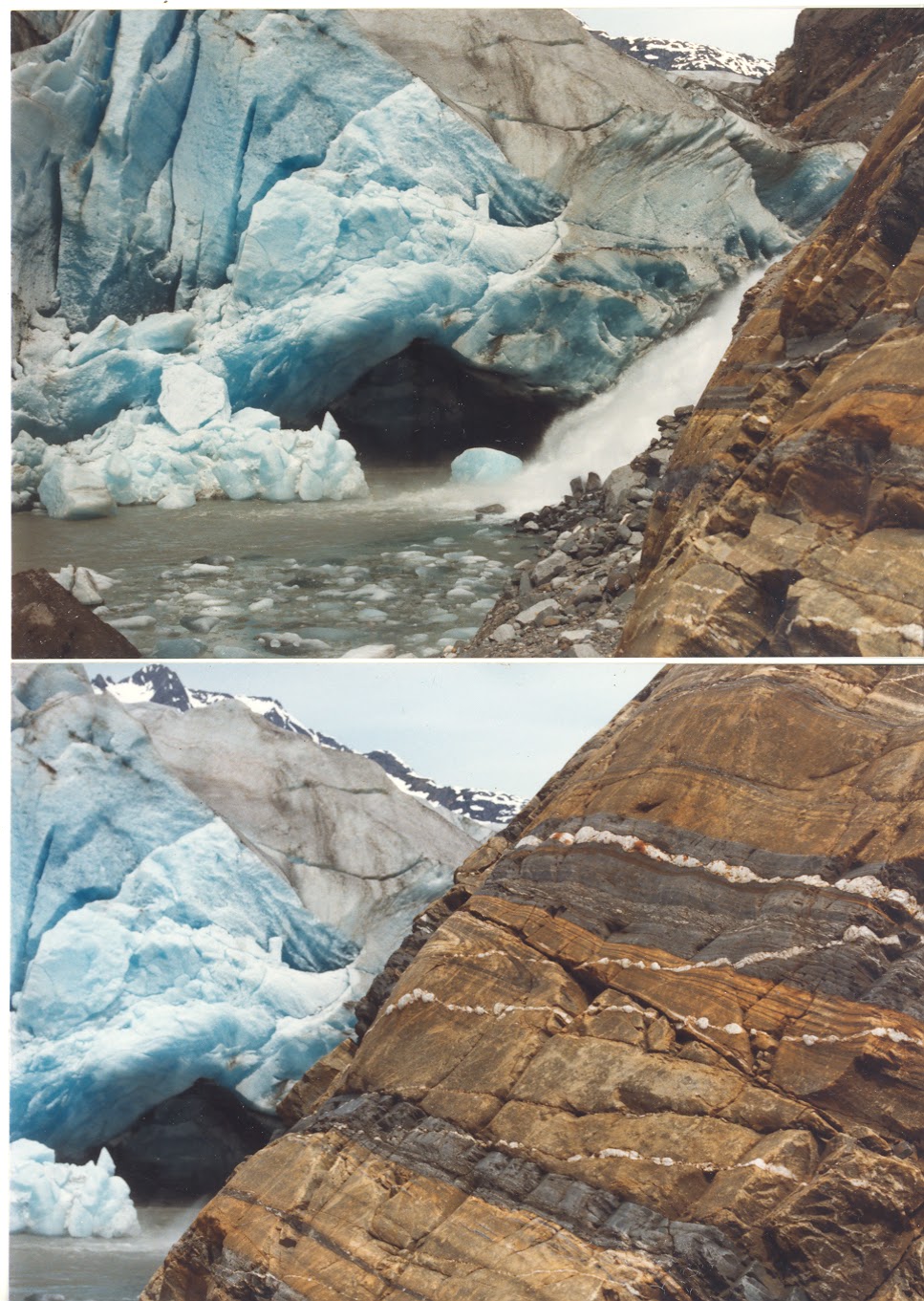
In the background is Mendenhall Glacier.  Like most of the two dozen or so glaciers that pour down from the Juneau Ice Cap (the main exception has been Taku Glacier), Mendenhall has been retreating for a long time.  When I was a boy, living a mile and a half to the west, the glacier partly obscured the waterfall.  You can still see signs posted every couple hundred yards, warning visitors to get no closer.  When we lived in Juneau, a woman was, in fact, crushed to death by falling ice, but that was in winter, I think, when Mendenhall Lake freezes over a couple feet.  You can't easily get that close in the summer.

John has been here twice.  The first time, he stood by the lake across from the big glacier and asked, "Is this the North Pole?"

The cliffs over which the water falls, are in places streaked with quartz.  Look closer at the rocks that the glacier has left in its retreat, and you can still find garnets in the scheist, and other beautiful stones. 

Follow the East Glacier Trail around the falls into a valley towards the backside of Thunder Mountain.  I never made it as far as I wanted -- some day I'll return. 

Go into the visitor's center, point the scope onto Boulder Mountain behind Nugget Creek, and sometimes you can find mountain goats, little white specks thousands of feet above. 

A magnificent stuffed timber wolf now also stands in the center -- hit by a car, they told me. 

There are plenty of live animals around, too.  As we walked up the ramp to the Visitor's Center, a small but adventurous bear was coming down.  He went over the rail, and clambered down the rocks to avoid us: the boys were deeply disappointed.  Beavers created a pond out of another little creek that flows into the river just beyond the parking lot.  Bright red sockeye salmon fight their way up the creek every fall, attracting bears.  Even the plants in Mendenhall Valley enchant: the freshly-washed cottonwoods, the deep mosses, the pink flowers establishing themselves in white sand when the glacier has past.  Of all the places in the greater Juneau area, hundreds of square miles of mountain and fjords, the smell here seems freshest, as if the world had been created this morning.  And who can deny it -- with mists rising off the mountains, water pouring down from deep mossy hills, many-colored mushrooms popping out of the green?  Here indeed, where the glacier passes, the world comes to life anew. 

Mom and Laurel on return to East Glacier trail:
Mendenhall glacier and lake,
Mt. McGinnis and Stroller White -- I still remember
the names of the mountains,  and the
lakes we foolishly slid across in 8th grade, when the
ice was still only an inch and a half thick. 
Tourists off big ships that tower over downtown Juneau climb out of big buses half a mile from this spot, but never get here.  They don't climb the rocks and bath unclothed in the little ponds up in the glacier-scoured hills, as we did when we were boys.  They don't chase the salmon.  They don't ski across the lake, because they don't come in winter.  They should do these things: here where the world is still young.


Monday, June 20, 2011

How Jesus Has Liberated Women: My Story

Alana Hiha, from the YWAM tribe, reaching out and
befriending a Lahu (?) child that day in 1984.
Art Sandborn told us, before we visited this village in northern Thailand, about another visit a team he led had paid to it the year before. 

 The Christian outreach team, which was doing evangelism and various good works, had to spend the night in the village.  Villagers told the men to say in one house, and the women in another.  The men were then asked, "How about a girl for the night?"  Villagers were willing to sell their daughters, and no doubt in the past had sold their daughters, for a pathetically low price. 

They didn't know that AIDS was just around the bend. 

These colorfully-dressed girls
were playing a game with nuts where we drove
into the village.  
I had heard about the problems hills tribes in the Golden Triangle were facing while we were in Hong Kong preparing for the trip.  Much of the territory was disputed between a patchwork of states, tribes, and drug warlords. Nationalists from China were well-armed, and the Burmese government was trying (and is still sometimes trying) to snuff out resistance among hill tribes, at any cost. Opium and heroin were staples of the economy, and girls were trafficked across porous borders for the enormous sex trade that had grown up in Thailand.
Theoretically, there seems little reason why any of this should have bothered me.  "No man is an island," John Donne pointed out.  But according to John Hartung, cited by Richard Dawkins in The God Delusion, evolution cannot easily explain why we should care about those who belong to different tribes from ourselves.  Furthermore, both Dawkins and Hartung believe that the God of the Bible, especially the Old Testament, exacerbates the tendency towards tribal myopia that evolution already programs into us. 

In fact, many Westerners and Japanese who visited Thailand seemed to welcome such attitudes, and the cheap sex and drugs that came with them.  What is more natural?  Whatever feeble instinct we might have towards universal compassion, surely history shows that the male instinct for getting laid is far stronger!

But while in Hong Kong, I had taken to reading the prophet Isaiah. It almost seemed as if he were touched by the plight of such pitiful hill tribes:

“How lovely on the mountains are the feet of him who brings good news, who announces peace and brings good news of happiness . . . ’”

Isaiah’s searing denunciation of oppression also caught my eye:

“But this is a people plundered and despoiled; all of them are trapped in caves, or are hidden away in prisons; they have become a prey with none to deliver them, and a spoil, with none to say, ‘Give them back!’” (42:22)

Girls were, in fact, sometimes chained to beds. The police having been bribed, indeed, no one did seem to stand up and say, "Give them back!" I underlined the last lines of a passage from Isaiah 61 in red, where he seemed to offer hope, though:

 “The Spirit of the Lord is upon me, because the Lord has anointed me to bring good news to the afflicted; he has sent me to bind up the broken-hearted, to proclaim liberty to captives, and freedom to prisoners.”

And sketched in an arrow to link the human acts which Isaiah said in Chapter 58 would lead to a divine response: 

“Is this not the fast which I choose, to loosen the bonds of wickedness, to undo the bands of the yoke, and to let the oppressed go free . . . Then your light will break out like the dawn . . . “ (58:6)

And now here we were, and here was the terrible darkness that Isaiah had seemed to be writing about in passages that had struck me so forcibly back in Hong Kong.  There were the girls who were being bound, hidden away in prisons, despoiled, a prey with none to say "Give them back!"

While the rest of the team set up to put on a dramatic show about the life and death of Jesus, I went behind the hut to pray. 
Snake Alley, Taiwan; I took
this picture on the sly, thus
the weird angle.

I had been praying, as an evangelical, since I was a boy, but this time, something out of the ordinary seemed to happen.  I suddenly seemed to see this village as if it were in itself and entire planet.  I seemed to hear (not verbally) a voice saying,

"Just as my Son entered the world, so my children also need to enter into this little world, and give their lives for it." 

I began to weep for these girls.   

I never returned to that village.  But years later, while living in Taiwan and encountering horrible forms of sexual exploitation (see picture above right), I began crusading against the sex trade there, and for the young women who were exploited by it.  I wrote articles for a local newspaper, preached in churches, and sent out letters to alert churches in tribal villages. 

Along the way, I met others who seemed to have heard the same call.  I visited an American-Taiwanese couple who had a dramatic conversion experience from the drug culture (he was a Vietnam vet), and ran a rehab center for drug addicts, also taking in prostitutes rescued by the police.  I met Baptists and Presbyterians who ran centers for such girls, and a YWAM group in the Philippines who helped 150 women a year out of the sex trade. I visited Jackie Pullinger, the charismatic English woman who tells her story in Chasing the Dragon.  The woman who served us water had spent a lifetime as a prostitute. 

Studying world history, I came to the conclusion that this reaction of Christian compassion to those "hidden away" in brothels, while on far too small a scale still, was no fluke.  The Gospel of Jesus, I came to believe, has done more to liberate more women, than any other force in human history. 

And there is evidence that the teachings not just of Isaiah, but the teachings and example of Jesus even more, have had such a dramatic effect.  Let us move, now, from the intimate scale of "personal testimony," to the broadest scale of planetary sociological research.

In the following section, I will offer an overview from a UN study that describes the status of women in 99 countries around the world, and show how Christian influence generally correlates to a higher status for women. Then I'll argue historically that the Gospel itself is responsible for elevating billions of women around the world, even in "non-Christian" countries like Thailand and Taiwan.  After that, I'll consider every passage in the gospels related to women, and show where that power originated.