Pages

Saturday, July 02, 2016

Thirty-Two Bad Arguments by Godless in Dixie

Thirty! 

Last year I played a game with my students. One handed me her copy of their short Chinese world history text. I scanned the contents briefly, and estimated that I would find thirty errors in the book. That proved very close to the final count, though I was surprised where the errors were concentrated . . . Mostly in attacks on Medieval Christianity, and gross oversights about modern Chinese history.


Today someone brought to my attention a popular on-line argument by Godless in Dixie, or Neil Carter, entitled "Seven Bad Reasons to Believe in the Resurrection of Jesus."  The article is written as a critical review of Tim Keller's The Reason for God, an excellent and positive popular-level statement of the case for Christianity.  


After scanning bits of this article, I think I'll play the same game and shoot for the same section of the fence. Given the quality and length, I'll make a preliminary guestimate of thirty errors. Though I suspect afraid I'm playing this one too conservatively. 


The game will be somewhat hampered by the fact that while I've read Keller's book, I don't seem to have a copy on hand, anymore.  So I won't be able to point to any errors of representation, which often pad the score in these sorts of games. 


Given the over six hundred comments on this article, it may be worth responding, despite my flippancy.

Seven Bad Reasons to Believe in the Resurrection of Jesus

easter01Well, it looks like I spoke too soon. Contrary to my previous declaration that Tim Keller was done trying to build a logical case for Christianity and had just moved on to sermonizing, it turns out the second-to-the-last chapter in his apologetics work The Reason for God really did contain one last shot at arguing for the legitimacy of the Christian faith.
In Chapter 13, Keller rehashes the story of the resurrection of Jesus, arguing that it must have actually happened, not so much because he has positive proof for it besides a collection of stories in an ancient book, but more because until you can definitively explain how this story came to be in the first place, you are supposed to assume that it must be true.
I suspect a misrepresentation here, but cannot confirm it.  
This is what we call “shifting the burden of proof.” Ordinarily a person engaging in counter-apologetics (which is what I suppose I am doing in this series of posts) has to carefully break down the other person’s logic order to expose when and where this sleight of hand occurs in the other person’s argumentation. But Keller just comes right out and states his bias in plain language:
Most people think that, when it comes to Jesus’s resurrection, the burden of proof is on believers to give evidence that it happened. That is not completely the case. The resurrection also puts a burden of proof on its nonbelievers. It is not enough to simply believe Jesus did not rise from the dead. You must then come up with a historically feasible alternate explanation for the birth of the church. (p.210)
(1) At least, this statement does not support Carter's original representation of Keller.  Keller says it is "not completely the case" that the burden of proof is on the Christian.  But this does not at all support the claim that Keller says it is "more" because "you are supposed to assume the story is true" until you can explain it.  It is like confusing, "Mr. Keller did not eat all the chocolate ice cream: Mr. Carter ate some, too" with "You must believe that Mr. Carter ate most the ice cream."  There are two changes in meaning, here: "some" to "most," and the appearance of the imperative.  
Um, why, exactly? That seems a rather facile assertion on Keller’s part. Why am I obligated to explain why a religious community or tradition exists? Must I give an adequate explanation for why Islam exists? Or Hinduism? Or Mormonism? Or Scientology?  Each of these religions makes claims upon which the rest of their beliefs are based, and I fail to see why we are automatically obligated to accept them by default until we can first definitively prove that those claims are false. Or does Keller mean that only his religion should be privileged in that way? I wonder why, exactly?
(2) Even if Keller didn't explain that (didn't he?), many other apologists have, so Carter need not wonder so.  
Hinduism is the religion of India, named thousands of years after it appeared, which grew up in native soil and came to include a number of ideas over those millennia, such as reincarnation, caste, the importance of the guru, and a set of gods and goddesses. 
Hinduism is easily explained in such general terms.  It does not depend on any historical action by any historical person.  If Krishna did not speak to Arjuna, Hindus can take the story metaphorically, or ignore it and attend to any of the millions of other Hindu gods.  
Christianity, by sharp contrast, grew up in a hostile environment (both Jewish and Roman) proclaiming two things (see Acts): the death of Jesus for the sins of the world, and his resurrection.   That Christians were hated and killed for their faith, is certain.  That they preached Christ risen, is clear throughout Acts.  That Jesus died shortly before the Gospel spread out from Palestine, is clear, historically.  
Since Christianity is founded on the resurrection of Jesus, a recent event to those preaching it, and since Jesus' first disciples would have known whether they really did meet Jesus or not, the truth of Christianity is supported by the early spread of that faith, in a way that is not paralleled by Hinduism or these other religions.  (Some attempt has been made to find a parallel with Mormonism, but I think unsuccessfully.)
(3) We have not been given any evidence that Keller said we should believe Christianity "by default." 
A resurrection is an extraordinary claim, and as notable skeptics Sagan, Hitchens, and before them LaPlace have all said in various forms, “Extraordinary claims require extraordinary evidence.” 
(4) And before them, David Hume.  
But in the full context of background facts to the Gospel, I have argued that in fact, the resurrection of Jesus (but only Jesus -- let us not imagine there are valid parallels) is really not so "extraordinary" in the relevant sense.
It would mean very little for someone to simply argue that a peasant rabbi amassed a following in ancient rural Palestine only to fall in with zealots and get himself killed by the Roman authorities.  
(5) The Zealot Party probably did not exist in Jesus' time.  Anyway, all the evidence is against Jesus having been a precursor, so that argument would not really work.  
We have evidence of that occurring on more than one occasion. But it’s another thing altogether to claim that, after a weekend in a tomb, one of those rabbis came back to life, walked through walls, ate breakfast, and then flew away up into the sky. Those are extraordinary claims, and yet Keller says it’s on you to believe them all unless you can prove they never happened.
(6) Oh, and doesn't Tim Keller offer any positive reasons to believe in those claims?  Of course he does.  
Given other "reasons for God," the claim that God acted on behalf of not some random rabbi, but the central figure in human history, who has changed the world more than anyone else, and offers the world it's most luminous teachings, simply is not "extraordinary" in the sense, or to the degree, Carter facilely assumes. 

Why Are We Still Debating This?

Arguments for the historicity of the Gospels wear me out, I have to confess. Like apologetics discussions in general, I find them tedious and repetitive. It seems to me that after people slog their way through all the details (and that can go on for days, weeks, or months) they come away believing the exact same things they believed going into the discussion. 
(7) This impression should be seen as a gross over-generalization and corrected.  In fact, converts both to atheism and to Christianity often cite their study of the historicity of the gospels as key to their conversions, in both directions. 
I would also suggest that if the subject bores Mr. Carter, he not post on it.  Work that bores one, is often done poorly.  
My own personal feeling is that the whole preoccupation misses the most important point of all:
If the resurrection of Jesus really happened, we wouldn’t be still debating its historicity today. The present-day evidence for the other claims of the Christian faith would be overwhelming, and all around us. They would leave little room for doubt.
(8) This is non-sequitur, and ignores Christian anthropology and even secular psychology.  As atheists often point out in other situations, human beings have a strong propensity for "cognitive dissonance reduction," to believe what they want to.   The human heart, says the Bible, is "wicked."
From the fact that not everyone believes Fact X, it does not follow that Fact X is untrue, of course.  Nor does it follow that evidence for related truths would be overwhelming.  
The very fact that we are still dissecting these ancient stories, looking for clues to determine whether or not they really happened says enough, don’t you think? I believe we have too quickly forgotten that the same book which asserts that Jesus came back from the dead also asserts other things, such as: 1) if you pray for people to be healed they will get better, 2) if you give money to God you’ll get even more back in return, and 3) if you truly trust Jesus with all your heart then his spirit will empower you to become a better person. It says all of those things, and so much more, yet the devout keep pointing us away from present-day evidence toward ancient stories which we will never be able to positively disprove without the use of a time machine.
(9) Carter is simplifying Christian claims to refute them more easily.  The gospels note that because of lack of faith, in one place even Jesus was unable to do many miracles.  Furthermore, Paul prayed for his own healing of some sort, and did not receive it.  Yes, there are also passages that seem, on the surface, to imply that everyone prayed for will be healed, but they must be taken in this larger context.  See recent books by Eric Metaxis and Craig Keener on miracles, to see that miraculous healing does sometimes occur.  
(10) The money promise is one of those phony pseudo-verses that prosperity preachers love.  The New Testament makes no such promise, if you read it seriously.  
Jesus does say, in Luke 3:38: 
"Give, and it will be given to you. A good measure, pressed down, shaken together and running over, will be poured into your lap. For with the measure you use, it will be measured to you."
But look earlier in the same chapter!  
"Blessed are you when men hate you, and ostracize you, and cast insults at you, and spurn your name as evil, for the sake of the Son of Man.  Be glad in that day, and leap for joy, for behold, your reward is great in heaven . . . "
It is clear throughout the chapter that Jesus is talking about rewards beyond the here-and-now, and therefore beyond Mr. Carter's calculations.  
(11) I happen to think (3) is true.  I have seen people do just that -- trust Jesus with all their hearts -- and I have seen them become better people.  I was just talking with my aunt today about how this happened in my mother's life.  I know that if I trusted Jesus more, I would become a much better person.  
According to the writer(s) of the fourth Gospel, Jesus himself indicated what he intentioned would be the most visible evidence for his own legitimacy: The unity of the church. If the author(s) of that gospel can be believed at all, Jesus had the audacity to gamble his own legacy on his followers’ ability to remain in harmonious relationship with one another.  I have often called this “the most failed prayer in history,” and it seems to me that any student of history should be forgiven for concluding based on what we have seen that in fact Jesus wasn’t who the Bible says he was.
(12) We're wandering quite a distance from Tim Keller's arguments for the resurrection, you will notice.  The thread connecting the two issues has not quite broken, but has become thin, long, and multiply frayed. 
Suppose that John, in his old age, fondly remembered the words of Jesus in his youth -- and remembered some of them not quite correctly. 
How much easier is it to remember the most significant and awe-inspiring sight of your life -- whatever that may be, a marriage, a sudden death, an unexpected victory -- than the precise words of even a close friend, 50 years later?  From which it follows that even if John did slightly romanticize Jesus' promise, that would in no way undermine the dramatic claim that he met him alive, after dead.  
But did Jesus actually say anything about "the unity of the church" in the John 14-17?  Well he does pray as follows: 
15My prayer is not that you take them out of the world but that you protect them from the evil one. 16They are not of the world, even as I am not of it. 17Sanctify them byd the truth; your word is truth. 18As you sent me into the world, I have sent them into the world. 19For them I sanctify myself, that they too may be truly sanctified.

20“My prayer is not for them alone. I pray also for those who will believe in me through their message, 21that all of them may be one, Father, just as you are in me and I am in you. May they also be in us so that the world may believe that you have sent me. 22I have given them the glory that you gave me, that they may be one as we are one— 23I in them and you in me—so that they may be brought to complete unity. Then the world will know that you sent me and have loved them even as you have loved me.

Carter seems to have forgotten, somehow, that this is primarily a prayer, not a prophecy.  And it is primarily about the disciples themselves, secondarily about those they would lead to faith.  (As the whole prayer shows.)  
That Jesus was not just waving a magic wand and making his followers be nice, is clear throughout the gospels and the epistles.  They are stubborn, pig-headed, argumentative, even treacherous -- that very night!  In other words, the Spirit leads, but gives Christians the freedom to follow -- or not.  
That aside, I see no reason not to work my way through the handful of reasons which Keller believes the burden of proof—or rather disproof—remains on people like me who disbelieve that a guy died and came back 36 hours later nearly 2,000 years ago. I do feel the need to throw in couple of caveats first, however.
(13) Given the claim of your article, you really would need, not "work through" Keller's arguments, but fairly evaluate them, to come to the conclusion that Keller really is just tossing the whole issue into the unbeliever's lap, as you claim.  I don't think he is, and you seem to sort of concede that here, too.  
First, I will assume for the sake of argument that Jesus was in fact a real, historical person. I will admit this is far from certain, and I dare you to bring that subject up within any gathering of English speaking atheists today. 
(14) It is quite certain.  Name the gathering, and if they are polite and intelligent, name the hour.  
But for the purposes of interacting with this chapter, we might as well start with that assumption. Remember that just because a guy named Jesus lived and died in the way the Bible says he did does NOT necessarily establish that he also performed miracles and came back from the dead. I hope most readers can separate Supernatural Jesus from Regular Joe Jesus long enough to get through the topic at hand.
(15) There never was any "regular Joe" Jesus.  The historicity and supernatural character of Jesus are interwoven throughout the gospels (AN Wilson saw this even as an atheist) in such a manner that they cannot be rationally separated.  That is the very fact -- a challenge to their core world assumptions -- that forces skeptics like Carrier et al into the absurd "mythicist" position, and the likes of Stephen Law into downgrading the gospels as historical sources.  And aside from his miracles, Jesus is never "regular Joe" -- his teachings are as amazing as his acts, his social character, his style.  
Second, I cannot help but note that in a chapter aimed at convincing skeptics of the historicity of the resurrection of Jesus, Keller relies upon the same individual for 9 out of 10 citations, and that individual happens to be an Anglican bishop. Granted, N.T. Wright is a brilliant writer and a devoted student of primitive Christianity who gratuated with honors from Oxford University. He’s no slouch. But he’s still an Anglican minister, and at heart he is a student of Christian theology. I found it somewhat disappointing to see him relying so heavily upon a fellow man of the cloth to establish a question of objective history.
(16) And yet Carter, to argue for his principle of "extraordinary claims require extraordinary evidence," cited three skeptics alone, and none as historically-literate as Wright. 
Also, aside from his undergrad days, people like Marcus Borg and Raymond Martin, neither I think a Christian, set Wright at or near the pinnacle of historical Jesus studies.  What difference does it make what clothes he wears?  Maybe he's a pastor BECAUSE he finds the evidence so strong. 

Seven Arguments Against the Resurrection NOT Happening


1. While the gospels weren’t written until a full generation after the time of Jesus, the letters of Paul attest to the resurrection as well, and they were written earlier. 
Well, yes, that is most likely true. Although we’re still talking about second- or third-hand information at best, and it’s still at least 20 years after the time at which these events were to have taken place. If I were to write a piece today about the untimely death of Princess Diana, I doubt it would carry much historical weight, given that I was neither there to witness the automobile accident that claimed her life nor was I even in the same country at the time. I wouldn’t be much of an authority on the details of her death, nor would anyone treat me as such unless they were desperate for reliable sources of information on the matter.
(17) But Paul says he met Jesus.   He also knew Jesus' closest friends, who say they met him after his death.  That changes things.  
2. ZOMG there were 500 witnesses to the risen Jesus!
Okay, so Keller never used the word “zomg,” but I feel entitled to poke fun after having heard this thrown out as many times as I have over the years. The passage in 1 Corinthians 15 to which Keller refers doesn’t establish what he thinks it establishes at all, because Paul is merely repeating what he was told by someone else, and we don’t even know if that someone else was supposed to be one of those 500 people in the first place. Keller seems a bit overly impressed by all of this:
Paul’s letter was to a church, and therefore it was a public document, written to be read aloud. Paul was inviting anyone who doubted that Jesus had appeared to people after his death to go and talk to the eyewitnesses if they wished. (p.212)
Just how often does Keller think people on the other side of the Mediterranean made trips to Jerusalem? And if they did travel the nearly 1,800 miles by land (or 800 by sea), how exactly would they track down any of those 500 witnesses now that more than 20 years had come and gone since that time? In short, this doesn’t count as 500 points, it only counts as one point, if even that. It’s not even an eyewitness’s account. It’s a second-, third-, or even fourth-hand retelling of a story that claims there were eyewitnesses. Can people really not understand this difference? I’m kind of baffled.
(18) Actually, the Jewish Christian community seems to have been surprisingly mobile.  (Or not surprisingly -- read the Greek historians, and see how much traffic there was by sea between ports even centuries before Christ.)  Many Jews from around the Mediterranean visited Jerusalem for Passover, and many Christians were scattered by persecution -- Paul should know, he was one of the persecutors -- throughout the Jewish diaspora.  
We KNOW Paul interviewed some of the eyewitnesses: it is probably that he had met many of them, even that some were in Corinth, a  major seaport just down the road from Athens.  According to Rodney Stark (and Carrier echoes him), the church had less than a thousand believers by this time -- a large percentage were probably eyewitnesses, even outside of Palestine.  
3. We don’t give ancient people enough credit for their skepticism, nor for their ability to distinguish between fact and folklore.
Both Wright and Keller borrow heavily from C.S. Lewis, who frequently accused his contemporaries of “chronological snobbery” whereby modern people look down on their ancient counterparts as simpletons who would believe any tall tale they heard.  
(19) Wright does no such thing.  He cites Lewis extremely sparingly in his massive historical works.  He obtains his opinions first-hand, from a massive amount of first-hand reading in ancient sources.  
My main problem with this contention isn’t that people back then weren’t as smart as we are today, it’s that people today are still much more gullible than we care to admit. In other words, it’s not that ancients were so easily duped, it’s that we all are, even today.
Fair enough, which is why I'm dissecting your article.  
The advent of the Information Age hasn’t necessarily spawned a generation of critical thinkers. I often say that misinformation travels just as fast as information, perhaps even faster. So this isn’t just a problem of ancient history. I’ve worked in a supplement store and I know good and well that as long the person giving nutritional advice is wearing a lab coat and/or has a stethoscope around their neck, people will buy whatever they are selling. And you don’t have to travel far from an major city before you run into a culture of superstition that makes you want to put your car in reverse and head back home as quickly as possible.
(20) Yes, but that cuts both ways.  People are both eager to believe, and to disbelieve.  It depends on their biases.  
4. Women were among the first to report the resurrection, and nobody in that day would have made that up.
Far too much has been made of the fact that the gospels report women as the first to testify to the resurrection. Apologists for many years have counted this as a mark in favor of the “criteria of embarrassment,” meaning that if the early church had truly fabricated the resurrection account, they would have made sure to put the first testimonies in the mouths of men for reasons of social convention.
Women’s low social status meant that their testimony was not admissible evidence in court…The only possible explanation for why women were depicted as meeting Jesus first is if they really had. (p.213)
Well, that’s not exactly the only possible explanation, and this isn’t exactly a court of law, either. But in that particular culture and time, women’s lower social status actually made them more likely to be the ones given the responsibility of handling burial rituals, wrapping bodies and unwrapping them again to reapply burial spices and so forth. It’s quite normal and expected that if there had been a burial and a subsequent removal of the body of Jesus, women should have been the first to discover that he was missing.
(21) Which makes the Gospel story more credible, doesn't it?  
And I should probably add here that I think this is exactly what happened. I don’t personally subscribe to the mythicist position which suggests that Jesus never even existed.  To my mind, it is more likely that there was a guy named Jesus who did in fact get executed for being in the wrong place at the wrong time, and that his body was removed at some point, leading to a whole host of theories and legends which eventually grew into post-crucifixion sightings of a resurrected Jesus.
(22) But that hypothesis has long since been massively debunked.  Let's not put too much faith in folk historical theorizing.  This "argument" doesn't even lay a glove on the usual arguments of a Craig or a Habermas, which have been bandied about for decades, now.
On just one minor note, remember that the gospels were written within the normal life-expectancy of Jesus' first followers -- and Paul's accounts, even earlier.  So we don't have an "eventually" to work with, here.    
The earliest version of the earliest gospel (Mark 16:1-8) ends with two women carrying burial spices to an empty tomb only to flee the scene “trembling and bewildered, saying nothing to anyone because they were afraid.” The oldest manuscripts we have of this gospel end with two confused women and no resurrection appearances. Which means at bare minimum we can surmise that the stories of later appearances by Jesus must have grown up later on, and in time were even added to the end of the text of Mark’s gospel in order to corroborate the legends that grew up between the different versions of the story.
(23) No, we cannot.  Because Mark already mentions the resurrection at least two previous times in his gospel.  (Mark 9:31; Mark 10:34)  And also because Paul's conversion, and I Corinthians 15, were written first.  And also because of the internal credibility of the resurrection accounts, from an historical point of view.  
5. People in that time would have never believed in an individual bodily resurrection because it wouldn’t have fit their worldview.
Keller here again leans heavily on the work of N.T. Wright who argues in several of his works that any concept of resurrection familiar to the people of this time period would have disallowed for a personal resurrection of just one individual, and certainly not one that is physical in nature. Keller seems far too confident in ruling out any such thinking when he says things like:
Once your soul is free of its body, a return to re-embodied life was outlandish, unthinkable, and impossible… The very idea of an individual resurrection would have been as impossible to imagine to a Jew as to a Greek. (p.215-216)
And yet we have right there in the letter to the Hebrews (arguably the most Jewish book in the New Testament) this illuminating admission:
By faith Abraham, when he was tested, offered up Isaac, and he who had received the promises was in the act of offering up his only son, of whom it was said,“Through Isaac shall your offspring be named.” He considered that God was able even to raise him from the dead…
It seems to me that whoever wrote the letter to the Hebrews believed that, even as far back as Abraham, there must have been some kind of concept of individual resurrection. If not for a belief in individual resurrection, how else would Abraham have been willing to march up that mountain ready to sacrifice the very offspring through whom the man was supposed to become “the father of many nations?”
I think this argument is not so obviously mistaken.  Wright's point, that the Jews of the time were not looking for an individual resurrection, is no doubt correct, and Carter does nothing to overthrow it, however.    
6. First-century Jews would never have agreed to worship a human as divine, unless he really were God incarnate.
Keller makes it sound like the deification of Jesus happened immediately. He takes the time-frame in which Jesus goes from rabbi to prophet to messiah to God and collapses it into an instantaneous event.
Jews…believed in a single, transcendent, personal God. It was absolute blasphemy to propose that any human being should be worshiped. Yet hundreds of Jews began worshiping Jesus literally overnight. (p.218)
Did they really, though? Because it seems to me the bulk of our knowledge about primitive Christianity comes from the later Pauline communities, not the earlier Judean ones. 
(24) "Later" Pauline communities?  We're talking about groups of believers who appeared more closely in time than the present is to my first trip to Asia, in my early 20s.  It wasn't that long ago.  The concept of "primitive" and "later / developed" here is bogus, chronologically.   
(25) And the gospels do clearly represent the first community of believers.  Bauckham has made a strong case for that, and I am presently writing what I believe is an even stronger case.  
Do we really know how quickly they adapted to the idea that Jesus was somehow both human and divine?  Even the early Christian hymn which Keller cites from Philippians 2, while situating the development of a high Christology in the mid-first-century, doesn’t really tell us that it wasn’t the more Greek-leaning diaspora communities who provided that particular innovation.
And as I mentioned in my last post, a cursory glance through the early church councils of the Fourth and Fifth centuries reveals that the divinity of Jesus was still being hotly debating in the church even 400 years after its inception. That’s not to say that the worship of Jesus didn’t start as early as the first century, but it does mean that the church’s understanding of the divinity of Jesus wasn’t exactly a fully developed thing right off the bat.
(26) Carter is conflating "understanding" with "belief."  Yes, it is clear that Jews were worshiping Jesus as Messiah, Savior, and God within the first generation.  That IS a reason to believe something spectacular happened -- as the gospels say.  It is not by itself proof of the resurrection, but it fits within the rest of the evidence.  
7. The early disciples would have never sacrificed their lives if the resurrection didn’t really happen.
Honestly, I don’t see how any American living in post 9/11 society can overlook the very real possibility that a dozen or more zealous young men would be willing to sacrifice their lives for a religious belief. Zealotry is no proof that the things you believe are actually true. It only means that you sincerely believe them to be true.
(27) I don't see how any American interested in the question, can still garble the argument this badly. 
How many years has Josh McDowell been repeating, "Yes, people often die for a belief.  But not for a belief that they know is untrue?"  Thirty?  Three thousand?  It seems like it.  
The key here is that the early followers of Jesus who claimed to have met Jesus alive, would have known if they "made a mistake," and would not willingly have died for that little error!  There are ways of getting around this argument -- but not if you don't see that it's there in the first place!
Did the original 12 apostles in fact give up their lives for their faith? I don’t really know. This is another one of those many points at which people like Keller immediately believe any and every story that church tradition has preserved about the deaths of the earliest disciples. One such story I recall describes the apostle Peter being crucified upside down at his own request because, as the story goes, he didn’t consider himself worthy to be crucified in the same manner as Jesus. Because of course, Roman emperors were always taking requests from their captives, right?
(28) Occam doesn't like it when people who claim to be interested in the facts keep on dumping historical evidence ("church tradition") because it causes them unease.  
Actually, Clement of Rome refers to Peter's martyrdom just 20-30 years after the fact. 

Making Easter Relevant

I must comment on one last assertion that Keller makes in this chapter because I hear it from time to time and it has always struck me as a non sequitur. Following Wright’s lead, Keller suggests that the story of the resurrection of Jesus isn’t just about getting sins forgiven, but that it also portends to a future restoration of the whole world, and that the expectation of this future deliverance should motivate the church to become a meditating force to implement that deliverance in some anticipatory way.
Each year at Easter I get to preach on the Resurrection. In my sermon I always say to my skeptical, secular friends that, even if they can’t believe in the resurrection, they should want it to be true. Most of them care deeply about justice for the poor, alleviating hunger and disease, and caring for the environment. (p.220)
My first thought when I read that last sentence was about how unconcerned about those things evangelical Christians in America seem to be. If the story of the resurrection is supposed to motivate the church to seek to effect change in those areas, they sure haven’t made any of those things central components of the culture wars they’ve been fighting over the last few decades. The church in America is much more concerned with exerting control over what people do in their bedrooms than whether or not they’ve had enough to eat or what their carbon footprint happens to be.
(29) Carter is, apparently, too focused on politics, and not enough on social reality. 
Sociologist Arthur Brooks shows that in fact, pious Christians in America contribute many times as much to charity, and are "by every measure" more charitable, than secularists, on average.  (See Who Really Cares?)
(30) What lunatic would care more about whether, say, their daughter burns off ten gallons of gasoline in her car over the weekend, than if she sleeps with a VD-laden pig who's going to dump her and leave her with an unsupported child AND an STD?  The messed-up priorities are, I think, Carter's own.  
And I would think that even if I did believe in apocalyptic global warming, which I do not.  
Keller goes on to give a lengthy quote from one of Wright’s sermons to argue that the Easter story should move the church to become a force for good in the world in precisely those ways:
Easter means that in a world where injustice, violence and degradation are endemic, God is not prepared to tolerate such things—and that we will work and plan, with all the energy of God, to implement the victory of Jesus over them all. (p.221)
Those are wonderful goals, and I would love to see the church in America come to focus on such real-world activities as alleviating injustice, war, poverty and disease. But I fail to see how stories of miraculous feedings and healings necessarily inspires that. I mean it’s not like Jesus taught his disciples about antibiotics or how to better irrigate arid tracts of land. The early church didn’t travel to impoverished districts to dig wells or lobby to change the laws or foreign policies of the Roman Empire. In fact, the only direct action I can recall Jesus taking toward the environment was when he killed a fig tree for not bearing figs out of season. Not exactly the environmental hero we were looking for.
(31) Well, then, like many secularists, thanks to our biased and delinquent educational system, you're missing out on a huge chunk of human history.  
I don't see anything in Keller's comment about the environment.  But I see a great deal in history about followers of Jesus changing the world for the better in the ways Keller mentions here.  (See, for instance, pages 63-86 of my How Jesus Passes the Outsider Test, also numerous posts on this site.)  
And yes, that emphatically did begin with the early Church, as is crystal clear throughout the gospels and Acts, and as people like Will Durant and Rodney Stark chronicle for the next few centuries as well.  So Carter is just wrong: the gospels did inspire massive, world-changing reforms, which have changed his life, and those of everyone he loves, for the better, whether he realizes it or not.  
Furthermore, the things we are told that Jesus did were all instantaneous miracles. Now we are being told that his example is supposed to lead the church to do the same things he did, but in non-miraculous ways because of course everybody knows better than to expect that? I’ve never understood the appeal of this line of reasoning. It tickles the fancy of the modern progressive listener, and I guess I can’t blame either of these two churchmen for seeking to make their own ancient religious tradition relevant to the times in which we live.
But this has always felt like a bit of a stretch. And I suspect the majority of the church instinctively knows that, which would explain why those things haven’t really caught on in the church today.
(32) Again, Carter is just parading his ignorance -- both of the enormous reforms by which the Gospel of Jesus has changed the entire world, and of miracles that still occur, today.  

So I predicted 30, and found 32.  We do our best to add value, here at Christ the Tao.  

Sunday, June 26, 2016

EO Wilson and the Meaning of Human Existence

Image result for eo wilsonI recently finished reading the kind of atheist rant I enjoy: an eloquent, deeply human, and oh-so-wrong (yet not so long) tome by evolutionary biologist EO Wilson, entitled The Meaning of Human Existence.  I concluded that Wilson may be the best person in the world to talk about ants, but only among the top (say) billion in his insight into human beings.  Still, there's hardly a dull word in the book: it is a pleasure to read, even with false skeptical cliches increasingly clogging the flow of Wilson's prose towards the climax of the work.

Here are some initial reactions to Wilson's thoughts.  This is a preliminary and incomplete form: I may rearrange this into a review article later, adding additional material:

"We are not predestined to reach any goal, nor are we answerable to any power but our own.  Only wisdom based on self-understanding, not piety, will save us." (15)

But it seems free will is an illusion, so we have no power or understanding, either, just whatever thoughts (right or wrong, who can say?) that evolution has programmed into us.

Anyway, most of what Wilson says in this book against religion is mere assertion: he is in hurry, does not seem to anticipate many skeptics of his secular humanism to read it, and thus gives few, if any, reasons for rejecting "religion."  So why should anyone accept such dogmas as this from the world's leading authority on ants?

On the Humanities

"This task of understanding humanity is too important and too daunting to leave exclusively to the humanities." (17)

Wilson argues for a two-pronged approach to understanding meaning, which includes both science and a scientifically-informed humanities.  While a famous scientist himself, he thinks visiting aliens would find our humanities more unique and therefore far more interesting than our science, which they would see as rudimentary indeed.

On Human Social Nature

The key to human evolution, Wilson posits, is something he calls "eusociality."

Eusociality, the most advanced social system in Nature, arose among 19 separate species, Wilson argues, including termites, ants, and two kinds of African mole rats, a few kinds of shrimp, and preeminently human beings.  The key to this important advance is a protected nest, from which specialists emerge to forage: "risk-prone foragers and risk-averse parents and nurses."  Society thus begins with a "nested community:" a care-giver or mated pair, and one or more leaving the nest (or hearth, in the case of humans) to find food, from which eventually develops a more complex society.  A fully specialized community works wonders for the social insects, who constitute a small fraction of insect species, but half by weight, due to their success.  

(Isn't this why making women serve in the army is against our nature?  And why women think the world is too dangerous, and men think it is too safe?  Why should we now pretend that women and men must be interchangeable?  Isn't modern social dogma a triumph of dogma over human nature, "malsociality," if I can coin a word?)

The family is the basic structure, Wilson suggests, from which society emerges. (Are you surprised, Plato and Confucius?  Has evolutionary science really provided us with a new insight,here?)

"We are compulsively driven to belong to groups, or to create them as needed."  (24-5; True, as Aristotle pointed out, man is a political animal.)

Are humans intrinsically good or sinful?  "Scientific evidence, a good part of it accumulated during the past 20 years, suggest that we are both of these things simultaneously.  Each of us is inherently conflicted."  So then we won't need Pascal to tell us that 400 years ago, describing this as a discovered of his much older faith:

"The more enlightened we are the more greatness and vileness we discover in man." 
Or Walker Percy, with his Pascalian dualities: "I am at once the hero and the asshole of the universe."

Or even Shakespeare's "What a piece of work is man!"  And the soliloquy that follows.

"All normal humans are geniuses at reading the intentions of others, whereby they evaluate, proselytize, bond, cooperate, gossip, and control." (30)

"Within groups, selfish individuals beat altruistic individuals; but groups of altruists beat groups of selfish individuals." (31)  

Wilson should read Don Richardson's Peace Child, and see how the Gospel of Jesus Christ can transform groups of selfish individuals within a single generation.

Creativity involves "inevitable and necessary conflict between the individual and group levels of natural selection." (37)
What makes (or made) us human is relationship. (75)  Here Wilson unconsciously echoes none other than Moses: "It is not good for man to be alone." 

"The meaning of human existence cannot be explained until 'just is' is replaced with 'just is, because.'" (81)

But Wilson can't do that.  He can only see a proximate not ultimate "because."  He sees the golf ball heading towards the hole , and tells us he knows the velocity and topography and wind speed -- but refuses to consider what set the ball rolling and why.

On Francis Bacon

1620 Bacon "Empire of Man" (38) was the greatest forerunner of the Enlightenment, which proposed that "entirely on their own, human beings can know all that needs to be known."  But what Bacon actually said, was that shallow science frog-marches one towards atheism, but deep study of science draws one back to Christ.

On the Humanities

"Metaphor is everything" in the humanities.  That will be news to historians, even to psychologists, heck even to a writer like George Orwell or J.R.R.Tolkien.

Chapter 5 "The All Importance of the Humanities."  The humanities which we as humans create are unique: an alien visitor would know our science better than we do ourselves, he would stay to read Shakespeare and listen to the Blues.  And now, individual scientists can discover much less than when Wilson was young, ten researcher co-authoring reports together.

Wilson expends a great deal of ink attacking a rival theory of evolution called Inclusive Fitness Theory, and kin selection.  He does not try very hard to prove the relevance of the topic to his book, which seems odd, since the topic of the book is great and the page count small.  But this does make for interesting "creative rivalry" with Richard Dawkins, especially.  And it is interesting to hear so committed an atheist echoing complaints Dawkins' Christian rivals have made about Darwinian selection mores for years:

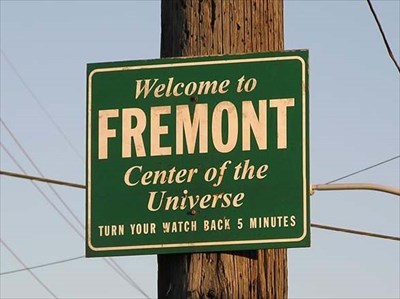
On Fremont

Image result for fremont center of the universe signThe discoveries of astronomy "affirm that Earth is not the center of the Universe."

Actually every point is at the center, modern astronomy postulates.  (C.S. Lewis appeared to recognize, or anticipate, this astronomical insight already in the speeches he gave his heroes at the end of Perelandra).

But physical centrality is itself a mere metaphor for importance.  If you set a baby in her crib in the corner of the room, does that make the stuffed bear she throws out of the crib into the geographical center of the room more important than the child?  The actual center of the Earth is volcanic nickel and iron, not the choicest real estate on the planet.  Nor is the brain at the center of the human body.  Placement does not entail importance.

On Evolutionary Bigots

"By 2005, they had gained enough strength represented in the anonymous peer review system to hinder publication of contrary evidence and opinions in leading journals." (71)

Well fancy that!

When Wilson and two like-minded colleagues published a rebuttal in a 2010 edition of Nature Magazine, the following year 137 biologists signed a response, and Mr. Dawkins suggested hurling Wilson's book against the wall with the usual violence.  Dawkins responded, in Wilson's words, "with the indignant fervor of a true believer." 

Wilson had best be careful, or he will give comfort to Intelligent Designer proponents who have been calling Dawkins and his ilk "fundamentalists" for years, to much scoffing among his fellow skeptics.

On Cool Ants

Humans are limited, Wilson notes, to a narrow range of vision and sound, and miss out on the rich word of chemical smells.  "Ants are possibly the most advanced pheronmenal creatures on earth." (87)  Aside from ten or twenty different pheromes they use, the meaning of those scents further depends on dose, combinations, and context -- creating an entire chemical language.

Wilson then proffers a full chapter on ants, and why humans should respect but not copy them. ("Admire their stripes but avoid their claws" as Chesterton said of tigers.)

On Clever Microbes

He then praises the flexibility of microbes.  Life arose quickly after the Earth had cooled a bit, and microbes have learned to thrive in diverse biomes.  Wilson suggests this proves that life could arise easily elsewhere.  But the adaptive power of DNA is not relevant to how easily DNA-based life could first arise, anymore than the many uses computers can be put suggests they can be casually manufactured.  That life arose quickly is at best very weak evidence that chance creates life easily, since we do not know that chance created it this time, and it may be that (from an anthropic perspective) microbes required billions of years to build up soil and to fix minerals, so if they had NOT arisen quickly, we would never know our loss.

On ET

Image result for spock
Watch out for those fingertips
Wilson's chapter on ET offers fascinating speculation - he lives on land, depends on eyes and ears like us, has sensitive fingertips.  Wilson is here conspiring with physicists and astronomers to pour cold beer over the bar scene in Star Wars, indeed on most space fiction in general.  Even if we could travel between planets, which is highly unlikely, when we got to an occupied one, not only would the locals not speak English and fall in love with Captain Kirk, their microbes would kill him and all the crew almost immediately, as in War of the Worlds.

Wilson is not satisfied with being a second second Adam (by naming the animals) or a new and better Solomon (considering the ants), he also takes up Noah's cause of saving our fellow earthlings.  While I doubt climate change alone has driven anything extinct, generally speaking Wilson adopts a lofty air, writes eloquently and insightfully on the environment.  "We alone among all species have grasped the reality of the living world, seen the beauty of nature, and given value to the individual.  We alone have measured the quality of mercy among our own kind." (132) Wilson is a genius at describing nature, but can be a darn good preacher, too.

Unlike Adam, Solomon, Noah, Pascal, or Moses, Francis Bacon is not only echoed by Wilson, he is named as among Wilson's heroes, indeed a whole chapter nods to Bacon by being entitled "Idols of the Mind."

"Some writers have tried to deconstruct human nature into non-existence.  But it is real, tangible, and a process that exists in the structures of the brain." (141)

On Music

"Our loving devotion to (music) has been hard-wired by evolution in the human brain." (147)

Odd, that evolution would choose just one species to do this with (birds do not chirp just for fun, nor compose), and that so recently.

On Religion

"A religious instinct does indeed exist." (148)

Yes.  So do angels. 

"The brain was made four religion and religion for the human brain." (150) 

Here Wilson should be cited at length, to get a feeling for both sides of his insight:

"The great religions "perform services invaluable to civilization.  Their priests bring solemnity to the rites of passage through the cycle of life and death  They sacralize the basic tenets of civil and moral law, comfort the afflicted, and take care of the desperately poor.  Inspired by their example, followers strive to be righteous in the sight of man and God.  The churches over which they preside are centers of community life.  When all else fails, these sacred places, where God dwells imminent on Earth, because ultimate refuges against the iniquities and trajedies of secular life.  They and their ministers make more bearable tyranny, war, starvation, and the worst of natural catastrophes." 

However:

"The great religions are also, and tragically, sources of ceaseless and unnecessary suffering  They are impediments to the grasp of reality needed to solve most social problems in the real world.  Their exquisitely human flaw is tribalism.  The instinctual force of tribalism in the genesis of religiosity is far stronger than the yearning for spirituality . . . It is tribalism, not the moral tenets and humanitarian thought of pure religion, that makes good people do bad things."

While there is much truth, there is also much confusion in this second paragraph.

Does "pure religion" have moral tenets and humanitarianism?  Wilson observes humans so more cavalierly and simplistically than ants.  Were the Aztecs not religious?  Their religion was not humane.  Why assume that all religions or "great religions" (which means "big") are equally human in their pure form?  That is simply to toss aside the scientist's curiosity, the empirical call of Bacon which always results in empirical differentiation, and escape hard reasoning and the inevitable complexity of any set of concrete realities, by positing a silly equivalence.

God is not the center of "pure" Buddhism, anymore than the Aztecs were driven by humanity.  And tribalism, Wilson has already pointed out, was a force upward in evolution.  And was the Good Samaritan told by a mere tribal leader?  Or Mozi's (let me paraphrase) "God is love, so man ought to model his own actions on the love of God?")

But Wilson has a theory, and ignores such complications.  Religions define themselves by their creation stories, "the supernatural narrative that explains how humans came into existence."  (Actually, they often do no such thing.) "The core belief assures its members that God favors them above all others."  "There is no way around the soul-satisfying but cruel discrimination that organized religions by definition must practice among themselves.  I doubt there ever has been an imam who suggested that his followers try Roman Catholicism or a  priest who urged the reverse." (151)

Actually, there have been, but like Wilson, they were mostly heretics.  And the reason is one Wilson, of all people, should understand.

We Christians believe that Christianity is true, as Wilson believes materialism is true.  He does not advise people to believe what he thinks to be a lie.  Why should he?  Neither do we.  This is not "cruel" or "soul-destroying" (and Wilson does not believe in the soul anyway-- has he forgotten?) -- it means treating other people with the dignity that allows one to say, "You are wrong."

Wilson says philosophy is on the endangered list, thanks to the insights of science.  Of course the truth is, this is itself largely a book of philosophy.  Though to give Wilson credit, if that's all the better modern, science-fed teachers can do when it comes to philosophy, maybe it is, indeed, in danger of going extinct.

But I like Wilson.  He is a graceful, intelligent writer, and seems a graceful and likable gentleman.  One can learn a lot from him -- including many insights that his Christian and pagan forebears announced centuries ago.   He tries to weave the wisdom he has "discovered" into a comprehensive evolutionary narrative, leaving out far too much of human experience -- miracles, for instance, and answered prayer, and the revelation of God.  (Not to mention freedom, and truth, and a genuine choice between right and wrong.)   But his instinct is sound.  We do need to tell a story, one which embraces the truths Wilson has noticed, and those he has overlooked.

I believe the Gospel does that, better than anything else.  Nothing in this book works to change my mind.  

Thursday, June 23, 2016

Did Christianity Spread by the Sword?

Christianity is the world's largest and most widely-believed faith.  Islam is second.  How did they get that way?  Many suppose they both spread by conquest and force.

This is true of Islam, but not of Christianity.

I initially posted my analysis in response to a claim by Richard Carrier, on another web site.  Since the question is of perennial interest, I've now adapted that article for this site, to make it more easily available to readers.

Perhaps in late 2008, a young atheist and philosopher who read my book, The TruthBehind the New Atheism, challenged me to read and respond to the work of Richard Carrier.  He felt Carrier, editor-in-chief of the “Internet infidels,” who holds a doctorate from Columbia in Roman history, offered a more substantial atheist critique of Christianity than the likes of Richard Dawkins and Sam Harris.

I bought a copy of Carrier’s book, Sense & Goodness Without God, and began reading.  I later posted a mostly critical, but courteous, review on Amazon.

I pointed out fourteen errors in Sense & Goodness, including Carrier's claim that Christianity usually “spread by the sword,” only thrived when it could wipe out other religions by force, and was (with Islam) the bloodiest and most intolerant religion known to man.

Carrier responded with pique, calling me a “liar,” among other things. (The accusation only slightly surprised me, since he had told me in a personal e-mail that his debate partners generally turned out to be dishonest.  Who am I to be the exception?  He reverted to this style more recently in response to my comments on the Amazon forum for On the Historicity of Jesus.)  After arguing back and forth several rounds, Carrier posted an attack on me on his web site, focusing on the issue of biogenesis. Several other people joined the conversation at times, including three philosophers, who had been taking part in the Amazon discussion already, and two scientists, who weighed in (at my request) on the state of the evidence on the origin of life, which was another issue on which Carrier had offered strong views.

While the tone of Carrier’s attacks is often discreditable, his claims are popular enough that they merit response.

Here, I’ll post our arguments on whether or not Christianity mostly “Spread by the Sword," beginning with two rounds of argument, then an analysis of how Christianity spread over twelve regions and eras, then an additional round of argument.  

Round One Richard Carrier, from Sense & Goodness Without God:

"Most people in ancient times believed it was proper to respect the gods of other peoples.  This changed on a global scale when Christianity was spread, quite literally, by the sword.  Those who attempted to assert their religious differences were harassed, tortured, robbed of their land and belongings, even killed.  Before it achieved political power, Christianity was a small sect, a heresy against the Jewish faith, that had to accept equality among all the other religions of the Roman Empire.  Yet it was the first religion to openly attack the religions of other people as false (the Jews, at least, were a little more tactful).  Needless to say, Christianity only truly flourished when it had the ability to eliminate the competitionwhen it had the full support of Rome’s Emperors after 313 A.D., and when, in 395 A. D., every religion other than Christianity was actually outlawed. Through force and decree Christianity as immersed in the cultural surroundings of lands near and far, and in an environment where it was widely accepted, it not the only thing accepted, it spread and planted itself among subjugated peoples.  As kids grew up taking Christian ideas for granted, they often did not realize that only a few generations ago those ideas were entirely alien.”  

Colonization of the world, more often than not by robbery and warfare, spread Christianity into the Americas and other corners of the earth, just as Islam was spread throughout Asia and Africa.  It is not a coincidence that the two most widespread religions in the world today are the most warlike and intolerant religions in history.  Before the rise of Christianity, religious tolerance, including a large degree of religious freedom, was not only custom but in many ways law under the Roman and Persian empires . . . Indeed, Christians were persecuted for denying that the popular gods existed – not for following a different religion.  In other words, Christians were persecuted for being intolerant." (264)

David Marshall, from review on Amazon.com: "Finally, from another section of the book, there's this jumbled thicket of confused revisionism " . . ."

"To begin at the end, if it is "intolerant" to deny that popular gods exist, what is Richard Carrier? He denies not only the Greco-Roman gods, but Christian, Muslim, Confucian, Aussie, and every other vision of God as well!

"In fact Christianity mostly did NOT spread by the sword.  Constantine adopted the faith because it had already become the strongest spiritual force in Roman society already -- by caring for the sick, treating women well, and showing courage in the face of death, as Rodney Stark shows in The Rise of Christianity.

"Richard Fletcher's The Barbarian Conversion tells the rest of the story for Europe, others for the rest of the world -- force was the exception, not the rule.

"Christianity has always been strongest in a free market of faiths -- as in modern America, Korea, and even modern China.  Here Carrier badly needs to read Stark's other studies.

"To say even Islam is the most intolerant or warlike religion in history reveals gross ignorance.  Has he never heard of the Aztecs?  The Tai Pings?  Yanomamo shamanism?  Jim Jones?  Or (to stretch the term "religion" slightly) Vladimir Lenin?  Adolf Hitler?

"The tolerance of the Greco-Romans was punctuated by episodes of persecution, bigotry, witch-hunting, and murder.  Elsewhere in the same book, Carrier admits that one sect began their rituals with the shout,  "Away with the Epicureans!  Away with the Christians! . . . this hostility could come to slander and violence.  Challenging a popular legend might start a riot, even get you killed."   In fact you didn't even have to go that far -- Socrates was not the only one to get officially killed for unorthodoxy.

Round 2 (Note: Here I quote only Carrier’s response to this one issue.  For the rest of that part of our conversation, see the discussion under my review of his book on Amazon.com, linked twice above.)

Carrier: As I show in Not the Impossible Faith (chapter 18), Marshall is misusing Rodney Stark in his attempt to claim that Christianity became the dominant religion peacefully.  Stark argues (as do all other modern experts) that Christianity was still a small minority religion even in the time of Constantine.  And beginning with his conversion, force was used to support it: already in his reign pagan temples were robbed of their wealth by force, being given to Christian churches instead, while by the end of the same century paganism was actually outlawed, and over subsequent centuries gruesome displays of force were used to terrify the disobedient into compliance (see Not the Impossible Faith pp. 21-23).

Likewise, no one reading the history of the Christianization of the Americas can possibly believe "force was the exception, not the rule." The history of the European Middle Ages is likewise just as bloody (simply read The Carolingian Chronicles for the Christians' own account of what they did). Indeed, actual force was often not necessary precisely because the threat of it was enough (as I discuss on p. 265 of Sense and Goodness without God).  Since I cite abundant scholarship confirming everything I say (pp. 267-68), again, Marshall is the revisionist here.

Marshall: What did Carrier mean by saying that Christianity "spread by the sword?"  The comment is rather ambiguous.  From the context, in which Carrier talks first about the spread of Christianity in ancient Rome, then in the world in general, it is clear he is referring to the overall history of Christianity.  And given the rest of his comments, it is clear he is, at minimum, referring to the most normal method of proselytism.  He is not saying that Christianity has SOMETIMES employed force, but at the least, that it has USUALLY (if not ALWAYS) employed force.

What does "by the sword" mean?  I will not require that it mean most converts had actual metal pressed against their throats (though the adverb "literally" is, as often, misused here.)  I take "by the sword" to refer to bringing people to faith under military or police compulsion.

I do insist, however, that conversion involve direct physical violence, or the threat of violence, against the potential convert, to count in favor of Carrier's claim.  It cannot even mean that mob violence was occasionally employed, or even that Christians occasionally persecuted people of other religions.  This for the simple reason that Carrier is comparing "intolerant" Christianity with "tolerant" paganism in this passage.  ("It was the first religion to openly attack the religions of other people.")  Yet he admits there was persecution of Christians (and other sects) in pagan Rome, along with mob violence against them.  Clearly the phrase "spread by the sword" must mean something above and beyond what Christians experienced at the hands of the pagans, to justify the contrast Carrier is drawing.

Finally, what might Carrier mean by "spread?"  Should it refer to transmission of faith to new lands, cultures, or individuals?

We can probably rule geography out.  It would be unreasonable to count the spread of faith among Eskimos in Alaska as more significant than among some tribe in Rwanda, just because more territory is involved.

Spread to individuals seems more likely at first.  If this is what Carrier meant, however, his claim may be too obviously absurd.  The vast majority of Christians have accepted faith from parents or teachers, through education, not the threat of death.  Furthermore, most Christians have probably lived over the past 200 years. (By my back of the envelope calculation, about 40% of all people who have lived in the last 2000 years, have lived in the last 200. Towards the beginning of that period, the percent of Christians in world population increased dramatically.)  Over the past 200 years, only a tiny minority of believers converted on pain of death. Neither, of course, did most Christians in the Middle Ages.

So the only plausible meaning of "spread," and the meaning most likely intended, is "transmitted into a new politico-cultural sphere, so as to be adopted by a significant portion of the populace."

Now we can analyze the accuracy of Carrier's claims about the history of Christianity.  I'll look at twelve great population groups, to which the vast majority of Christians belong.  I'll begin from the first days of Christianity.

(1) Roman-European Christians, 33-600 AD 

According to Rodney Stark, by the time of Constantine's conversion and the Edict of Milan in 313, proclaiming religious tolerance, about 10% of the entire Roman empire had become Christian. Obviously, before this time Christianity was NOT spread by military compulsion.  In fact, it spread in the face of often severe persecution.

Furthermore, according to Stark, Christianity was growing by about 40% per decade at this time.  By that natural growth rate (similar to that later traced by Mormons), Stark argues, the success of Christianity was already a fate accompli:

"In fact, Constantine's conversion was, in part, the response of a politically astute man to what was soon to be an accomplished fact - the exponential wave of Christian growth had gathered immense height and weight by the time Constantine contended for the throne (One True God, 61)."

Capturing 10% of the "market" shows that a religion has "arrived." We know that before this time, Christianity had spread to almost all of the empire - without force of any kind, but in the face of force.  By the natural growth pattern it had already established, even without state support, one could expect Christianity to surpass 50% of the population in the latter half of the 4th Century.

While Christians did take matters into their own hands by forcibly destroying temples at times, for the most part conversion to Christianity during the 4th Century was by free will, not compulsion. (Read Augustine's Confessions, for example - St. Augustine converted as late as 386, in apparent freedom, having freely chosen among contemporary beliefs.)   Occasional mob violence or state sanction do not constitute "conversion by the sword" on Carrier's own terms, as we have seen that he praises the ancient Romans, who engaged in both, for being quite different than and superior to Christians.

Theodosius I established "Catholic" Christianity as the state religion in 380.  In the 5th Century, the conformity of all, apart from Jews, was mandated and enforced.  As we will see when I address Carrier's second claim, Stark and I agree that the vital impulse of Christianity largely died in this period.

Several of the most prominent 4th Century Christians were born into a Christian family: Ambrose, Gregory Nazianzus, (his father was converted not by the sword, but by his wife), Basil the Great and his many siblings, Jerome.  This is consistent with Stark's thesis that like Mormons today, much of the Christian increase came through larger families and better health care.  Others, like Augustine, came from a partially pagan background, and were converted after dallying with pagan philosophies: Theodore the Interpreter and John Chrysostom were both educated under the pagan Libanius and then chose the Christian faith -- again, not at the point of a sword. Nor do their biographies seem to involve anyone who converted that way, as far as I know.

Sketchy as this is, this empirical evidence, from various parts of the empire, tells against the claim that the great numerical increase in Christians over the 4th Century came about primarily through military force.  It agrees fully, however, with Stark's arguments.

In any case, what happened in the 4th Century is best described as "consolidation," not "spread" as we defined it.  As I pointed out, "spread" must refer to the transmission of a religion to a new politico-cultural entity, not to individual conversions, or consolidation.

If we count individual conversions, then the early Christians will count for very little, compared to the billions of Christians in the modern world, and Carrier's argument will be rendered even less plausible!

(2) North African, West Asian Christians, 600-2016

In the first centuries after Christ, as in European Rome, Christianity spread through missions, voluntarily. Some consolidating force was employed late in the Imperial era.

After the Islamic conquest, for the next 1400 years, Christianity in the Middle East was mostly transmitted from parents to children, rather than by military force.  Millions of Muslims become Christians today (especially in Algeria, Iran, Egypt, and in parts of black Africa), not only of their own free will, but in the face of often strong persecution.

(3) Chinese Christians, 624-2016 

Christianity spread to China in four main waves, and one or two smaller ones - all without military or police compulsion on anyone to convert.

Nestorian Christianity spread peacefully, with some minor support at first, and some persecution later, from Chinese emperors.

Catholicism spread peacefully, with some persecution from the government, in the 16th and 17th Centuries, until there were about 300,000 Catholics in China.  In this case, European meddling and Chinese strong-arm tactics combined to undermine Christianity, keeping it from growing much after the "Rites Controversy" erupted in 1705.

In the 19th Century, Protestants entered China as a correlate of European imperialistic action against a weak Qing government.  Missionaries did not, however, use force; in fact imperialism was a strong disincentive to conversion, making "yang jiao" or "foreign religion" very unpopular.  It was in the face of persecution (most famously by the Boxers, who killed tens of thousands of Christians in 1900, but all through the 19th Century at a lesser level) that Christianity spread.

In the 20th Century, both under the Nationalists, and far more under the Communists, Christianity was officially discouraged.  It has been under persecution that the number of Christians in China has grown to some 70 million not "gua ming" or nominal Christians, but largely highly committed believers - the second largest number of any country, after the US.

(4) European Christians, 600-1800 

The grassroots missions impulse having mostly died within Latin Christianity, the faith did however spread to northern Europe, and was then consolidated as the official religion.  (And later, as dueling Catholic and Protestant official religions.)  Mass forcible conversions did occur during this period, including of the Saxons under Charlemagne, in the 8th Century.

Joseph Fletcher, Professor of History at the University of York, notes however in The Barbarian Conversion, "It is a striking feature of the spread of Christianity to barbarian Europe that it was, before Saxony, so tranquil a process."

Force was also employed on later occasions, among some Norse, Slavs, Finnish, and Baltic peoples. Other methods of transmission that seem to have been more important, however, were evangelism (St. Patrick, to the Irish) and the export of Christian wives to pagan kings. Of course the history of the Middle Ages was bloody, as Carrier remarks - as are all histories. But the spread of Christianity in Europe can't be reduced to Charlemagne's religio-political campaigns.  As Fletcher shows, the most common pattern was for a king to marry a Christian bride; the kingdom generally following his lead. It's true that there often was an element of compulsion in the subsequent conversion of nobles and laity (also later, with the spread of Protestantism, and the Catholic reaction.)  But it would be simplistic to say Christianity was mainly spread "by the sword" to Northern Europe - sometimes it was, more often it doesn't seem to have been.

Still, this period is probably the second-best case for Carrier's claim. Christianity may have spread into new cultural spheres during this period between one twentieth and one quarter of the time, off the cuff.

(5) Latin American Christo-Catholics, 1492-1900 

This period is probably Carrier's best argument for the "spread by the sword" hypothesis.  The conquest of South and Central America by the Spanish and Portuguese was, beginning with Christopher Columbus himself, a bloody and terrible affair.  What spread most quickly, though, was germs, wiping out much of the Indian population before they had the chance to be subjugated by Rome.

I am not a Latin expert, but the history of conversion in Latin America seems complicated. Conquistadors did make Christianity a tool of oppression and conquest.  Colonists sometimes attacked the Jesuits, though, for defending Indians against their own depredations.  Slaves were sometimes baptized, perhaps against their will; at other times prevented from voluntarily becoming Christians voluntarily. Whether or not Christianity (as opposed to colonialism) spread primarily by the sword over this region during this period, would require closer study than I have had the chance to accomplish.  But on the surface, Latin America seems like the best case for Carrier's claim, as clearly it sometimes did.

(6) European Christians, 1800-2016 

Ours has been an era of consolidation, revival, and a neo-pagan and secularist ("Enlightenment") backlash.  While often seen a "great following away" credited to the Enlightenment, it was also in the modern period that the Bible itself was translated into most European languages, and printing allowed pietist and other revival movements to spread the influence of the Gospel in a way that it could not in the relatively illiterate Middle Ages.

Christianity spread, to the extent it did in modern Europe, almost entirely by voluntary conversion.  In Eastern Europe, Christianity spread in the face of communist suppression - most successfully in Poland, but also in other countries. (See, for example, the works of Richard Wurmbrand, George Weigel, and James Felak.) Solzhenitsyn's story of conversion was in some ways typical of the era - and was, of course, of his own free will.

(7) North American Christians, 1620-2016 

Christianity spread to North America primarily through immigration, education, and voluntary evangelism.  There may have been rare instances of force (mostly in the earliest years of this period, among small groups, and through schools in 20th Century Canada), but choice has been the overwhelming pattern.

In fact, predominately Christian American and Canada have allowed far more freedom of conscience than did pagan Rome.  Given that the US has had more Christians than any other country has ever had over the past century and a half (probably some 900 million self-declared Christians altogether), the history of his own society should have given Carrier pause.

(8) African Christians, 1800-2016 

In 1900, there were only about 9 million Christians in Africa, including Copts and other small minorities in Muslim countries.  Today there are over 400 million at least nominal Christians.  (For a total approaching perhaps a billion over the past century.)  The vast majority have come to faith of their own free will, in response to missions.  (Sometimes in the face of persecution, as in Uganda under Idi Amin, Ethiopia, and in some tribes.)

(9) Latin Protestants, 1900-2016

The number of Evangelical Christians grew from negligible in 1900, to some 60 million by 1997. (First Things, Pedro Morena, June / July 1997) Few converts seem to have been zealous Catholics; most seem to have been religiously apathetic, or Christo-pagans.  Few, if any, came to Christ "at the point of the sword," or any other weapon.

(10) Indian Christians, 33 AD-2016 

Aside from the case of Goa, where Catholic inquisitors forced the population to adopt Christianity, the vast majority of converts to Christianity in India came to faith of their free will.  Even during British rule, compulsion to Christian faith was seldom if ever used; some were even persecuted for belief.

Today, there are between 25 and 50 million Christians in India. The free spread of Christianity has worried some "Hindutva" fanatics to the point of persecution and other pressure on Indians to abandon Christianity.

(11) Korean Christians, 1900-2016 

Again, Korean converts adopted Christianity freely, not under compulsion. Much of the conversion went on in the face of communist or Japanese oppression.  Some 30% of South Koreans are Christian today, often extremely zealous.

(12) Tribal Christians, 1900-2016 

Taiwan: About 12 tribes (Ami the largest) converted to Christianity, under no compulsion.  China: Lisu, Lahu, Wa, Jingpo, some Yi, Miao, Bouyi, small groups of Dai, all converted freely, or in the face of anti-Christian persecution.  Southeast Asia: Karen, Kachin, Lisu, Lahu, Wa, Hmong, all converted freely.  India: Naga, Mizo, other tribes in eastern states, Santal, Kholli mountain tribes, also converted freely.  New Guinea: millions of Christians among the Dani, Yali, and other tribes, became Christians without being forced to it.  Polynesians also adopted Christianity because they wanted to, not because missionaries threatened to kill them if they didn't.  Tribes in North America have generally either adopted Christianity of their own free will, or not at all.

Some exceptions may be found among Indian children who were forced to go to Christian schools during the mid-20th Century.

In summary, Carrier is clearly  and badly mistaken. As I said, use of force was clearly the exception than the rule in the spread of Christianity.  Only in some parts of Latin America, and in some cases in Northern Europe, did Christianity spread to new people groups primarily by force.

In the vast majority of cases, peoples adopted Christianity because they wanted to. The same is even more clearly true if we look at individual conversion, rather than the conversion of groups. Furthermore, both of the periods in which force WAS an important means of "converting" people, occurred (1) long after the initial and defining spread of Christianity; and (2) after Christianity had become institutionally corrupt, in part for reasons I will now explore.

Does Christianity only thrive by violently suppressing other faiths?

Round 3

Carrier: "Marshall falsely claims `Christianity has always been strongest in a free market of faiths -- as in modern America, Korea, and even modern China.'  Yet it is not "strong" in China or Korea (it is a minority in both countries), and even in America it claims only about 80% of the population. Compare that to a rate of 95% and more in much of medieval Europe and all of early Spanish-controlled America, when one had to be Christian under pain of death or prison or dispossession or exile, then you'll understand the difference I am talking about: Christianity was strongest then, not now.

Allowed to compete fairly in a free market, Christianity slowly washes out into a minority religion, or else must change radically to accommodate popular desires (which is why Catholicism is a minority now and losing ground in America, while most Christians are merely nominal, unable even to name the four Gospels, with nearly half now claiming Christianity is not the only path to eternal life, while secularism and other minority religions are growing, as they have done in Europe--slowly reversing the after-effects of an ages-long era of force and intimidation that really only ended in America with the demise of the McCarthy witch-hunts barely fifty years ago)."

Marshall: Carrier’s arguments here are not just wrong, they are poorly informed and often bizarre.

Senator Joe McCarthy’s career marked the end point of Christian “force and intimidation” in America?  Can he be serious?  Carrier seems to be conflating “Christians” with “everyone I don’t like.”

As Stark shows in “Secularization, RIP,” citing a great deal of primary and quality secondary data, Medieval Europe was by nothing like "95 % Christian" in the very sense Carrier defines the term here. ("Most Christians are merely nominal, unable even to name the four Gospels.")  Compare that to Christians, and even the CLERGY, during the Middle Ages:

"In 1551 the Bishop of Gloucester systematically tested his DIOCESAN CLERGY. Of 311 PASTORS, 171 could not repeat the Ten Commandments, and 27 did not know the author of the Lord's Prayer." (my emphasis - DM) "During the middle ages and during the Renaissance, the masses rarely entered a church, and their private worship was directed toward an array of spirits and supernatural agencies, only some of them recognizably Christian." 

"In 1800, only 12 percent of the British population belonged to specific religious congregation. This rose to 17 percent in 1850 and then stabilized - the same percentage belonged in 1990." 

"French Catholics today participate more willingly and frequently, with far greater comprehension of what they are doing, than was the case 200 years ago." (All from Stark, “Secularization, RIP”)

So by Carrier's own criteria, and citing a leading sociologist of religion whom Carrier himself appealed to for demographics, it is balderdash to claim that "95%" of Europeans were Christian before the Enlightenment, in some more significant sense than Americans are Christian today.  Not even most MONKS could pass a simple test for biblical literacy in the Middle Ages, let alone ordinary folks!  Church attendance was often quite nominal, with only a tiny fraction of the populace coming to church even once a year.

In fact, the percent of Americans who belong to a church, and who go to church, is far higher today than it was in the late 18th Century.

I live in one of the most secularized corner of the United States. Washington State has had the lowest church attendance rates in the country, and Seattle is worse. Yet I know some two dozen "mega-churches," vibrant, evangelical Christian churches with 1800 or more attendees a week, in the Seattle area.  And only a fraction of evangelicals go to mega-churches.  And there are other kinds of Christians in the Seattle area, too, of course - Catholics, Orthodox, liberal Protestants.

To call Christianity "weak" in America, compared to the Middle Ages, is a secularist pipe-dream. And to say that about South Korea, where thousands meet for fervent prayer in the morning, or retreat to pray on mountains for days at a time, and has produced single churches numbering in the hundreds of thousands of worshipers, defies the imagination.

Christianity is thriving in huge swaths of the world today.  Under no compulsion, tens of millions of Africans and Latin Americans will engage in fervent worship this coming Sunday.  Millions more will meet throughout China, praying with fervency, singing and bringing friends.  Christians will meet in huge mega-churches in Singapore, then go out to eat in outdoor food courts, side-by-side with Buddhists, Hindus, Muslims, and "freethinkers," as they call them there. The freer the market, the better Christianity does.

In fact, one problem with Europe may be its state religions. As Stark has demonstrated through decades of empirical research (see our interview in Faith Seeking Understanding), monopoly religions lose their fervency:

"Christianity might have been far better served had Constantine's faith been pretended.  For, in doing his best to serve Christianity, Constantine destroyed its most vital aspect: its dependence on mass volunteerism." (One True God, 61)

"From a popular mass movement, supported by member donations and run by amateurs and poorly paid clergy, under Constantine Christianity was transformed into an elite organization, lavishly funded by the state, and bestowing wealth and power on the clergy.  Thereupon, church offices became highly sought by well-connected men, whose appointments greatly reduced the average Christian leader's level of dedication." 

"The Christianity that triumphed over Rome was a mass social movement in a highly competitive environment. The Christianity that subsequently left most of Europe only nominally converted, at best, was an established, subsidized, state church that sought to extend itself, not through missionizing the population, but by baptizing kings . . . corruption and sloth as well as power struggles and enforced conformity, became prominent features of the Christian movement . . . Most of the evils associated with European Christianity since the middle of the 4th Century can be traced to establishment." 

Stark traces that trend through the history of Europe to the modern day. (To me, he suggested that it is precisely the beginnings of competition in Europe that offers the most hope that Christianity will revive there.)  The atrophy of grass-roots fervor, and the corruption of the clergy by money and wealth, sent European Christianity into a long decline. There were still faithful Christians, but they were always a minority.  And they tended to come from the margins of society, like Francis of Assisi, or of the clergy, like Martin Luther. Most Medieval "Christians" also could not read, the Bible was prohibited them, and they knew little about their supposed faith.

Thus, Carrier's arguments simply display popular ignorance of the history and sociology of religion. His claim that Christianity has "only truly flourished when it had the ability to eliminate the competition" is near opposite of the truth.   In fact, Christianity thrives best in a free environment, with an open market of ideas. (Or even under some persecution.)  That is how it arose, and that is how it spread in many cases.

It is no coincidence that the persecuting church was also a corrupt church, a "Christianity" that had left its moorings, and the spirit of Jesus of Nazareth, far behind, in search of money and power.

Friday, June 17, 2016

Reza Aslan Eliminates the danger of Islamic Violence


Parents, stop worrying about whether your kids are going to join a cult or extremist ideology.  It doesn't matter.   It only matters that you raised them well.  

After all, Nazism is just an ideology, and like all ideologies, what you make of it depends entirely on what you bring to it.  Those who are naturally violent, like Adolf Hitler, bring genocide and attacks on Germany's neighbors.  But gentle, kind, and loving converts to Nazism, do as you know make a name for themselves by feeding the poor, curing the sick, and holding the hands of the terminally-ill poor, around the world.  

Voldemortism is also just a magical orientation, and like all such orientations, depends no more and no less than on what you bring to it.  If you are incurably gothic, you will probably get nothing out of it but death to muggles.  But many other followers of Voldemort become outstanding and kindly citizens, known for their public-spiritedness.  This is why "Death-Eaters" are known for their charity work on six continents, and are fast putting Kiwanas and Lions Club out of business.  

Security Risks?

Satanism, too, is just one of many choices off the shelf of modern religions, no better or worse than any other, which will in no way affect your kids, should they choose to hang their hats on that particular sharpened peg.  

Quarkerism, too, is just a denomination.  Like all denominations, what you make of it depends no more and no less than on what you bring to it.  If you're a violence person, then you will join the world-wide Quaker Jihad, and blow up people on a weekly basis on every continent except Antarctica.  (Since Quakerism just happened to spread by men on camels carrying swords, and there are no camels in Antarctica.)

Thank you, Professor Aslan, for explaining to your intellectual inferiors why they, too, can stop worrying, and learn to love the jihad.  We now realize, as Shakespeare put it, that "nothing is either good or bad, but thinking makes it so."

And I think you're a poor logician with a shaky grasp on the relationship between ideas and actions.  But no doubt in your own mind, you're brilliant.  


Monday, June 13, 2016

Chinese Wild Flowers

My hobby over the past two + years in China has been escaping the ugly cities and climbing mountains around the country.  One of my discoveries these years, though I knew this a little already, is the incredible diversity and gorgeousness of China's wildflowers.  Many of our favorite garden flowers -- lilacs, gardenias, numerous rhodys of different colors, lilies of the valley -- can be found in great profusion above the treeline in different parts of China.

"Consider the lilies of the field.  They
neither toil nor spin, yet in their beauty,
here today and tomorrow cast into the fire,
they surpass Solomon."  Jesus, right yet
again.  
Here are some of my favorite shots, the ones that I can find.  (Not counting all those gorgeous pictures from Mount Song in Henan -- no card in the camera! -- or the even more beautiful pictures of mustard fields in bloom, cherry blossoms against tiled roofs, and best of all, the lotus fields near my school, and other domesticated yet accidental beauties.) Also sorry to disappoint, you apologetic junkies and politics addicts who follow this blog, but stop and smell the wild roses (of which I found another kind on the border of Ningxia and Inner Mongolia this past weekend, the yellow one below.)


Flox, I think - though my co-worker claims it's a kind of lily.  This weekend, border
of Ningxia and Inner Mongolia,about 7000 feet above sea level.  

Is this what the yellow rose of Texas looks like? 

One of many kinds of rhodydendrums, on Green Mountain above Dali, Yunnan.  (This is the
mountain from which Kublai Khan mounted a successful attack on the city.  See, you can
be a flower-lover AND a warrior!)
Grass is a flower, and bamboo is a flowering grass.  


Lilacs  above the timberline in the dry north.  Others are white. The fragrance is amazing.  

Monday, June 06, 2016

The Truth About Pascal's Wager


One of the most popular arguments for God, among those who claim not to believe in Him, is something often called "Pascal's Wager."  Ascribed to the great scientist and philosopher Blaise Pascal, generally by people who have never read him, this is the idea that even if there is no decent evidence for God, or if the evidence flows against Christianity, you should believe anyway, because the consequences of being wrong (hell) are so severe, and of being right (heaven) so wonderful, if you lay your stash on the "Yeah God!" slot, and gamble all you got on Christ in the great gaming casino of life.