Pages

Showing posts with label New Atheism. Show all posts

Saturday, February 03, 2018

A challenge to Robert Williams

Amazon is a fun place, but I wish the natives would wittle up some sharper spears.  Here's a critic, I think an editor in real life, who once wrote a poor review of The Truth Behind the New Atheism which I debunked on Amazon, trying to describe me and my motives to another skeptic.  I then offer a response, encouraging him to think deeper and read better: 

"I'm not sure if you are entirely aware that David Marshall's main occupation and preoccupation, beyond writing non-selling books has been to systematically trash every Atheist writer and book he can lay his quivering hands on, especially those sold here on Amazon. He does this because he is a slobbering jealous malcontent who is completely outraged because books by Dan Barker and Richard Dawkins are outselling his own tomes, ten to one.

"Curiously, one might conclude that this is due in part to the recent rise in popularity of New Atheism, however, this would be incorrect because even half cracked biblical twits like Lee Strobel and Ken Ham have no difficulties peddling their own books by the thousands, perhaps even millions. The real reason for this disparity is because David's books, although having some really good ideas, cause the reader to stop half way through and ask himself, what in the world is this guy talking about? The unsuspecting reader quickly becomes lost and awash in a bewildering trail of convoluted rhetoric, profusely speckled with the names of every important person David has ever heard of. Reality fades and quickly dissipates together with all logic, sensibility and reason .

"David also defends his own works like a hungry mastiff guarding a greasy bone and viciously attacks anyone and everyone who dares to discredit his love for Jesus naritive with a single one star review. But that's the nature of religion."

Robert: You say you "always try to give Marshall the credit he deserves," but then in this very thread, you tell the most ridiculous falsehoods about me.  (Again.)

"I'm not sure if you are entirely aware that David Marshall's main occupation and preoccupation, beyond writing non-selling books has been to systematically trash every Atheist writer and book he can lay his quivering hands on . . . "

#1 No, my "main occupation," actually, is to run a school.  Amazon is a hobby.
#2 I have, indeed, posted hundreds of book reviews on-line over the past twenty years.  But only a small minority were by atheists.  Despite my wretched writing, those reviews have garnered some 14,000 "helpful" votes so far, even occasional comments like "Best.  Review.   Ever."   I enjoy this hobby very much, and try to give readers a truthful anticipation of what they will find in the books I recommend or censor. 
#3 SOME books by atheists I reviewed favorably, when they deserved it, such as Bertrand Russell's autobiography, and Phil Zuckerman's fascinating account of secularism in Scandinavia.   Also Richard Dawkins' beautiful book on evolution comes to mind. 
#4 I only post negative reviews of books I find poorly written, poorly-argued, tendentious, dishonest, fanatical -- in short, more or less the kind of book you seem to like.  (Except the poorly written part -- let me try to be fair.)  So no wonder we disagree on specifics. 

"especially those sold here on Amazon. He does this because he is a slobbering jealous malcontent who is completely outraged because books by Dan Barker and Richard Dawkins are outselling his own tomes, ten to one."

#5 A lot more than that.
#6 But your psychobabble is self-evidently absurd, because I give five stars to many books, MOST of which are best-sellers, or at least sell better than mine.  Of course that includes Russell's book.  And I EVEN posted a positive review of Dawkins' beautiful book on evolution.  So your psychological acuity leaves something to be desired.  That's two bad guesses about my motives.

"Curiously, one might conclude that this is due in part to the recent rise in popularity of New Atheism, however, this would be incorrect because even half cracked biblical twits like Lee Strobel and Ken Ham have no difficulties peddling their own books by the thousands, perhaps even millions. The real reason for this disparity is because David's books, although having some really good ideas, cause the reader to stop half way through and ask himself, what in the world is this guy talking about?"

# 7 I accept your report that you often failed to get my point.  My working class parents, however, and my carpenter brother, also other working-class readers, generally seem to understand.  My own suspicion is that ill-will explains the frequent failure of determined skeptics to follow even easy contrary arguments -- as when after our debate, Richard Carrier posted a "review" of Jesus is No Myth that misrepresented almost every single facet of the book that he mentioned, even its main point, while calling me lots of nasty names and wishing a premature death upon me.  The bias is often father to the misreading.   

"The unsuspecting reader quickly becomes lost and awash in a bewildering trail of convoluted rhetoric, profusely speckled with the names of every important person David has ever heard of. Reality fades and quickly dissipates together with all logic, sensibility and reason."

#8 Odd, then, that so many reviewers have commented on how well-written my books are.  But I try not to talk down to people: I think most readers like to see arguments framed in their larger contexts.  As an historian, I make no apology for appealing to that bigger picture, and the names of people associated with it.   
#9 I also think the reason survives just fine, even if it escapes many atheists.  (They are often sloppy jail-keepers.)

"David also defends his own works like a hungry mastiff guarding a greasy bone and viciously attacks anyone and everyone who dares to discredit his love for Jesus naritive (sic) with a single one star review. But that's the nature of religion."

#10 It seems to be the nature of the New Atheism that its defenders will tell even the most taudry and absurd falsehoods to defend it. 

Again, I have given positive reviews to works by Dawkins, Russell, Loftus (he even asked for a blurb, which I gave), and Zuckerman, among other skeptics.  Susan Jacoby's well-written history of American secularism also comes to mind. So your accusation is just false.  Therefore your reading of my psychology is as false as the mistaken premises on which it is based. 

But yeah, I am inclined to refute lame rebuttals of my arguments.  Is there something wrong with that? 

The solution, were you to avail yourself of it, and which would make me growl and snap less, would be for you to read with a more open mind, and then make better and more sincere arguments for whatever point you find yourself unconvinced about.  The world has enough over-generalizations, poorly-evidenced premises, flat-out falsehoods (such as that you try to give me fair credit), and psychobabble, already.  I gather you can write.  I have yet to see much evidence that you can read well, but I'd be delighted to encounter it. 

Tuesday, May 23, 2017

Peter Boghossian's obscene satire dismantles the New Atheism

As author of one of the first (and best, some say) books critiquing the New Atheism, I have criticized Portland State philosopher Peter Boghossian on this site before, here and here, and here and here.  I found his book on how to broadcast atheism ignorant and over-the-top: I challenged him to debate what he calls "faith" even before that book came out, and he responded petulantly (See first link). 

The man is full of bombast, but I have to admit he has a certain style. 

Sunday, June 26, 2016

EO Wilson and the Meaning of Human Existence

Image result for eo wilsonI recently finished reading the kind of atheist rant I enjoy: an eloquent, deeply human, and oh-so-wrong (yet not so long) tome by evolutionary biologist EO Wilson, entitled The Meaning of Human Existence.  I concluded that Wilson may be the best person in the world to talk about ants, but only among the top (say) billion in his insight into human beings.  Still, there's hardly a dull word in the book: it is a pleasure to read, even with false skeptical cliches increasingly clogging the flow of Wilson's prose towards the climax of the work.

Here are some initial reactions to Wilson's thoughts.  This is a preliminary and incomplete form: I may rearrange this into a review article later, adding additional material:

"We are not predestined to reach any goal, nor are we answerable to any power but our own.  Only wisdom based on self-understanding, not piety, will save us." (15)

But it seems free will is an illusion, so we have no power or understanding, either, just whatever thoughts (right or wrong, who can say?) that evolution has programmed into us.

Anyway, most of what Wilson says in this book against religion is mere assertion: he is in hurry, does not seem to anticipate many skeptics of his secular humanism to read it, and thus gives few, if any, reasons for rejecting "religion."  So why should anyone accept such dogmas as this from the world's leading authority on ants?

On the Humanities

"This task of understanding humanity is too important and too daunting to leave exclusively to the humanities." (17)

Wilson argues for a two-pronged approach to understanding meaning, which includes both science and a scientifically-informed humanities.  While a famous scientist himself, he thinks visiting aliens would find our humanities more unique and therefore far more interesting than our science, which they would see as rudimentary indeed.

On Human Social Nature

The key to human evolution, Wilson posits, is something he calls "eusociality."

Eusociality, the most advanced social system in Nature, arose among 19 separate species, Wilson argues, including termites, ants, and two kinds of African mole rats, a few kinds of shrimp, and preeminently human beings.  The key to this important advance is a protected nest, from which specialists emerge to forage: "risk-prone foragers and risk-averse parents and nurses."  Society thus begins with a "nested community:" a care-giver or mated pair, and one or more leaving the nest (or hearth, in the case of humans) to find food, from which eventually develops a more complex society.  A fully specialized community works wonders for the social insects, who constitute a small fraction of insect species, but half by weight, due to their success.  

(Isn't this why making women serve in the army is against our nature?  And why women think the world is too dangerous, and men think it is too safe?  Why should we now pretend that women and men must be interchangeable?  Isn't modern social dogma a triumph of dogma over human nature, "malsociality," if I can coin a word?)

The family is the basic structure, Wilson suggests, from which society emerges. (Are you surprised, Plato and Confucius?  Has evolutionary science really provided us with a new insight,here?)

"We are compulsively driven to belong to groups, or to create them as needed."  (24-5; True, as Aristotle pointed out, man is a political animal.)

Are humans intrinsically good or sinful?  "Scientific evidence, a good part of it accumulated during the past 20 years, suggest that we are both of these things simultaneously.  Each of us is inherently conflicted."  So then we won't need Pascal to tell us that 400 years ago, describing this as a discovered of his much older faith:

"The more enlightened we are the more greatness and vileness we discover in man." 
Or Walker Percy, with his Pascalian dualities: "I am at once the hero and the asshole of the universe."

Or even Shakespeare's "What a piece of work is man!"  And the soliloquy that follows.

"All normal humans are geniuses at reading the intentions of others, whereby they evaluate, proselytize, bond, cooperate, gossip, and control." (30)

"Within groups, selfish individuals beat altruistic individuals; but groups of altruists beat groups of selfish individuals." (31)  

Wilson should read Don Richardson's Peace Child, and see how the Gospel of Jesus Christ can transform groups of selfish individuals within a single generation.

Creativity involves "inevitable and necessary conflict between the individual and group levels of natural selection." (37)
What makes (or made) us human is relationship. (75)  Here Wilson unconsciously echoes none other than Moses: "It is not good for man to be alone." 

"The meaning of human existence cannot be explained until 'just is' is replaced with 'just is, because.'" (81)

But Wilson can't do that.  He can only see a proximate not ultimate "because."  He sees the golf ball heading towards the hole , and tells us he knows the velocity and topography and wind speed -- but refuses to consider what set the ball rolling and why.

On Francis Bacon

1620 Bacon "Empire of Man" (38) was the greatest forerunner of the Enlightenment, which proposed that "entirely on their own, human beings can know all that needs to be known."  But what Bacon actually said, was that shallow science frog-marches one towards atheism, but deep study of science draws one back to Christ.

On the Humanities

"Metaphor is everything" in the humanities.  That will be news to historians, even to psychologists, heck even to a writer like George Orwell or J.R.R.Tolkien.

Chapter 5 "The All Importance of the Humanities."  The humanities which we as humans create are unique: an alien visitor would know our science better than we do ourselves, he would stay to read Shakespeare and listen to the Blues.  And now, individual scientists can discover much less than when Wilson was young, ten researcher co-authoring reports together.

Wilson expends a great deal of ink attacking a rival theory of evolution called Inclusive Fitness Theory, and kin selection.  He does not try very hard to prove the relevance of the topic to his book, which seems odd, since the topic of the book is great and the page count small.  But this does make for interesting "creative rivalry" with Richard Dawkins, especially.  And it is interesting to hear so committed an atheist echoing complaints Dawkins' Christian rivals have made about Darwinian selection mores for years:

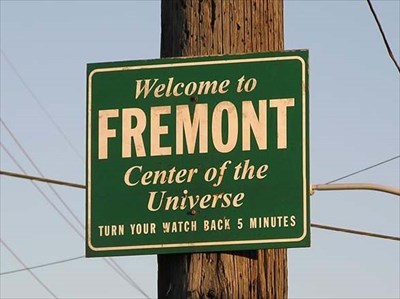
On Fremont

Image result for fremont center of the universe signThe discoveries of astronomy "affirm that Earth is not the center of the Universe."

Actually every point is at the center, modern astronomy postulates.  (C.S. Lewis appeared to recognize, or anticipate, this astronomical insight already in the speeches he gave his heroes at the end of Perelandra).

But physical centrality is itself a mere metaphor for importance.  If you set a baby in her crib in the corner of the room, does that make the stuffed bear she throws out of the crib into the geographical center of the room more important than the child?  The actual center of the Earth is volcanic nickel and iron, not the choicest real estate on the planet.  Nor is the brain at the center of the human body.  Placement does not entail importance.

On Evolutionary Bigots

"By 2005, they had gained enough strength represented in the anonymous peer review system to hinder publication of contrary evidence and opinions in leading journals." (71)

Well fancy that!

When Wilson and two like-minded colleagues published a rebuttal in a 2010 edition of Nature Magazine, the following year 137 biologists signed a response, and Mr. Dawkins suggested hurling Wilson's book against the wall with the usual violence.  Dawkins responded, in Wilson's words, "with the indignant fervor of a true believer." 

Wilson had best be careful, or he will give comfort to Intelligent Designer proponents who have been calling Dawkins and his ilk "fundamentalists" for years, to much scoffing among his fellow skeptics.

On Cool Ants

Humans are limited, Wilson notes, to a narrow range of vision and sound, and miss out on the rich word of chemical smells.  "Ants are possibly the most advanced pheronmenal creatures on earth." (87)  Aside from ten or twenty different pheromes they use, the meaning of those scents further depends on dose, combinations, and context -- creating an entire chemical language.

Wilson then proffers a full chapter on ants, and why humans should respect but not copy them. ("Admire their stripes but avoid their claws" as Chesterton said of tigers.)

On Clever Microbes

He then praises the flexibility of microbes.  Life arose quickly after the Earth had cooled a bit, and microbes have learned to thrive in diverse biomes.  Wilson suggests this proves that life could arise easily elsewhere.  But the adaptive power of DNA is not relevant to how easily DNA-based life could first arise, anymore than the many uses computers can be put suggests they can be casually manufactured.  That life arose quickly is at best very weak evidence that chance creates life easily, since we do not know that chance created it this time, and it may be that (from an anthropic perspective) microbes required billions of years to build up soil and to fix minerals, so if they had NOT arisen quickly, we would never know our loss.

On ET

Image result for spock
Watch out for those fingertips
Wilson's chapter on ET offers fascinating speculation - he lives on land, depends on eyes and ears like us, has sensitive fingertips.  Wilson is here conspiring with physicists and astronomers to pour cold beer over the bar scene in Star Wars, indeed on most space fiction in general.  Even if we could travel between planets, which is highly unlikely, when we got to an occupied one, not only would the locals not speak English and fall in love with Captain Kirk, their microbes would kill him and all the crew almost immediately, as in War of the Worlds.

Wilson is not satisfied with being a second second Adam (by naming the animals) or a new and better Solomon (considering the ants), he also takes up Noah's cause of saving our fellow earthlings.  While I doubt climate change alone has driven anything extinct, generally speaking Wilson adopts a lofty air, writes eloquently and insightfully on the environment.  "We alone among all species have grasped the reality of the living world, seen the beauty of nature, and given value to the individual.  We alone have measured the quality of mercy among our own kind." (132) Wilson is a genius at describing nature, but can be a darn good preacher, too.

Unlike Adam, Solomon, Noah, Pascal, or Moses, Francis Bacon is not only echoed by Wilson, he is named as among Wilson's heroes, indeed a whole chapter nods to Bacon by being entitled "Idols of the Mind."

"Some writers have tried to deconstruct human nature into non-existence.  But it is real, tangible, and a process that exists in the structures of the brain." (141)

On Music

"Our loving devotion to (music) has been hard-wired by evolution in the human brain." (147)

Odd, that evolution would choose just one species to do this with (birds do not chirp just for fun, nor compose), and that so recently.

On Religion

"A religious instinct does indeed exist." (148)

Yes.  So do angels. 

"The brain was made four religion and religion for the human brain." (150) 

Here Wilson should be cited at length, to get a feeling for both sides of his insight:

"The great religions "perform services invaluable to civilization.  Their priests bring solemnity to the rites of passage through the cycle of life and death  They sacralize the basic tenets of civil and moral law, comfort the afflicted, and take care of the desperately poor.  Inspired by their example, followers strive to be righteous in the sight of man and God.  The churches over which they preside are centers of community life.  When all else fails, these sacred places, where God dwells imminent on Earth, because ultimate refuges against the iniquities and trajedies of secular life.  They and their ministers make more bearable tyranny, war, starvation, and the worst of natural catastrophes." 

However:

"The great religions are also, and tragically, sources of ceaseless and unnecessary suffering  They are impediments to the grasp of reality needed to solve most social problems in the real world.  Their exquisitely human flaw is tribalism.  The instinctual force of tribalism in the genesis of religiosity is far stronger than the yearning for spirituality . . . It is tribalism, not the moral tenets and humanitarian thought of pure religion, that makes good people do bad things."

While there is much truth, there is also much confusion in this second paragraph.

Does "pure religion" have moral tenets and humanitarianism?  Wilson observes humans so more cavalierly and simplistically than ants.  Were the Aztecs not religious?  Their religion was not humane.  Why assume that all religions or "great religions" (which means "big") are equally human in their pure form?  That is simply to toss aside the scientist's curiosity, the empirical call of Bacon which always results in empirical differentiation, and escape hard reasoning and the inevitable complexity of any set of concrete realities, by positing a silly equivalence.

God is not the center of "pure" Buddhism, anymore than the Aztecs were driven by humanity.  And tribalism, Wilson has already pointed out, was a force upward in evolution.  And was the Good Samaritan told by a mere tribal leader?  Or Mozi's (let me paraphrase) "God is love, so man ought to model his own actions on the love of God?")

But Wilson has a theory, and ignores such complications.  Religions define themselves by their creation stories, "the supernatural narrative that explains how humans came into existence."  (Actually, they often do no such thing.) "The core belief assures its members that God favors them above all others."  "There is no way around the soul-satisfying but cruel discrimination that organized religions by definition must practice among themselves.  I doubt there ever has been an imam who suggested that his followers try Roman Catholicism or a  priest who urged the reverse." (151)

Actually, there have been, but like Wilson, they were mostly heretics.  And the reason is one Wilson, of all people, should understand.

We Christians believe that Christianity is true, as Wilson believes materialism is true.  He does not advise people to believe what he thinks to be a lie.  Why should he?  Neither do we.  This is not "cruel" or "soul-destroying" (and Wilson does not believe in the soul anyway-- has he forgotten?) -- it means treating other people with the dignity that allows one to say, "You are wrong."

Wilson says philosophy is on the endangered list, thanks to the insights of science.  Of course the truth is, this is itself largely a book of philosophy.  Though to give Wilson credit, if that's all the better modern, science-fed teachers can do when it comes to philosophy, maybe it is, indeed, in danger of going extinct.

But I like Wilson.  He is a graceful, intelligent writer, and seems a graceful and likable gentleman.  One can learn a lot from him -- including many insights that his Christian and pagan forebears announced centuries ago.   He tries to weave the wisdom he has "discovered" into a comprehensive evolutionary narrative, leaving out far too much of human experience -- miracles, for instance, and answered prayer, and the revelation of God.  (Not to mention freedom, and truth, and a genuine choice between right and wrong.)   But his instinct is sound.  We do need to tell a story, one which embraces the truths Wilson has noticed, and those he has overlooked.

I believe the Gospel does that, better than anything else.  Nothing in this book works to change my mind.  

Wednesday, March 30, 2016

The Descent of Jesus Criticism

Ours is an age of demogogues in both politics and scholarship.  What counts in a media-saturated era, which has lost patience for substantial debate, and has been infantalized by pop culture, is the sound bite, the crudely startling meme.  Thus a man with no accomplishments, a left-wing ideologue who beats up on America's allies and kisses up to her enemies, is elected to the presidency twice, despite the utter failure of his policies.  But he possesses a voice of smooth modulation and pitch, and speaks with confident, "coolly" derisive tones.  The scum rises to the top on the other side of the aisle now, with a demogogue who (among an endess list of taudry untruths) falsely accuses the former president of his own party of deliberately lying to get us into a war with Iraq -- without a hint of evidence to back up that accusation.  Such antics have put him at the top of the polls. 

Jesus Skepticism has followed a similar downward path of devolution, enabled by Internet memes and self-publishing, along with the sheer bravado and emotional power of the empty bluff. 

The Jesus Seminar was bad enough.  As I showed in my 2005 book, Why the Jesus Seminar can't find Jesus, and Grandma Marshall Could, the scholars who constituted that colloquium committed twelve systematic errors which degraded their scholarship.  They also overlooked numerous qualities in the gospels that make them historically-persuasive texts.  Still, the work of Funk, Crossan, and Borg (less Mack) contained a great deal of value, too: recognition and a keen description of Jesus' spirit of celebration, his fondness for people on the margins, the background of social revolution and oppression in the Roman Empire, even Borg's concept of a "spirit person."  Such scholars were grossly mistaken on many counts, and subject to systematic blindness, but still, they were largely serious men and women who while they misplaced the historical Jesus, did find traces of his footprints in the sand along the Sea of Galilee. 

Then Richard Carrier came along, an Internet sensation and a self-published author.  Carrier earned a doctorate in the History of Ancient Science from Columbia, and talked an academic publisher into printing his twin works on the historical Jesus.  As Machen predicted long ago, liberal scholarship was bound to give rise to extreme skepticism -- the Jesus of the Gospels is simply too much for atheists to take even in small doses.  Carrier thus overlooked not the elephant in the room, but a whole thundering herd of elephants of fulsome evidence within the gospels, in his determination to overthrow the scholarly belief that Jesus was a real person, if nothing else. 

Carrier is at least intelligent and well-read.  His thesis seems, however, to depend on his readers never picking up the books he refers to, because they often simply do not say what he represents them as saying.  His work is perfect for an Internet Age, an age in which original texts are widely available, but few are bothered to read them.  Thus today a lie gets all the way around the world (not just half-ways, as before) while truth is putting her boots on. 

Reza Aslan then wrote the Number One Best-Seller in America, a hatchet-job on Jesus that revealed the "best-selling scholar" not as merely a rookie, but as a phony.  Aslan claimed to have done 20 years of research on the historical Jesus, though there was little evidence of any previous work from him on the subject.  Aslan showed that he didn't even know that the Sea of Galilee was made of fresh water -- among other remarkable whoppers in his best-selling book.

Still, Aslan can at least play a serious scholar on TV.

Yet another step down this slope is Matthew Ferguson, whose scholarly failings I have chronicled here and here.  Even worse was Raphael Lataster.  These young men are graduate students who seem to be learning wrong lessons about scholarship, from the wrong people.  Ferguson compares the Gospels to an obscure work called The Contest of Hesiod and Homer -- an embarrassing and silly comparison, which I skewered here.  In the process of implying that The Contest is a more credible work of history, Ferguson fails to so much as mention that the work was written most of a millennium after the "facts," or that unlike the Gospels, it doesn't even pretend to be historical!  Failing to mention two such game-changing facts is scholarly malpractice of the highest order.  Not to mention dozens of other differences between the Gospels and The Contest which demonstrate why the former are believable and the latter are not -- including some which even members of the Jesus Seminar recognize.  But my most basic criticism of Ferguson is that, for all his study, including in Greek and Latin, he does not seem yet to have really learned how to read and understand what he is reading well

Ferguson at least seems to me to show more intellectual promise than Lataster.  In my critique, I therefore spoke at times as a teacher correcting an errant younger scholar.  Ferguson seemed offended by my tone, no doubt feeling that I was striking an artificial posture.  But as an experienced teacher, I do see the immaturity of Ferguson's work, as well as his potential.  So this was no mere rhetorical posture: were he to learn from the criticism I offered, I believe Ferguson could become a better and more potent critic.   

I saw much less potential in Raphael Lataster's first book, self-published and crude to an extreme degree, but shockingly popular. I don't think I found a single impressive English sentence in the entire book -- or as much as I could stand to read of it.  Even his footnotes were a mess.  His thesis was repudiated emphatically by his own professor.  Yet he managed to get published on the Washington Post website. 

The decent continues, unimpeded it seems by any self-critical sense on the skeptical side. 

A couple weeks ago, I posted a somewhat slap-dash critique of one R Carmona, who posts on a blog called Academic Atheist.    Despite the title of his blog, R. Carmona, an undergraduate student aiming to go on to graduate studies, did not appear in the post to which I responded to have done much if any original research on the historical Jesus.  There was little sign that Carmona had read much ancient material for himself.  I found no original thesis or carefully thought-out methodology.  Rather, Carmona had scanned Ferguson's blog, and taken his arguments as "gospel." as they say.  (Along with some readings, again, from Carrier.) 

Carmona's biggest error was to describe his site as "academic," yet parrot the work of immature, untested, and fringe "scholars" with barely a trace of critical inquiry. 

In short, Carmona wrote an old-style, pre-reform SAT essay, which I am trying to teach my 17 year old students to grow beyond.  He cited two marginal and unproven scholars who think, like Trump, that because they stand outside the "establishment," their motives must be pure, and they alone have found the truth.  He offered a thesis and some slap-dash "evidence" to support it, without worrying about opposing arguments or evidence that might undermine that thesis.  Attack the right enemy with sound-bites that sound good, and the merest patina of what looks at a glance vaguely like scholarship, and many young fools predisposed to your biases seem eager to buy your thesis hook, line, and sinker. 

Real scholarship addresses boldly and fairly the best in opposing positions.  It seeks truth in work that is not personally amenable.  It tests one's thesis not with ad hoc observations, but with an objective and pre-determined set of criteria.  (As I did in critiquing Carrier and Ferguson -- my criteria for doing so were published already in 2005, long before I had heard of either gentleman.  I took on the best of liberal scholarship in doing so, and respectfully pointed out what seemed valuable in the work of Borg, Funk, and Crossan, as well as what I saw as mistaken.)

So I posted 47 criticisms of Carmona's argument on this site several weeks ago. 

Carmona responded at first with outrage.  He began with an obscenity and by misunderstanding my interest in Matthew Ferguson's on-line articles. 

Now he has posted a longer rebuttal, gentler in tone but of little more value in substance. 

I will not pretend to treat Carmona as a debate partner.  He is even younger that Ferguson or Lataster, and looking at his "arguments," I don't find any that are intellectually interesting, still less represent an educational challenge.   He seems to be under the silly impression, for instance, that "arguments from authority" are logically fallacious or inappropriate, a bias that would prove deadly to scholarship in general (and to the Law, not to mention Medicine, and therefore to patients) were it to be accepted.   ("What do you mean, Dr. Crockpuss says I have malaria?   Don't you know it is a logical fallacy to appeal to authorities?") 

Carmona attempts to answer, it appears, even one of my points, without admitting anything or learning anything.  I have no intention of going over them all again.  But I do wish to point to five comments that illustration this general trend.  It is not that Carmona is stupid (as I am afraid Lataster may be), but that atheism has taught him to be arrogant, to assume that his status as a "bright" makes up for his palpable ignorance and lack of skill -- neither of which would be unbecoming in a student, were it not for that error-forcing arrogance. 

(1) Carmona insists, after reading my demurral, that "If the Gospels are shown to be historically reliable, this does not imply that Jesus, as depicted in the Gospels, is historical."

Of course it does.  If Arrian's account of the death of Alexander is historically-reliable, then it does follow that Alexander's death, as depicted by Arrian, is historical.  In fact, this is a tautology, and it is hard to know what Carmona means by denying it.  He doesn't explain.

(2) I say "there is a great deal of evidence (see Bauckham, Jesus and the Eyewitnesses, and just wait for my new book!) that the gospels DO present eyewitness accounts."

Carmona responds at length:

"What evidence? Give me something to field, something to consider. What are his arguments? How does he support them? Does he engage with scholars who disagree with him? This is essentially a Courtier Reply. This is the same thing John Loftus called you out about. You claim to have read so much and yet you never prove to have any understanding of what you read–even in cases like this one where an understanding of your sources would help to strengthen your presentation. This just looks as though you’re citing Bauckham because the title of his book agrees with your view. It adds no force to your “rebuttal.” Also, there’s no need for self-promotion here. If your book is that great, let it speak for itself when it is published.

"I’m sure Christians think the consensus says otherwise, since many of them seem to have done nothing but indulge their confirmation bias and read what conservative Christian scholars have had to say about this matter. Like the evangelists and first readers, these scholars want to confirm the Christian faith. They never intended to conduct honest research."

How tedious, and how utterly childish. 

I am briefly listing 47 errors in Carmona's article in an informal blog post, between more important projects.  I am not going to spend the time to prove every point I offer: I have better things to do with my time.  But what I say here is true, and it is Carmona's thus-far rudimentary education alone that makes my comment appear false to him. 

Carmona claimed that "the gospels do not present eyewitness accounts" of Jesus' life.  That is a shoddy claim, because it fails to take into account or deal with an extensive work by a major scholar that has won plaudits from (and seems to have convinced) other leading scholars, arguing with a great force of evidence to the contrary.  Mature scholars don't or shouldn't make such glib remarks.  If their claims are contested by leading scholars like that, they should deal with or at least admit the controversy. 

I am not obliged to prove Bauckham's point, to show that Carmona is writing carelessly.  If Carmona wants to know what Bauckham argues -- and he should, if he deigns to write on this subject -- he should read his book, as of course I have, despite Carmona's sleazy insinuation that I merely "claim" to "have read so much" without having any real understanding, and throw out a helpful-sounding title to support my case. 

Indeed, if Carmona were more careful (a scholarly virtue) and did a few moments worth of research (research for scholars is fun, like eating almonds mixed with chocolate for other people), he would have found that exactly four years ago, I reviewed Jesus and the Eyewitnesses on Amazon in enough detail to demonstrate that I had actually read the book.  (Winning, so far, 14 out of 14 "helpful" votes from other readers, one of whom posted to say he bought the book on my recommendation, and found my representation of it accurate.)  So Carmona's snide insinuations about my lazily citing a book I probably had not read because I liked its title, only suggests that Mr. Carmona is himself at present something of a lazy fool.  (A combination of conditions which I sincerely hope he overcomes.  I wish the best to his teachers!) 

Again, Carmona sleazily accuses "these scholars," apparently including me, of never even "intending" to conduct "honest research," which apparently (the boundaries of the accusation are puffy) means we Christians generally don't read opposing points of view.

Yet I met "Carmona" on John Loftus' blog.  John complains not that I don't read his books, but that I do, and post devastating (not that he uses that word) reviews of them on Amazon.  He even tried to "buy me off" by offering to delete one of his reviews of my books, if I would delete my review of his new book. 

The claim that I "never prove to have any understanding of what  I read" is just more childish nonsense.  My reviews on Amazon, largely critical reviews of some of the most important books by writers of many persuasions (including numerous atheists), have received some 13,000 "helpful" votes so far.  Reviews of my books by informed scholars have gone out of their way to say that I describe opposing positions fairly -- even Loftus has admitted that, once or twice.  (While, admittedly, saying the opposite at other times.) 

(3) "Curiously enough, you allude to something important: “they were written when Christians were persecuted.”  That says much about their allegorical style.  Also, your insight meshes better with the idea me and Matthew endorse, namely that the Gospels were written to confirm Christian faith.  More specifically, they were written as means of communication between believers and not as histories to be passed down the centuries."

This is how scholarship goes downhill.   Ferguson may think that a book written during a persecution is likely to be "allegorical:" I haven't seen that particular argument, but I have seen many of a similar confused nature from him.  Allegory is a genre, which can be written under any set of political circumstances: C. S. Lewis' Pilgrim's Regress, for instance, was written in England between the wars, when Christians were not persecuted severely.   But Carmona has picked up some claim of a link between the literary genre and the political condition from Ferguson, it seems, and forgotten that he needs to at least explain, if not defend, this rather magical and not-at-all-obvious link.

Young scholars often make that mistake: they forget that their readers can't read their minds, and don't see the links they think they recognize as self-evident. 

The gospels obviously are not "allegorical."  As an authority on allegory (yes, this is an appeal to authority), Lewis scoffed at that absurd claim.  But wide reading in various genres will affirm (for those who undertake it) Lewis' point.  Read Pilgrim's Progress, or Regress, and then the gospels, and most minimally-literate people can recognize the mountainous differences between these genres.

Ferguson compares the gospels to "histories," but that is his error.  Scholars often now describe the gospels as bioi, or Greek biographies, not as histories.  Of course they were written to confirm the Christian faith: they are public depositions, as they say themselves.  The fact that someone writes to say something is true, obviously does not by itself imply that it is not true. 
 
(4) Now notice this sneaky little gambit.  First, Carmona quotes Matthew Ferguson:
The mainstream scholarly view is that the Gospels are anonymous works, written in a different language than that of Jesus, in distant lands, after a substantial gap of time, by unknown persons, compiling, redacting, and inventing various traditions in order to provide a narrative of Christianity’s central figure, Jesus Christ, to confirm the faith of their communities.
Then he says in his own words:

"Even conservative scholars like Craig Blomberg accept this conclusion, so if you’re the type of Christian to bypass that and say the Gospels were written by Matthew, Mark, Luke, and John, you might as well continue in your delusions."

I expressed my doubts about this quote:

"What, the author of The Historical Reliability of the Gospels, and The Historical Reliability of John?  I think Blomberg's true views are being misrepresented here. A direct quote would help."

Carmona now provides such a quote:

Craig Blomberg states:

“It’s important to acknowledge that strictly speaking, the gospels are anonymous.” Strobel’s The Case for Christ (p.22)

This is the sort of game I hope this young man will learn not to play, so the world can have another honest scholar, rather than another cheap trickster. 

What does "this conclusion" in his first line in blue above refer to?  That the gospels are anonymous?  That their anonymity is widely accepted?  Or that the gospels were written "in distant lands" after a "substantial gap in time" and all the rest that lies in the paragraph after the claim to anonymity? 

Carmona doesn't seem to realize that the most likely referent for his claim about Blomberg's opinion is not the first claim in the prior paragraph, but the whole bloody paragraph.  And the quote he now offers in no way even begins to support that whole paragraph as something Blomberg would accede to. 

Carmona also doesn't seem to recognize the relevance here of Bauckham's demonstration that the gospels used exactly those names archeology shows were most frequently in use in Palestine during the time of Jesus, with remarkably exact coincidence in frequency.  He shrugs that fact off elsewhere in his "rebuttal," arguing (in effect, not an exact quote), "that just shows that people were using those names at that time."  But if the gospels were written in other languages, as he (and Ehrman, for instance) claim, and in lands distant from that in which Jesus lived, why would these fifth or tenth generation copyists manage to reproduce the exact same NAMES used in 1st Century Palestine among Jews of that time and place, in almost precise mathematical frequency? 

The whole scenario goes up in smoke.  Clearly, the gospels were closer to the facts than either Ehrman or Carmona insinuate. 

And (having read and had interaction with him), I think Blomberg agrees with that fully.

Carmona should also know that "strictly speaking" implies even by itself that Blomberg does not think the gospels really are anonymous in a less-strict sense.  If Carmona wants to be a scholar, he should get in the habit of representing opposing views accurately, and not quote-mining and ignoring what Blomberg says next . . . and what is that?  Come on, man, be honest even if you DON'T keep on calling yourself a scholar.  Cite sources fairly and in context.   What did Blomberg say next?  And read my criticism the same way, not culling one early sentence out of the full paragraph to which Blomberg's comment would most naturally refer.

That is what happens when young pups rely on other young pups like Matt Ferguson, who themselves rely on the likes of not-quite-so-young-anymore pups like Richard Carrier, who perceive themselves as radical rebels against an already radical status quo represented by sloppy liberal scholars like Bart Erhman and the Jesus Seminar. 

None of these men need be fools.  But all of them, IMO, need at this point to take active steps to arrest their slide into the mire, the feet of one pushing the back of the next and sending the whole troop cavorting down the slope into intellectual (at least) ruin. 

Tuesday, January 12, 2016

A Secularist Manifesto for Biblical Scholars

Have you ever noticed how Religious Studies programs in secular universities have become a villainous hive of wanton religiosity and pro-Christian propaganda?  No?  Well, Hector Avalos and Andre Gague have.   And they're mad as heck and decided they can't stand it any longerSo they've written a manifesto.  It's not as pithy as the Communist Manifesto.  And that's not the only evidence that Avalos and Gagne have forgotten what really happens when society decides to show nothing but contempt for "religion." 

Wednesday, December 02, 2015

Hamlet in China: why we all need critics.

Somewhere in this neighborhood.
A week or so ago, I visited the southern Chinese city of Shenzhen.  This is the most important of those new cities that have sprung up between Hong Kong and Canton (Guangzhou), that with the latter older cities together constitute the densest and largest urban conglomerate on the planet.  Some 50 million people live in these cities: Hong Kong, Shenzhen, and Canton EACH have the population of New York City or so. 

I found a chain hotel a few minutes walk from the border, and stood behind a woman who wanted to get a discount or change rooms.  The clerk was polite, but the customer didn't get what she wanted, and started complaining.  "Everything is bad here!  The elevator is slow, there are no restaurants nearby -- everything is really bad." 

Actually, I was pleasantly surprised to find so reasonable a hotel in such a choice spot.  True, the elevator was like molasses.  But the staff was courteous and eager to help, the place was clean, and it only cost $30 a night.  Furthermore, not only were there some cheap eats -- Muslim noodles, Hunanese, soups and dumplings -- a five minute walk down the road, walking in the other direction, I found myself in the center of a very fashionable and attractive neighborhood, with lights pulsating on a 70 story skyscraper, and all sorts of shops, if that's what you like. 

"Nothing is good or bad, but thinking makes it so," said Hamlet.  His complaint was weightier than that of the woman in front on me in line: his uncle had murdered his father and shacked up with his mother.  So being Prince of Denmark, while attractive from the outside, proved not to be all it might appear from the outside. 

"I could be bounded in a nutshell, and count myself a king of infinite space, were it not that I have bad dreams."

Especially, of course, after his father visited him and his friends as a ghost, and demanded revenge. 

The next day I came across someone who was having good or at least happy dreams, and was not bound within his nutshell. 

I asked a taxi driver to take me to the nearest church, it being Sunday.  I knew there was a white one on a hill -- I'd been there before.  He mentioned a neighborhood, and it sounded vaguely familiar --- it had been five or six years -- and off we set. 

The driver seemed delighted to find an American who spoke Chinese.  He was from Henan Province to the north.  His fondest hope seemed to be to argue with an American about world politics. 

How lucky he got me. 

I obliged him, and we both enjoyed the fifteen minute trip to the church.  When the argument over the relative merits of our general national policies grew vehement, twice he stopped, worried that I was growing angry.  "No, I'm enjoying our chat," I told him, assuring him that I didn't take his criticism personally.  When he stopped, I got out of the cab, shook his hand, paid my fair, and said goodbye. 

What troubled me about the conversation was not the driver's patriotism.  As I told him, I believe a person should love their country.  Nor exactly that he seemed to buy into all the standard communist propaganda.  He did say, "China is a peaceloving country," but couldn't help but add, "You might win in the short run, because you have better weapons, but we have studied the art of war for much longer." (But who wants a war?  I actually had to ask that myself -- usually even the most strident Chinese patriot make it clear that conflict with the US is the last thing on their minds.)

I was troubled by the driver's insistence that he was not simply parroting the Official Line.  "You think we are brainwashed!  But I got these ideas myself, from reading books."  And he did, indeed, seem pretty well-informed, but what books had he read?  Any that challenged his assumptions?  Apparently not. 

But what really concerned me about our conversation was when I asked,

"Do you really think China never is to blame for anything?  It's always the other country's fault?  When you have a war with India, it's India's fault.  When you dispute islands with the Phillipines, it's entirely their fault.  You put the world's worst tyrants into power in North Korea, and that's America's fault?" 

The driver replied, "Yes."   He seriously maintained that China really is never to blame.  Chinese are peace-loving, and he could prove that each and every time China had a conflict -- and it has had plenty of them over the past 70 years, with almost every neighbor -- it is the other guy's fault. 

In other words,

"Nothing is good or bad, but thinking makes it so." 

I just went through the Genesis story of Adam and Eve with my first-year students, in which Adam blames Eve, and Eve blames the snake.  (The serpent probably blamed his genes, or God for creating him.) 

These two anecdotes are part of a larger trend that includes you and I.  Atheists call it "confirmation bias," but then almost never notice their own.  Another word for it is "cherry-picking," or in the case of Christ-mythicism, "parallelmania."  It is the picking and twisting and spinning of data to confirm those beliefs that have become close to your heart. 

This is why propaganda is a community activity.  As Jacques Ellul pointed out, propaganda always appeals to values, or "myths," that the community already has its heart set on: "Democracy," "Science," "Socialism," "Peace," "Equality."  'Grace" and "Faith" might qualify for Christians.  And then you can sell it anything, even the opposite of what those words normally mean, because in a sense, the community, the individual, is selling the package to himself.  That's because self-deification has become a collective activity.  To the extent "China" -- or "America," or "Christianity," "the Seattle Seahawks," or any other group identity -- is our god, we make ourselves into the incarnation of that god, and an attack on it is an attack on our own egos.  Which we will fight to the death to defend. 

This is one reason the doctrine of sin and of human corruption is so liberating -- because it confronts us with our own duplicity. 

And this is one reason I DO thank God for the New Atheists, and for other critics.   We need them, as they need us. 

This is one of several reasons that, when asked who our favorite "apologists" were, I wrote:
"Personally, I appreciate John Loftus, Richard Carrier, Richard Dawkins, David Hume, Sam Harris, Robert Funk, Marcus Borg, John Crossan, Carl Sagan EO Wilson, Elaine Pagels, Reza Aslan, Greta Christiana, Celsus, Philostratus, Matthew Fergusen, Bart Ehrman, Phil Zuckerman, Dan Brown, Dan Dennett, Christopher Hitchens, Steven Law, Robert Price, John Hick, and other apologists of that stripe. Don't know what I'd do without them."

And this is also one reason why, while I am not sure about evolution and creation scientifically, Genesis is one of my favorite books in the Bible.