Pages

Showing posts with label politics. Show all posts

Tuesday, January 20, 2026

What is a True Progressive?

Adapted from an article originally published at The Stream on September 8, 2021. 


What does it mean to be progressive? Language is a game people play. If every game requires agreed rules (and it does), then every word requires agreed meaning. Definitions are the first step to rational thinking and action.  

Take dueling, for example. Shall we meet at sunrise, or sunset? Shall we bring seconds? Will we fight by pistols? Swords? Light sabers? Who gets to shoot first?

A duel without common language rules becomes a mere cat fight — or less. If you say, “Let’s meet on an island in the Volga River at sunrise,” and your opponent thinks of a river in Russia, but you have in mind a river in Brazil, the joust will not come off. When words lack agreed meaning, we may clash like rutting elk or we may miss by the width of a continent. One can't even fight intellectually without the common ground of clear definitions. 


Confusion Over “Progressive”

This is why many quarrels about religion and politics are mere “dust in the wind.” Poorly-defined words lodge in the eyes and obscure the vision: “faith,” “science,” “democracy,” “socialism,” and of course, “racism.” These words means such different things to different people, our rhetorical ships do not merely pass in the night, they float on different oceans. Except when carefully defined (see for example J. Budziszewski on the dangers of “liberalism” and “conservatism”) our buzz-words usually stir more emotion than thought.

The duel of our times is being fought, and it is over the meaning of progress: where we should go, and whether, having arrived there, we shall still be fully human.

Perhaps no word is more confusing today than “progressive.” It sounds lovely: Who doesn’t want a future that is better than the past? Wait a minute, though: What does “better” mean? Once it was “progressive” to save girls from infanticide. Then a new “progressive” catechism made it a sacred right to kill babies up to the moment of birth. In 1965, “progressives” stood boldly against segregating based on race or discriminating based on skin color. Now some who claim that label put blacks and whites in different classrooms, and select students or employees by how much light their epidermis reflects.


In Which Direction Is “Progress”?

“Progress” means forward motion. It is the opposite of “regress,” and perpendicular to “digress.”

Was Odysseus sailing towards
the sirens a "progressive?" 

Once again, though, to go forward begs several questions. Where are you standing? Which direction are you facing? What will you find that way? What is your goal? What islands, currents, storms, or pirate ships stand between?

 Would Odysseus be “progressive” to head toward the sirens where he yearned to go, or on to the next island? C.S. Lewis pointed out that if one has taken a wrong turn, the quickest way to get ahead is to go back.

“Getting ahead” requires a map and compass so we know which direction is truly ahead. Suppose we map “progress” on a cosmic scale, say, by watching the Andromeda and the Milky Way galaxies collide, and see what that can teach us about contemporary politics?


Progress Toward Chaos?

Some physicists say the ultimate end of the universe will be “heat death.” All material objects will finally turn into a cold porridge of protons and leptons, reaching a state of “thermodynamic equilibrium” after the largest black holes finally decay.

In what direction are “progressives” taking us, then? “Movement towards ultimate chaos,” maybe? Notice the mile markers they’re passing on their route:

Toppled statues? Check.

Graffiti on walls? Check.

Tents, syringes, and human waste on major city sidewalks? Check.

Anarchy in the streets? Shootings? Coyotes without borders? COVID-laden cough particles scattering through ICE facilities?

How about crowds in Afghan airports scattering as bombs explode?

“Now that one’s unfair!” You complain. “We do not call it ‘progress’ when an army that locks women indoors and carries out executions in soccer fields conquers a country. This isn’t moving forward, it’s religious kooks, an Afghan Moral Majority, dragging us back to 7th Century theocracy!  So no, this is the furthest thing from true progressivism!”

Or does saying that make you an "Islamophobe?" 


Who Says Islam Isn’t Progressive?

Black was the dress code in both Kandahar and downtown Portland.  Progressives and radical Muslims alike decree that only people with pure thoughts should speak.  They merely differ over who should get the mic. If you recall Lewis’ comment about turning around after a wrong turn, the Taliban might claim to be better progressives than Alexandria Ocasio-Cortez.

“Backtrack to 6th Century Arabia, and we can find the true stairway to heaven!” say the Afghanis. This is a coherent idea, if not a good one.

Western “progressives,” lacking a sacred Scripture, are more muddled in their thinking. “Go forward!” They say.  But the direction they deem "forward" keeps changing, and they spin blindly in a fog of changing fads, from Marxism to liberalism, environmentalism to Woke ideology to such fear of "racism" and "Islamophobia" that they are afraid to object to Somali scams or Pakistani grooming gangs.  

One cannot progress, said Chesterton, if one’s goals keep on changing.

If degrading the most intricate and productive forms of civilization is “progressive,” then left-wing and Taliban philosophies have more in common than the Left cares to see.


Regress in Both Uniformity and Chaos

One can die of uniformity or of chaos. You may be frozen into a crystal, each molecule in your body lined up in tight rows. Or you may dissolve in chaos, like the T-1000 Terminator in a vat of molten steel. One is the totalitarian clone-like “diversity” of a modern sociology department or of a Chinese Community Party Politburo meeting. The other is South Chicago on a Friday night in summer or the streets outside Kabul’s airport.

Modern progressivism often imposes a sameness of thought like molecules in a crystal, even while breaking social connections into the sludge-like chaos of death. Simple ideologies, whether “forward to the future!” or “back to 7th Century Arabia!” demand conformity. They atomize and isolate us, eroding the fabric of civilization.

Progress? If death is our goal, I’m afraid America has made quite a lot over the past year.


True Progress Echoes Creation

An alternative vision of progress echoes Creation. Quarks unite to become protons and neutrons. Atoms form molecules. Nucleotides, proteins, and DNA make cells, then tissues and organs. Organs, said St. Paul, cooperate to form bodies, each with its unique and valued contribution. Men and women make families. Centers, forwards, and point guards become basketball teams. Farmers, tradesmen, soldiers, and other specialists create a city, said Plato. The Medieval Church invented even higher forms of harmony, unity within diversity, such as contrapuntal music, the great cathedrals, and the university.

“Death, thou shalt die,” said John Donne. Whereas today’s “progressives” often seem to aim toward entropy, from Creation to the Resurrection of Jesus, Christian progress has meant defeating it. The American motto, “Out of many, one” (E Pluribus Unum) spits in the eyes of chaos and conformity alike. Diversity in creative harmony is the form of progress on which western civilization was founded.

Followers of Jesus may thus call ourselves true progressives. We have a Guide who does not change, and the unity we seek is not “equity,” a sludge of conformity, but the oneness of organs within a living body.

The duel of our times is being fought, and it is over the meaning of progress: where we should go, and whether, having arrived there, we shall still be fully human.

The myth as I’ve read it has them sailing right on by, with Odysseus lashed to the mast, and his shipmates protected by earplugs. They didn’t turn around.


Wednesday, December 10, 2025

Europe vs. America


Everyone seems to be at war with everyone these days.  Certainly this is true in the United States, where conservatives have divided into a million factions and battle daily.  Our president seldom seems happier than when taking a piece out of an old ally.  He is much like Mao Zedong, author of On Contradictions, in that regard. 

America and its old allies in NATO also keep up a feud, or a number of feuds, even as they partly support Ukraine against Russia.  (And North Korea!)  

Charles Cooke, a British immigrant to the United States and an American citizen, just attacked his home continent with great zest in a National Review article entitled "Europe is Delusional."  To be fair, he didn't start this argument.  But he tried to finish it with a beautiful burst of bombast: 

"As a former Brit who enjoys spending time in both France and Italy, I take no particular pleasure in unloading in this manner, but honesty compels it: In its current incarnation, Europe is a poor, corrupt, sclerotic, vampiric open-air museum, and its leadership class is full of priggish, dishonest, supercilious, rent-seeking parasites, whose boundless sense of superiority ought by rights to have vanished in 1901. Europe, in the year 2025, is what a continent would look like if it were run by NPR. It is a librarian in a pair of horn-rimmed spectacles, snobbishly shushing the workers outside. It is a faculty meeting, a Sierra Club protest, a forum for those who believe that words create reality. There is no reason that we in the United States should consent to be lectured by the apologists for such a silly place."

Bravo!  That's the way to roast a continent.  

Much of Cooke's rebuttal to this alleged European attitude has to do with relative wealth: 

"Criticize a European from America and you will immediately be hit with a wall of undeservedly self-righteous disdain . . . At Least We’re Not American — . . .  What about the massive gap in GDP that has opened up between the U.S. and Europe since 2008? At least we’re not American. What about the anemic performance of European companies relative to those in the United States? At least we’re not American. What about the gulf between GDP per capita in Europe and GDP per capita in the United States, or about the U.S.’s great advantages in biotech and energy and advanced semiconductors, or the fact that, if most European countries were to join the U.S., they’d have a lower standard of living than people do in Mississippi, or that the average European is six times more likely to die from a lack of heating or air conditioning than an American is from a gun, or that most European countries are unable to usefully project military power? At least we’re not American."

Let me emphasize the distinction here between rhetoric and reasoning, between Aristotle's Logos and his Pathos, which I often bring up with my students.  

Cookes' essay sizzles.  It burns the grill and everything on it -- from Iberia to the Baltic.  It is smoking hot.  His rant is even better than Richard Dawkins' famous attack on God: "misogynistic, homophobic, racist, infanticidal, megalomaniacal, maliciously malevolent bully."

Bully, indeed. Two cheers for Charles, one and a half for Richard. (I explained why Dawkins' arguments deserve no more in The Truth Behind the New Atheism.)


Charles gets the extra half star for even better rhetoric, and arguably more truth.


But don't let those stars dazzle your eyes.


He says "I take no pleasure in saying this." Hogwash, Charlie. No one could write with such zest and not enjoy it, as we enjoy reading it.


But it is not rationally convincing:


"If most European countries were to join the U.S., they’d have a lower standard of living than people do in Mississippi, or that the average European is six times more likely to die from a lack of heating or air conditioning than an American is from a gun . . . "


And yet Italians, whom he mentions, live 14 years longer than the residents of Mississippi. Despite all that lack of heating or air conditioning.


Isn't a lifespan that includes fourteen extra years worth mentioning?  


Comparisons, they say, are odious. Comparisons that cherry-pick vital facts and ignore those that tell against one's argument -- a common flaw at National Review, and in modern rhetoric in general -- should not be called rationally persuasive. Cooke hits a home run on rhetoric, but weakly grounds to second with logic and cherry-picked factoids.


Life expectancy? Advantage, western Europe, by a mile.


Domestic peace? Low murder rates? Advantage, western Europe, by two miles.


Long vacations? Advantage, again, Europe.


Healthy food? Beautiful architecture? Yes, the latter must be credited to earlier generations, except for a few buildings in Barcelona.


Fighting off the Russian army? Advantage, Ukraine, which last I checked, was a country in Europe.


Who has the less awful politicians? That's a hard one. But see who is in charge in Italy and Poland before you give his Orangeness the nod.


Yes, you can work the data around to the opposite conclusion. Yes, I am also irritated by the common European assumption that America is a racist, half-barbaric nation. And by American liberal sycophants who make the same assumption, backed up with even weaker facts and worse logic.  


The sweetest revenge, though, is to tell the truth, the whole truth, and nothing but the truth, so help you God.


Cooke's rhetoric is sweet. But on logic and evidence, I can't give his essay very high marks.


And I bet, when he goes to bed tonight, he'll admit that to himself.


Ours is an age of sentimental rhetoric.  The art of reasoning seems almost to have been lost.  This may be why ours is becoming an increasingly fractious age as well.  

Wednesday, November 11, 2020

Answer to an angry John Pavlovich


Calling someone "dear" is a letter-writing convention in English.  It does not imply that the recipient of your letter IS dear to you.  Such is certainly not the case with John Pavlovich's "dear White Evangelicals" letter, below.  It was written two  years ago: I hope John has calmed down.  

Let us, at least, respond dispassionately.   


"Dear White Evangelicals,"

"I need to tell you something: People have had it with you."

What, all people everywhere?  With all of "us?"  Aren't we people, too?  What did we do, forget to feed the cat?  

"They’re done.

"They want nothing to do with you any longer:"

Nothing?  Not even writing letters?  

"And here's why.  They see your hypocrisy, your inconsistency, your incredibly selective mercy, and your thinly veiled supremacy."

Wow!  All of us?  Maybe we stepped on the cat's tail!  

"For eight years they watched you relentlessly demonize a black President; a man faithfully married for 26 years; a doting father and husband without a hint of moral scandal or the slightest whiff of infidelity."

I never demonized Barack Obama.  Does that mean I'm not really saved?  Or not really white?  

I see Barack Obama as a human being, not a devil.  Yes, he seems to be a good family man.  I have never questioned that, nor his intelligence or political talent.  

Most of his policies, I soundly reject, like those of all liberals.  I think they are dead wrong, on most issues.  I also didn't care for the way Obama politicized the FBI, which was one of many forms of political corruption he is charged with.  And whenever he spoke about conservative ideas, he unleashed an army of straw men on us.  He is a talented politician, but not that rare thing, an honest one.  


Which is the greater bigot: a person who criticizes a black politician (born to both black and white parents, actually) for policy reasons he can articulate, or a person who accuses "white evangelicals" of all manner of evils, without specifying which ones, when they offended, what precisely they did wrong, and where?  

Bigotry does not depend on race.  

You accuse us of quoting Bible verses. One does, indeed, come to mind, about a man with a log in his eye, offering to do surgery on a man with a speck in his.    

    you never publicly offered prayers for him and his family, you never welcomed him to your Christian Universities, you never gave him the benefit of the doubt in any instance, you never made any effort to affirm his humanity or show the love of Jesus to him in any quantifiable measure."

Pavlovich is dishonest and not very smart, obviously.  Otherwise one might try to explain to him the unique burdens of proof placed upon those who make universal negative claims.  

If I owned a Christian college, I certainly would not welcome a politician who adhered to the policies of Barack Obama to speak to the student body as if I thought they should hear those policies affirmed.  And it is true, I was not very grateful for his leadership, nor for that of Bill Clinton or Joe Biden.  And I doubt Pavlovich is grateful for that of the Bushes or Donald Trump.  (He'll prove that shortly.)    

The president needs mercy?  In the American system, citizens have a right to criticize political leaders.  Barack Obama had the power to grant mercy to whomever he wished.  I have no such power.  Did St. Paul offer "mercy" to Nero?  Not that I'd put Obama in the same category, but this is a strange demand.  The love of Jesus does not require us to affirm immoral policies or people who use power to oppress the weak.  Neither does American democracy demand that we "offer solidarity" with people with whom we wholeheartedly disagree.   


"And yet you give carte blanche to a white Republican man so riddled with depravity, so littered with extramarital affairs, so unapologetically vile, with such a vast resume of moral filth—that the mind boggles."

Here comes the love Pavlovich was talking about. 

As a matter of fact, I wrote an ebook recommending against Trump, in the 2016 primaries.  And my article saying the same went viral on a Christian web site.  So much for "carte blanche."  But clearly this man is far beyond caring whether what he says is TRUE or not.  


"With him, you suddenly find religion.
With him, you’re now willing to offer full absolution.
With him, all is forgiven without repentance or admission.
With him you’re suddenly able to see some invisible, deeply buried heart.

"And White Evangelicals, all those people who have had it with you—they see it all clearly.

"They recognize the toxic source of your inconsistency.

"They see that pigmentation and party are your sole deities."

Odd, then, that you and your allies are always the ones who bring up race.  Your allies are the ones who make fake racial incidents go viral, again and again, as I show in Letter to a 'Racist' Nation.  This is your obsession, not ours. 

The sheer stupidity of this claim, its desperation, is astounding.  We are not only racists, we WORSHIP skin color.  Furthermore, aside from the Republican Party, it is our ONLY god. 

This is a man who cares nothing about truth.  He only wants his rant to sound deep to himself and whoever gets off on listening to such tedious, fact-free, hateful rants.    

"They see that you aren’t interested in perpetuating the love of God or emulating the heart of Jesus.  They see that you aren’t burdened to love the least, or to be agents of compassion, or to care for your Muslim, gay, African, female, or poor neighbors as yourself.  

"And I know you don’t realize it, but you’re digging your own grave in these days; the grave of your very faith tradition."


Three seats on the Supreme Court now, actually, thank you.  And maybe fewer less dead infants, and more fidelity to the US Constitution. 

In that first ebook of mine, like some other evangelicals, I did in fact express concern about what a Trump presidency would do to Christianity in America.  So you're wrong about that, as about everything else -- and I wasn't alone. 

But as citizens, we have a civic obligation to vote for the person who is most likely to do our country good.  I doubt it would have been Hilary Clinton, and I doubt it will be Joe Biden.  

If some people leave the faith because of that judgement, so be it.  That is their decision.  Perhaps fueled by the sort of over-the-top anger you are displaying.    

Anyway, God hasn't died.  Who knows what His plan is?  I know some people have walked away from Him.  No doubt politics had something to do with that.  But it would be immoral to allow oneself to be manipulated by threats into voting for a political party that justifies partial birth abortion.    

"You’ve lost an audience with millions of wise, decent, good-hearted, faithful people with eyes to see this ugliness."

What, wise, decent, good-hearted and faithful like you? 


And you, John, need to grow up and think like an adult.  You should be ashamed of such childish rants.  

Find out what people really think, and why they think it.  

Or maybe you're afraid to.  Maybe your sweeping denunciations, without bothering to ask questions, without bothering to read, without bothering to offer evidence, reflect a deep-seated fear in your own soul.

A fear of what?  At some level of your being, perhaps you know.  See if you are willing to ever knock on that door.    

Wednesday, June 03, 2020

Does History Doom African Americans?

A Facebook friend (JW) offered the following argument about the impact of history upon African-Americans.  He argues that even if America is not overtly racist today, the evils of the past are bound to continue adversely impacting the black community.  This sounds reasonable, at first glance, though I think the argument needs to be made more clear, and ultimately I don't think it explains America's social and ideological problems very well.  

I'll try to clarify six points in JW's comments first, then briefly consider whether historical injustices really do explain modern problems in the African-American community.

If you ask me what right I have to offer my opinion about this subject, well it is my country being trashed right now in the name of racial justice.  So the question is forced upon us all, even if we are not sociologists or African-Americans.  Plus some of these questions are related to the fields of history and inter-cultural understanding on which I may have insights.  The present climate of hysteria and hate in America certain demands critical and fair thinking, especially from Christians.  But I'll try to recognize my limits. 


I. JW's Thought-Experiment

"This is an unsettling thought to consider: some would like to think that the United States doesn't (anymore) have a systemic problem of racism.(1) That is, there may still be some (many?) individuals with racist tendencies or beliefs, (2) but society as a whole is color-blind and each person has the same opportunities and protections as everyone else. (3) 
"But when you consider that racism has been part of American society from the very beginning, when you consider that economics (from the lucrative slave trade to redlining), law (from slave ownership to Jim Crow) and culture (the Lost Cause narrative, public commemoration of slave-holders and Confederate officers,(4) etc.) have all actively created and sustained racism for centuries,(5) you have to ask how likely it is that the systemic problems we face today do not have racist dimensions. (6)
"History leaves its mark. Society today is the product of institutions and events of the past. And in the American case, those institutions and events heavily involved slavery and racism."


II.  Preliminary Problems  

1. Biases.  Let me first question the premise that this line of reasoning is "unsettling."  I suspect it supports rather than upsets the political worldview of the person making this argument.  It also tends to support, for instance, those demanding reparations for slavery, the protesters, the Democratic Party establishment, and even moderate conservatives like George W. Bush.  

The point behind calling this line of reasoning "unsettling" seems to be rhetorical, to predispose the reader to boldly consider the point the writer wishes him to believe.  It is also seems to be implied that opposition to that argument may be emotional and self-serving.  

Which, indeed, it might be.  But biases may lie on both sides, and should be recognized where they lie.   

See the source image
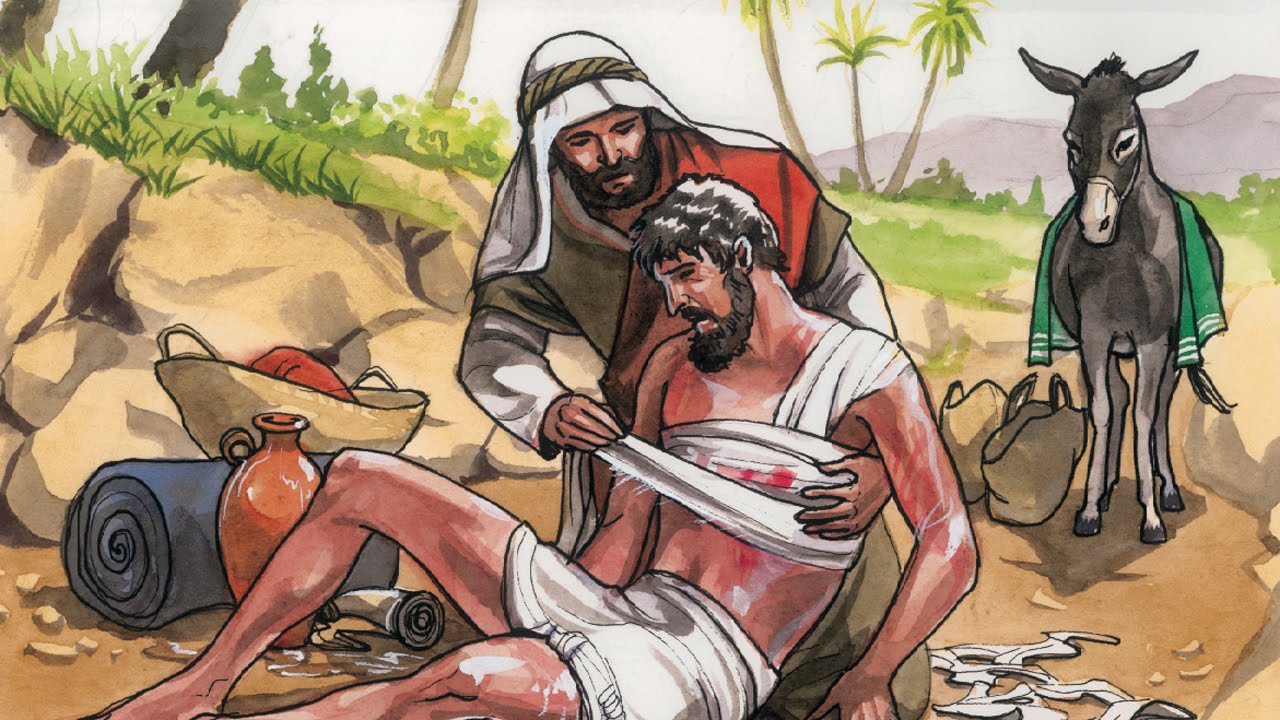
"Who is My Neighbor?"
2. Racism vs. Love.  I also question the assumption, so common that it is not even questioned, that "racism" should be the sole or primary criterion of justice.  (And, perhaps, that racism is how white people see blacks, not how blacks may see Koreans, Irish, or some other group.)  

The present American obsession with the sin of racism strikes me simplistic, dangerous, and sub-Christian.  Jesus told us to "Love God, and love your neighbor as yourself."  It is true, to explain what that meant he gave the example of the Good Samaritan, a person who cared for a stranger of another nation along the side of the road.  

But while it had a racial component, the conflict between Jews and Samaritans seems to have been primarily ideological and cultural rather than racial per se.  One could convert to the God of Israel, have a minor operation (as a male), and become a Jew.  The two groups (related in blood) were at odds, as human groups often are, whether divided by grade, sex, race, neighborhood, natiosn, football team, clan, philosophical school, political party, or any of the hundreds of other ways in which human beings team up and face off.  Jesus' point was clearly broader than any one of those divisions: your neighbor is whoever you meet, regardless how different in any category.  

In addition, "love" here is a concrete act to an individual one meets.  It is not a post on Facebook.  For all we know, at home this Samaritan insulted Jews like Archie Bunker.  Maybe those scornful words were wrong, even "racist," but Jesus didn't talk about them, he talked about how the Samaritan acted.  His point is that his followers are to love those we meet.  While the word "racism" is useful in a few narrow contexts, the term is broad, underdefined, and is most often used much like a brick through a storefront window, to attack the "Other," rather than to think clearly about degrees of good and evil.  

Jesus' vocabulary -- Love God, love your neighbor as yourself -- is far more challenging, covers everyone and every situation, and cannot so easily be used as an excuse for exploiting others or to excuse one's own wrong actions.  I think as Christians we should prefer this richer vocabulary and deeper moral philosophy -- and so should everyone else.  

3.  Color-blind society?  Is it true that "Society as a whole is color-blind and each person has the same opportunities and protections as everyone else?"

I don't think it is.  It seems rather that European and Asian Americans need higher SAT scores to get into top universities, for instance.  That doesn't sound color-blind.  I suspect the same justified racial discrimination occurs in many woke capitalist companies and in Democratic administrations.  

This is a racial injustice which I think America does presently accept, but should not.  

4. Should we remember George Washington?  Thomas Jefferson?  Robert E. Lee?  Plato?  JW appears to think that they should all resign in disgrace from their pedestals in our collective minds, with his comments about "public commemoration of slave-holders and Confederate officers."

I do agree that we should not commemorate anyone who is famous for slave-trading.  And heroes like William Wilberforce and Harriot Beecher Stowe, like those I recognize here, should be remembered warmly for their contributions against slavery.  But it strikes me as fanatical to use this one yardstick alone to measure everyone in the past.  George Washington was a man of his time, nor ours.  He is beloved as the "father of our nation," who led America in war against the world's most powerful nation and won, then helped establish America as a democracy by serving as president for two terms.  If JW thinks we should take his face off the quarter because he owns slaves, that is sad indeed.  Socrates, too, deserves his status in our memories.  The Union armies were not so narrow-minded as to fail to recognize the valor of Robert E Lee, despite his faults, and I see no reason why we should be more narrow-minded than the generation that shed its blood to liberate the slaves.  I fear JW will find few heroes from the past to remember, since aside from Jesus Christ, they were all sinners in one way or another.  And that would be a loss, not only for their memory, but for the assumption that to be heroic, a person needs to be perfect.  

5. Begging the question?  I challenge the word "have" in this sentence, which implies that racism against African-Americans is still a serious problem in America.  That is the matter yet to be proven.  

6. What?  "You have to ask how likely it is that the systemic problems we face today do not have racist dimensions."  I am not sure what it means for a problem to "have racist dimensions."  If it means, "People must be racist today because of past racism," I don't think that follows.  Habits change.  Nations of cannibals do not need to continue eating people.  Nations with slaves can set them free.  

If it means, "America is impacted by the racism of the past," that is no doubt true, but vague and tautological.  All major events of the past impact us in some ways, but often in surprising ways. The British Empire led to the colonization England by Pakistanis, for instance,  

So I am not entirely sure what JW means, still less what he thinks we should do about it.  But whatever we do, we should certainly be moved by the spirit of the Good Samaritan, in seeking the well-being of all whom we are given the chance to help.  On that I'm sure we agree.  

Let's look at the overall question, now.   


II.  Does History Doom African Americans?  

Really there are two or three questions here: sociological, anthropological, and historical. 

First, what problems are African-Americans presently experiencing?  (A)

Second, what would the "natural" state of any given cultural group be, aside from outside oppression?  Can the problems in (A) be explained apart from said historical oppression, in part or in whole? (B)

Third, does past oppression by itself necessarily create such pathologies in a given culture? (C)

Any of these questions could serve as the basis for a dozen quarrelsome doctoral dissertations. I shall be simpler, more obvious, and brief.

A. What problems do African-American experience?  I am not black, so some readers may find it presumptuous of me to try to answer this question.  And, after all, many African-Americans live happy lives, succeeding in their businesses, families, and maybe even finding and expressing the love of God.

Still, this question is assumed in JW's comments, and must be addressed.

While murder rates have come down, there is a high rate of violent crime among young black males, still.  About half the murders in America are committed by blacks, mostly young black males, mostly on other black males.  A lot of this, of course, is what is called "gang-related."

Some 70% of African-American children are born to unwed mothers, last I checked.  Since I believe marriage is vitally important for society, and because lack of a father in the family is terribly harmful to mothers and children, also to fathers themselves, I think that may be the most serious problem in modern African-American (and, increasingly, European-American and Hispanic) societies.

Finally, economists and sociologists will say wages and earnings are lower, while crime, obesity, and early deaths are higher, in the African-American community.

Such is my glib outside overview.  I will not presume to say more, and am open to being educated on this subject by those who know this question from the inside better than I. 


B. What is the natural state of any given culture?  Can the problems in (A) be explained apart from past oppression?  

Cultures around the world vary widely in their attitudes towards violence, marriage, intoxication, pre-marital sex, cuisine (which also impacts health), and every other relevant issue.  Here, for instance, is the murder rate by nation.

The highest murder rates are in Latin America, for instance 52 per 100,000 per year in El Salvador.  Murder rates vary across the Americas, with Mexico at 29, Brazil is 27, the US 5, and Canada 1.76.  Most of these countries contain a mix of nationalities, but Mexico and El Salvador contain few blacks or, I think, historic slaves.  So it is unlikely that a past history of slavery explains those high murder rates. Though one could ascribe it to the later effects of imperialism, Asian countries with very low murder rates were also part of European empires.

Official murder rates in Africa vary wildly, from about one third of the US rate in Malawi and Cameroon, to twice the US rate in Nigeria, and seven times in South Africa.   But overall, the rate of murder in Africa is listed at 12.5 /100,000.   This is much higher than the US rate, but about half of the murder rate among African-Americans, and much lower also than that in Latin America.

Marriage has changed over time.  From 1890 to 1970, both black men and women were more likely to be married than white men and women.  And marriage has fallen out of favor for whites, as well. 

So the breakdown of the African-American family is a new development, evidently not caused by slavery or historical racism.

As for earnings, this, too, varies tremendously among cultures, specifically subcultures in the United States.  By far the richest demographic in America are Indian Americans, with a median household income of more than $132,000 in 2016.  Presumably this is due to an influx of tech engineers. Apparently having dark skin is not too much of a liability for them.  Number three is South Africans, who may be white or black, while 4th, 5th, and 8th are Taiwanese, Filipinos, and Singaporeans, 9th are Iranian-Americans, and tenth are people from Russia.  At the bottom come Somalis, Domincans, Iraqis, Mexicans, Puerto Ricans, Bahamans, Ethiopians, Burmese, and Afghan-Americans.  Family groups at the top earn 2-3 times those near the bottom.

Clearly, a history of slavery or even Jim Crow laws cannot explain these variations.  Even white tribes vary greatly, from Australian Americans at $90,000, to Pennsylania German Americans at little more than half that.   Some figures seem quite random.  But I think if you checked the history of immigration, you would find that, for instance, educated Taiwanese are more likely to immigrate, while Afghans come more often as refugees and are more likely to come from non-professional classes.

There is even a great deal of variety among Native American tribes, from some that are very poor, to others that are doing pretty well.

Look around the world, and you find similar variety in earnings between countries, and between ethnic groups within specific countries.

So it is hard to believe that even in the complete absence of racism, families belonging to different sub-cultures will all earn a closely similar amount of money.  Different cultures emphasize different goods (Ruth Benedict), constructing world views which entail quite different ways of relating to one another, to outsiders, to God, and to the pursuit of worldly goods.

  
C. Does past oppression by itself necessarily create such pathologies in a given culture?  

Clearly not.  And what appears to my outside perspective to be the chief problem in the African-American community, which arguably causes many of the others, the breakdown of the black family, has mostly occurred since the end of Jim Crow laws, and was clearly not caused by them, still less by slavery.

So yes, society is a product of past influences.  But it appears that the worst of those influences is far more recent than slavery, and was sponsored by the ideological Left which blames them on something  called "systemic racism."

I recognize that people of different races in America are not always kind to one another.  We do not always act like the Good Samaritan.  But I agree with Booker T. Washington, and even with Malcolm X, in thinking that in a generally free society (as America is), what we become chiefly depends on what we make of ourselves.  And that is the real challenge for America today.

Let me recommend interested parties read Mona Charen's marvelous and sometimes painful Sex Matters: How Modern Feminism Lost Touch with Science, Love, and Common Sense.  JW is right to look for past effects for the present causes: here, I think, is one of them.  Welfare policy might be another, along with the other patronizing attempts to "help" that really hurt.


No photo description available.