Pages

Showing posts with label C. S. Lewis. Show all posts

Tuesday, May 19, 2026

How the Brothers Grimm Overthrew the Evil Empire

 The following was originally published in Books and Culture, in September / October, 2005. 


How the Brothers Grimm Overthrew the Evil Empire

A fairy tale.


It is rumored that, due to the cumulative effect of small atmospheric variations, downdraft from a butterfly's wings on one side of the world may cause a typhoon on the other. Similarly, Ray Bradbury told how a tourist traveled in time to the Jurassic Era and stepped on a butterfly. He returned to the 20th century to find tyranny had replaced democracy. The Butterfly Effect, as it is called, thus refers to "sensitive dependence on initial conditions," in particular the spell cast by small causes on large events at a distance.

What good is a fairy? In an era when fantasy was under suspicion, Bruno Bettelheim wrote an ingenious and fruitful book with a title, Uses of Enchantment, that justified Tinkerbell in just such utilitarian terms. Bettelheim argued that fairy tales not only entertain, but "enlighten (a child) about himself" and help him "find meaning in life." J. R. R. Tolkien had already pointed out that fairy tales teach children the wonder of simple things. If we lend credence to the Butterfly Effect, we may add a further use of enchantment: Grimm fairy tales helped win the Cold War.

What did Jacob and Wilhelm Grimm have in mind when they gathered, edited, and rewrote their collection of Central European folk tales? Bettelheim hinted at spiritual dynamics beneath his own gently Freudian reading of the Grimms. In The Owl, the Raven, and the Dove: The Religious Meaning of the Grimm's Magic Fairy Tales, Jesuit scholar Ronald Murphy explored those depths.1 Within the gingerbread of beloved tales—"Hansel and Gretel," "Sleeping Beauty," "Little Red Riding Hood"—he detected strangely familiar dogmatic latticework. Most obviously, perhaps, in "Snow White and the Seven Dwarves":

Once it was the middle of winter, and the snowflakes fell from the sky like feathers. At a window with a frame of ebony a queen sat and sewed. And as she sewed and looked out at the snow, she pricked her finger with the needle, and three drops of blood fell in the snow. And in the white snow the red looked so beautiful that she thought to herself: "If only I had a child as white as snow, as red as blood, and as black as the wood in the window frame!" … When the child was born, the queen died.

Snow symbolizes purity, and Snow White the young, innocent but vulnerable soul. The drops of blood from the queen's finger are Trinitarian: her death hints at divine purpose in suffering.

Like a traveler admiring a mountain stream, one can attend to the surface flow of the story or focus on the spiritual bedrock over which it pours. Snow White finds refuge among seven dwarves with seven candles (the church, which exists to warn and protect lost travelers). She undergoes a series of temptations, the first two—"Pretty things for sale!" "Now, for once, I'll comb your hair properly"—appealing to the vanity that ensnared her stepmother. Giving in, she falls down "as if dead," only to be revived by the dwarves. The third temptation involves an apple. Like Eve, Snow White falls, not "as if dead," this time, but "dead, and she remained dead." The dwarves anoint her with water and wine, but cannot revive her. They place her in a glass coffin on a hill, where owl, raven, and dove watch over her still form.

Scanning the Greek New Testament that Wilhelm Grimm read in morning devotions, Murphy found themes from the Grimm fairyland in the passages Wilhelm underlined: "The Spirit of God, divine providence, love of God and of neighbor, faithful confidence, ecumenical acceptance of other faiths, the Resurrection to eternal life."

One passage Wilhelm highlighted was the "Mars Hill" narrative in which Paul quoted Greek poets about a God who transcended culture: "As even some of your poets have said, 'For we are indeed his offspring.'"

At first glance the owl, raven, and dove by Snow White's grave may seem as ornamental—and even more incidental to the story—as Flower the skunk to Bambi or the English sheep dog to Disney's Little Mermaid. But in fact their presence carries deep theological meaning. By them, the Grimms symbolically address the great question that confronted Paul in Athens, and confronts us today: How do the religions of the world fit together? Should we simply reject other beliefs and (with Karl Marx) "abolish all eternal truths?" Should we welcome all beliefs to an undifferentiated and indifferent parliament of sectarian fowls?

The Grimm birds bring three spiritual civilizations to the grave of Snow White: Greek (owl), German (raven), and Hebrew (dove), the traditions on which the brothers drew for their stories. The cultures of the world, this scene implies, are beautiful, and can lead (like the white duck that carried Hansel and Gretel home) toward truth.

Yet in the end, salvation itself comes from another source: "A king's son happened to come into the forest and went to the dwarves' house to spend the night." The Prince, Lord of the seven churches, brings Snow White to life. (Wilhelm also marked the Johannian phrase, "en auto zoe en … phos ton anthropon": "in him was life, and the life was the light of men.") Confessing his love, the Prince took Snow White to his "father's palace" as wife. The evil stepmother put on "red hot slippers" and danced till she dropped dead.

The Brothers Grimm thus hint at what Paul Tillich called a "universalism" that "did not mix" but subjected other beliefs to "an ultimate criterion." That criterion is Christ, the King's Son (who appears in various guises in many of their most popular tales). Not only Jewish Scripture and Greco-Roman philosophy and poetry but also German folk tales could serve as "tutors to Christ," in Justin's famous formulation. And the stories do not fail to note the fate of wicked stepmothers, because Christian tradition is a free, therefore perilous, universalism: the cross stretches in all directions, yet still crucifies.

Adults who keep a foot in Never-Neverland continue to enjoy the simple narrative flow of these childhood stories. We may also sense their psychological depths. But before Murphy's detective work, few I think recognized the spiritual bedrock over which the stories flowed. Yet this quietly redemptive Grimm subtext set in motion a chain of events, like dwarfish dominos, or an avalanche released by the tread of leprechauns across powder snow, that ultimately toppled the castle of one of the most wicked philosophical "stepmothers" of our day.


Domino one. In Orthodoxy, G. K. Chesterton explained how fairy tales brought him to Christian faith. "The things I believed most then, the things I believe most now," he confessed in a chapter called "Ethics of Elfland," "are the things called fairy tales." Chesterton tipped his hat to "the fine collection of Andrew Lang," senior romantic at the Illustrated London News.2 But his examples were mainly drawn from the Brothers Grimm: "That giants should be killed because they are gigantic." "The terrible allegory of Sleeping Beauty … how the human creature was blessed with all birthday gifts, yet cursed with death, and how death also may perhaps be softened to sleep." Beyond specific lessons, the air of Fairy awoke in Chesterton a childlike wonder at the elementary phenomena of nature. "These tales say that apples were golden only to refresh the forgotten moment when we found that they were green. They make rivers run with wine only to make us remember, for one wild moment, that they run with water."

Fairy tales led Chesterton to five theological conclusions: "This world does not explain itself"; "There was something personal in the world"; "This purpose is beautiful in its old design, in spite of defects, such as dragons"; "The proper form of thanks to it is some form of humility and restraint"; and "All good was a remnant."

Just as owl, raven, and dove perched by the coffin of Snow White but could not save her, so Chesterton argued, in Everlasting Man, that mythology, while beautiful, had by the birth of Christ been "drained to the dregs." "Pan was dead and the shepherds were scattered like sheep." Christ himself gathered enchantment into the fold of redemptive history.

Domino two. J. R. R. Tolkien's understanding of fairy tales and their relation to faith owed much to Chesterton. In his essay "On Fairy-Stories," he mentioned Chesterton several times, and (in a passage that could almost serve to list the material assets of Hobbiton) echoed "Ethics of Elfland": "It was in fairy stories that I first divined the potency of the words, and the wonder of the things, such as stone, and wood, and iron; trees and grass; house and fire; bread and wine."

"Snow White"'s happy denouement suggested a conclusion even beyond the magic of nature. This Tolkien christened the "eucatastrophe," the good disaster. Fairy tales not only breathe the magic of renewed sight into earthly beauty, but hint that God will breathe life into mankind again:

It has long been my feeling (a joyous feeling) that God redeemed the corrupt-making creatures, men, in a way fitting to this aspect, as to others, of their strange nature. The Gospels contain a fairy-story, or a story of a larger kind which embraces all the essence of fairy-stories … But this story has entered History and the primary world … The Birth of Christ is the eucatastrophe of Man's history. The Resurrection is the eucatastrophe of the story of the Incarnation.

Domino three. Reprieved from trench warfare in France, C. S. Lewis read Everlasting Man and "for the first time saw the whole Christian outline of history" in a form that made sense. Echoing New Testament passages that Wilhelm Grimm underlined, Lewis wrote in Surprised by Joy:

The question was no longer to find the one simply true religion among a thousand religions simply false. It was rather, "Where has religion reached its true maturity? Where, if anywhere, have the hints of all Paganism been fulfilled?"

When Lewis returned to postwar Oxford, he fell in with "Tollers," and it was Tolkien who helped him see Christ as the answer to that question. (Phantastes, a "Fairie Romance" by another Grimm disciple, George Macdonald, also played a role.)

Domino four. Charles Colson is the first person in the lineage I am tracing to hold political power. He read Lewis' Mere Christianity just as he lost that power—the very moment students of Fairyland know to anticipate great things. In Born Again, Colson described the transforming impact of his conversion to Christ at that moment when he had hit bottom.

Domino five. A few years later, an imprisoned Filipino senator, Benigno Aquino, read Born Again and experienced spiritual renewal. Exiled to the United States, Aquino heard sociologist Tony Campolo speak on "Authority and Power in Social Change." Campolo argued that God redeems society through love, not force. (Without, however, specifically mentioning the prince's kiss in "Sleeping Beauty.") After the lecture, Aquino told Campolo he was "willing to die" for truth: "You have given me hope," Aquino said. "I know that when I return to my homeland I will be powerless: but you have helped me to see that I will have authority." Recounting their conversation in his book The Power Delusion, Campolo reflected, "I will be anxiously waiting to see how this once powerful leader affects the people in his native country."

Neither anxiety nor hope were misplaced. Aquino was shot to death at Manila International Airport. (Now named in his honor.) When the dictatorial President Ferdinand Marcos attempted to steal the subsequent election from Aquino's widow, millions of citizens poured into the streets and gave birth to what was called "People Power." Like the huntsman in "Snow White," Marcos' soldiers refused to fire on the demonstrators, and their king and queen (known, by the way, for her collection of slippers) danced off the archipelago to political doom.

Copy-cat revolutions erupted soon afterward in Burma and China and were suppressed. Then, on the turn of an autumn tide, the masses of Eastern Europe, inspired by People Power revolts, toppled statues of Lenin and smashed the Berlin Wall, fragments of which were sold in Western department stores to stuff stockings on Christmas 1989.

Redemptive history moves in mysterious ways. Events set in flow by the Incarnation touch individual lives, but the full causal pattern is (as Paul hinted) greater than those lives, and ultimately beyond human comprehension. Now and then, some small part of that great pattern comes to light.

"The rolling English drunkard made the rolling English road," Chesterton whimsically informed us. The line of causation I have traced may appear (as his poem put it) to "ramble round the Shire." But in the company of such as Tolkien and Grimm, what better place to wander? As that great Shire rambler, Bilbo Baggins himself, remarked, "Step into the Road, and … there's no knowing where you might be swept off to." If you follow my hobbit logic, it may be that a spell cast on the world by the Greek Prometheus (to whom Marx and Engels were in thrall) was broken by the angelic wings of German fairies, beating in tune to the canonical, and still useful, multiculturalism of St. Paul.

David Marshall is director of Kuai Mu Institute for Christianity and World Cultures. His newest book is entitled Why the Jesus Seminar Can't Find Jesus, and Grandma Marshall Could: A Populist Defense of the Gospels (Kuai Mu Press).

1. Ronald Murphy, The Owl, the Raven, and the Dove: The Religious Meaning of the Grimms' Magic Fairy Tales (Oxford Univ. Press, 2000).

2. Aside from his famous "color" collections of fairy tales, which remain popular with children, it was also Andrew Lang who cast doubts on two standard anti-Christian arguments of his day: Edward Tyler's theory of the evolution of religions, and James Frazer's theory that the gospels belonged to a common mythological pattern of "dying and rising gods."


Friday, May 01, 2026

Did Reza Aslan Eat Brains to Get Smarter?

Eating Brains Shows Reza Aslan Doesn’t Have Any, Or A Chest By: David Marshall Originally published in The Federalist March 26, 2017 When I heard that Muslim scholar Reza Aslan was caught on camera eating human brains with a Hindu cult, as author of a book refuting his best-selling but absurd notions about Jesus, I was tempted to respond, “The man could use more brains, though there are better ways to get them!” But Aslan’s stunt raised questions in many minds. Is cannibalism really so bad? A Facebook friend volunteered that he wouldn’t mind (health considerations aside) having his own brains consumed after death. Other observers took the opposite tack: “Aslan is defaming Hinduism! Mainstream Hindus would never do such a thing!” Who or what defines a religion? We’ve Become Men Without Morality I can well believe Aslan might defame Hinduism, considering how he has treated Judaism and Christianity. In his bestselling book “Zealot: The Life and Times of Jesus of Nazareth,” Aslan cherry-picked Bible verses to portray Judaism as blood-thirsty and purely hostile to Gentiles, and Jesus (incredibly) as a bigot who sought to overthrow Roman rule by force and set himself up as universal king. But in his dining choices in India, what Aslan defamed was the moral sense of most of humanity. In his classic “The Abolition of Man,” C. S. Lewis warned us not against men without brains, but against “men without chests”: They are not distinguished from other men by any unusual skill in finding truth nor any virginal ardor to pursue her … Their heads are no bigger than the ordinary: it is the atrophy of the chest beneath that makes them seem so.” Lewis described “the Tao,” a universal awareness of moral truth, and warned of those who “reduce our species to the level of mere Nature.” (Cuisine?) Such was a “magician’s bargain: give up our soul, get power in return.” There Are Moral Truths We Should Know Inherently The Tao consists of moral truths that “we can’t not know,” as Jay Budziszewski put it: truths implanted in our hearts. This is indeed how the great Chinese philosopher Confucius used the word, borrowing from pre-“Taoist” Classics. Aristotle noted that aside from scientific reasoning, one can test truth claims by the consensus of “the wise, the old, and the skillful:” recognized elders of a community. Lewis knew that within one culture even the wise might stumble. But moral truth perceived by great men and women of many ages and civilizations is likely to be well-grounded. This is what many “moral revolutionaries” today miss more than brains: that middle form of reasoning that derives from traditional wisdom and common human experience. Skeptics may build a case for cannibalism. Sure, we feel an instinctive repugnance, as of feces or bad meat, which protects us from neurological diseases like Kuru, which afflicted cannibals in New Guinea. Evolution was wise to place that warning bell in our heads, but now we understand physiology better. Just cook the meat well! Add a dash of salt and a pinch of pepper, beware of too much cholesterol, give a knowing “Look at daring me having a convention-defying cross-cultural experience!” mug for the camera, and you’re good to go. To the devil, perhaps. We Try To Assert Our Power Over Nature My friend Don Richardson worked as a missionary among the Sawi people in New Guinea, who also practiced cannibalism. Another of their customs, before he and his wife introduced them to Christ, was “touching the stench.” After a body had rotted in the jungle heat for a few days, a relative of a deceased person worked himself up into a paroxysm of sorrow to touch, even thrust his or her hand into, the defiling corpse. Don realized it was the very obscenity of the act that motivated practitioners: “I knew it would not be enough simply to tell them, ‘Look here! Stop doing this!’ . . . Obviously the very unniceness of it was somehow related to its purpose.” Richardson concluded that “touching the stench” allowed a person to gain power “over the whole supernatural world,” perhaps to “coerce an eventual abrogation of death itself.” Which Richardson believed Christ had already achieved by dying and rising from the dead. Aslan Sought Power Through The Obscene Now what is Hinduism? The word derives from the root “Indus,” the river, or “India,” the country. Unlike Islam or Christianity, Hinduism was not founded by one person, but evolved near the Indus over many centuries from a variety of beliefs, tribes, customs, and sacred texts. Hindus adhere to ideas like reincarnation, caste, guruism, and various concepts of God—He created all, is in all, is one or millions of gods—theologies churning and bubbling like an amorphous glob of papaya pudding over a stove. One such bubble which grew into Tantric Hinduism and thence into Tantric (Tibetan) Buddhism, though usually pricked and deflated by ritual, was the idea that one could seek power through “touching the stench,” as it were—by eating disgusting things, engaging in obscene sex acts, perhaps even acts of human sacrifice. Reza Aslan was just seeking ratings! You may reply. Yet ratings are a form of power. And the power of those ratings lay in flouting what we know, in our chests if not heads, to be right. Maybe that is also why some women wear hats in the shape of sex organs at protests. Why Peter Singer announces that pigs may be more worth saving than babies. Why abortion has become a sacred ritual. Why florists who refuse to patronize a “wedding” of two men must be legally disemboweled. We scoff at the “old, wise, and skillful” of tradition to gain power over Nature, Nature’s God, and one another—at whatever cost to our debunked and naturalized souls in the bargain. It has become trendy to be both sanctimonious and Satanic at the same time. Adolescent posturing, the “rebel culture” of the 1960s, has become our new, most sacred ritual. Why did Aslan eat brains? Not really for want of intellect, my jibes aside. He did it to show off. For want of understanding that comes of humility, for want of “chest.” David Marshall owns a doctorate in the theory of religions and is author of nine books, most recently "Jesus is No Myth: The Fingerprints of God on the Gospels." He helps prepare Chinese students who wish to study in American universities.

Friday, August 05, 2022

Susan and the "Aslan of Oxford"


What really happened to Susan? C. S. Lewis sometimes received letters asking about her fate. (JK Rowling and Philip Pullman also object to Lewis' story on this account.) He replied to one or two correspondents, "I think Susan's salvation is more of an adult story. Why don't you write it yourself?"


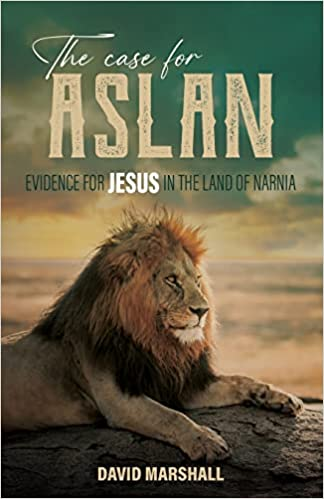
So I did, and wove that tale into my new book, The Case for Aslan: Evidence for Jesus in the Land of Narnia. Here's how one chapter, set at Wadham College in Oxford, begins:

Scene: A second-floor office in a functional stone building, with windows overlooking a grassy quadrangle and ornate spires. An elderly man is staring into space, books jumbled in lopsided piles on his desk. A drawing hangs near the door, of two men in old-fashioned wigs, sitting in a wooden boat with feathered wings, flying above the very quad visible out the window. One is smoking a pipe, while the other trails fishing tackle, at which peck a flock of ducks. A basket of apples rests on the cupboard below the drawing: a faint humming sound can be heard from the cupboard.
Knock, knock!
“Come in!”
A young lady of about twenty-five enters. She is stylishly-dressed and attractive, with long black hair and a skirt to match. She smiles, a bit crookedly, as if some weight were pressing on her cheeks.
The old man looks up, and his mouth drops open.
“My dear! So good to see you!”
“Sorry, professor... It’s been... a while.”
“Sit down, sit down! Tea? Coffee?”
“Tea, if it’s not too much trouble!”
“I have been praying for you.”
“Does it hit the ceiling and bounce back?”
The old man glances at his guest with furrowed brows. He nips several tea leaves and drops them in a ceramic mug decorated with a picture of a cat prowling among peonies.
“Here you are,” the professor sighs. The girl puts her hand on his shoulder.
“Sorry, Uncle Digs. But I do wonder. Am I a total lunatic? Did all that— really happen?”

“Crazy? No. But you do look tired. What have you been up to for the past, what is it, four years?”
“Searching for a door back in, I guess. But it seems the Emperor needed my parents beyond the bloody sea more than their daughter did!”
“I am so sorry. If there is anything I can do— anything at all.”
“Well, I wouldn’t mind some sugar. And a few answers, if you can spare them, Professor.
“Even if all those crazy memories were real— horseback rides with centaurs, visits from princes— Rabadash was a dish, you know, I would have loved to see him in donkey ears— the funny way Tumnus danced out of rooms after he scored a diplomatic victory— I can’t believe I’m saying these things out loud to another human being— how would I prove it? Or maybe there’s another way in. Maybe if I could find some clue that Aslan came to our world, I would feel a tad less... alone.
“So I started visiting the Bod.”
“To find... ?”
“If our Aslan is real. I mean, hang it all, half the colleges in this town— Jesus, Christ Church, Body of Christ... hang his name over their entryways.“

“Magdalen for a pert lady disciple.”
“Yes. And a bunch are named for male apostles, too. So I started reading Bultmann. Crossan. Vermes. Meier. Pagels. Ehrman. Piles of stuff, and everyone seemed to find a different Jesus, like the blind men and the elephant.”
“But who did you find?”

“If you don’t mind, professor, let me ask the questions. Sorry. I guess that means, I haven’t made up my mind. Except I think Empress Jadis runs this hell-hole of a planet.” She smiled faintly. “Especially London. London is the worst.”
“When a man is tired of London, he is tired of life,” the professor thought to himself. Still, her sarcasm showed spirit. That had to be a good sign.

Monday, August 01, 2022

Aslan is Loose!


Good morning! You can now purchase The Case for Aslan: Evidence for Jesus in the Land of Narnia, on Amazon!


I think you'll enjoy this book! Everyone else has so far. (See reviews below.)

The Case for Aslan does not, as some guess, merely say the obvious, that "Aslan is Jesus." Instead, first I argue that Lewis' critics (Pullman, JK Rowling, John Haldane, even JRR Tolkien) are wrong: Lewis' imaginative worlds are beautiful, morally sound, and appeal to the mind that searches for truth.

More importantly, The Case for Aslan is a case for Jesus. In some ways, it is my broadest "Case for Christ" so far. But readers to date also agree that it makes also fun reading -- among others, Puddleglum and Pascal, Dr. Digory Kirke on a flight to "CHAZ International Airport" seated next to Philip Pullman, and (what Lewis sort of asked me to write) how Susan Pevensie finally found Jesus, a story which involves Bart Ehrman and Professor Kirke at his office in Wadham College.

Please get a copy on Amazon, and tell people what you think! It would be great to see some thoughtful reviews up. Criticize anything you think I get wrong! My only request is that you make the major theme of the book clear -- some people don't realize how serious, and deep, light-hearted fun of Lewis' sort can be. But warning: like the Wood Between the Worlds, the Case for Aslan can take you anywhere.

My first interview was a three-part series with Justin Brierley, to be posted later this month on his C. S. Lewis podcast. I would love to visit your church or field questions on your podcast over the coming months.

I also hope some people will like the book enough to want to pass extra copies around. Christmas is coming! And I think this book would work well for a book club or group study. I'll let people know when they can order it directly, with group discounts. As for Kindle, DeWard likes people to purchase physical copies, so Aslan can greet them at the coffee table, then make the electronic version available much later.

Here are the first two reviews, and the Amazon link.

"In this fun, breezy, kaleidoscopic book, apologist David Marshall puts Lewis into dialogue with everyone from Plato, Pascal, and Plantinga to the intelligent design theorists to the new atheists. While staying true to the spirit and wonder of Narnia, Marshall helps his readers to see the implications that Lewis’s Chronicles have for philosophy, theology, ethics, and science."

Louis Markos, Professor in English and Scholar in Residence, Houston Baptist University; author of On the Shoulders of Hobbits: The Road to Virtue with Tolkien and Lewis.

"A wonderful exploration of the deeper meaning of Narnia. Beautiful, imaginative, and deeply personal. Anyone interested in the relevance of C.S. Lewis for today will find this book worthwhile.”

—John G West, editor, The Magician’s Twin: C. S. Lewis on Science, Scientism, and Society

https://www.amazon.com/Case-Aslan-Evidence-Jesus-Narnia/dp/1947929216/?_encoding=UTF8&pd_rd_w=Wsi6A&content-id=amzn1.sym.5fe95cd4-8512-42fa-bf21-63d83b898785&pf_rd_p=5fe95cd4-8512-42fa-bf21-63d83b898785&pf_rd_r=1YVR01J3QZXZ2S5HYP5K&pd_rd_wg=scIZ8&pd_rd_r=1a8538ca-279a-4d3d-9a31-575911f129e0&ref_=pd_gw_ci_mcx_mr_hp_atf_m

Monday, December 26, 2016

Why did Jesus Die? Loftus vs. Lewis

This morning, when I confessed that I was in process of reading John Loftus' new book, Unapologetic: Why Philosophy of Religion Must End, a friend expressed his condolences.  I replied that actually I enjoy reading John's books: for one thing, he possesses an uncanny instinct for setting the volleyball up over the net, just where his own side is most vulnerable.

Friday, September 30, 2016

The Genius of C. S. Lewis


Yesterday I conducted the following test on Facebook.  I asked:
Image result for c. s. lewis young


What can you deduce about the age, religion, and academic background of the person who wrote the following? 


"You ask me what a shee is: I reply that there is no such thing as 'A' Shee. The word (which, though pronounced as I have spelled it, is properly in Irish spelled 'Shidhe') is a collective noun, signifying 'the fairies,' or the gods -- since, in Irish these powers are identical. The common phrase 'Banshee' is derived from 'Bean Shidhe' which means ...'a woman of the Shee:' and the gods, as a whole, are often called 'Aes Shidhe,' or 'people of 'Shee:' and the gods, as a whole, are often called 'Aes Shidhe,' or 'people of the S.' The resemblance between this word 'Aes' and the Norse 'Aesir' has often been noted as indicating a common origin for Celtic and Teutonic races. So much for the etymology. But the word has a secondar meaning, developed from the first. It is used to indicate 'the faery forts' or dwelling places of the Shee: these are usually subterranean workings, often paved and roofed with stone & showing an advanced stage of civilization. These can be seen in a good many parts of Ireland. Who really builds them is uncertain: but scholars, judging by the rude patterns on the door posts, put them down to the Danes. Another set say that they were made by the original inhabitants of Ireland . . . "


So what can you tell me about this writer, just from the text?


People responded that the author of these lines was a "male professor of English," maybe at Oxford, in his 50s because of his vocabulary, "a very educated person in their 20s or their 50s," or "over 30 because he/ she sounds like a well-schooled academic."

In fact, they come from a 15 year old boy named Jack, writing to a friend named Arthur.  He was a young atheist or skeptic, who had never formally taught anywhere, still less at Oxford.

C. S. Lewis, as we know him today. 

Lewis was the greatest apologist of modern times, I think many would agree.   But his expertise is often attacked by skeptics, sometimes who have often only read Narnia or Mere Christianity, both in which he was deliberately making things simple for children, or for a popular radio audience in broadcasts with tight time constraints.

Recently I noticed a thread on Jerry Coyne (who doesn't seem to know that Lewis wrote a whole book on miracles) taking pot-shots at Lewis' 'puerile theology,' or straw men thereof. 

But even as a teenage atheist, who had never formally taught anywhere, Lewis was already a budding literary genius. 
 
Lewis' later letters, not to mention his academic writing and his adult fiction and essays, reveal his genius even more clearly.  In his letters, he converses with eminently accomplished literary figures often displaying a love of fun, but also prodigious learning worn lightly, and an authority that some of Britain's best poets and scholars are quick to recognize.  His forays into Shakespeare or Milton, the "discarded image," and his prodigious and vastly referenced volume in the Oxford History of Literature series remain classics of erudition and insight.  Though in his popular works, sometimes Lewis' very lucidity deceives readers who mistake simplicity and clarity for simple-mindedness, and who do not know the grounds for Lewis' opinions (Coyne) -- and there are almost always solid grounds, which Lewis does not always give.

To be blunt, I know of no skeptic, still less New Atheist who patronizes Lewis, who belongs on the same intellectual tier as Lewis, or anywhere near it. (At least not in the humanities, nor as a philosopher.) 
 
What does this matter? 
 
It matters in two ways. 
 
First, Lewis came to Christ through his love of great thought and literature in the broad western tradition -- including the Greeks and Romans, but also the "Celts" and Norse and pre-Christian Germanic mythologies as well as the rational tradition and modern philosophy. (His casual comments about India and China were often quite canny, as well, if limited.) 
 
Lewis was not a scientist, of course.  Though he had a keen interest in science, he cannot of course be held account for the latest in evolutionary theory, for instance.  But when Lewis speaks for Western Civilization, he should be listened to. He is almost always right, and usually notices connections that bear further investigation. 
 
His understanding of the relationship between Christianity and Western tradition is, I argue in my dissertation and some books, right on the money, theologically, and well-grounded, historically. (Though my own focus is on China.) 
 
Second, while Lewis' 3 L trillemma has often been mocked by skeptics and even repudiated by some Christians, his reasons for discarding the fourth L -- legend -- were articulated in several other articles outside MC, such as the brilliant essay "Fernseed and Elephants." I believe (and my Jesus is No Myth: The Fingerprints of God on the Gospels takes this argument further into empirical substantiation) that Lewis' insights into the gospels provide an inchoate but ultimately even stronger argument for the historicity of the gospels than the common historical arguments that our excellent modern evangelical scholars favor. When Lewis says "I have never read a myth or a hagiography like this, nothing else is like John," he gives us an Argument From Authority. My point is, Lewis' authority on this subject ought to be recognized as weighty indeed. Any skeptic who trots out talking lions in response, ought to be shot down and corrected. 
 
C. S. Lewis, talking on literature, ought to be listened to more carefully than (frankly) anyone else I have encountered. He is the greatest literary genius (reader, not just writer) I have so far been privileged to meet through his writings.

Sunday, December 13, 2015

Aslan and Ehrman make asses of themselves

 
In his work debunking the supposed parallel between Apollonius and Jesus, Eusebius says that while Apollonius may have been a genuine philosopher of sorts, if anyone takes Philostratus' work The Life of Apollonius of Tyana seriously as historical writing, he mistakes an ass for a lion: 
 
"We shall have an ass instead concealed in a lion's skin; and we shall detect in him a sophist in the truest sense, cadging for alms among the cities, and a wizard, if there ever was one, instead of a philosopher."
 
Perhaps this was a common metaphor of the day.  Or maybe these very words of Eusebius' are the origin of the plot of C. S. Lewis' prize-winning finale to the Chronicles of Narnia, in which an evil ape dresses up a gentle donkey named Puzzle in a lion's skin.  Dressed up to look like Aslan, the noble lion, Puzzle is paraded before the crowd of Narnians in the twilight (when he is hard to see clearly) by a cynical, often-drunk ape and his Calormene masters who wish to enslave Narnia. 
 
Ironically, in Zealot, Reza Aslan falls for this original trick of the fake Aslan, and compares Jesus (the lion) to an ass (a fitting description of Apollonius of Tyana, as I began to show in my last post.) 
Bart Ehrman does the same thing, in egregious and phony detail (again, see last post), in his recent book How Jesus Became God.
And so Eusebius was wiser than the present crop of NT scholars -- not just Erhman and Aslan, but the whole Jesus Seminar, Richard Carrier, Paula Fredriksen, the lot.  C. S. Lewis had their number  sixty years ago. All these scholars who are enamored of Apollonius are making asses of themselves, all over again. Because Eusebius was on the money: no one who looks at Apollonius in the light of day, can honestly make the mistake these "scholars" want us to all make.
 
So are they honestly "puzzled," or trying to fool people?  I am beginning to suspect the latter.  How could Bart Ehrman not know how stretched many of his analogies are?   Why else would he take his "lion" out in the darkness, by obscuring so many details, covering others up, as he does?  Are these sorts of scholars playing the role of honestly fooled Narnians, or the more pernicious role of the Calormenes or the drunk ape?  (Or perhaps the overly-clever cat, Ginger?)
But how fitting, that Reza Aslan should be caught mistaking his Aslans, while Eusebius called him out for such foolishness, 1700 years ago.   

Friday, December 19, 2014

Crowd-Sourcing Vacuity: (non) Ten (non) Commandments for the (non) 21st Century

The authors of a new book entitled Atheist Mind, Humanist Heart, Lex Bayor and John Figdor, have it seems awarded $1000 prizes to the winners of their "Crowd-Sourcing the Ten Commandments for the 21st Century" contest.  More than 5,000 entries poured in.  The authors, or their colleagues, corralled all kinds of humanist bigwigs (Adam Savage, David Silverman, executive directors, presidents and founders galore) to judge the entries.  

And here (drum roll, please) are the ten.  Or six.  Or, well, if you want to be technical, the three, repeated a few times: 

1) Be open minded and be willing to alter your beliefs with new evidence. 
 
2) Strive to understand what is most likely to be true, not to believe what you wish to be true.

 
3) Be open minded and be willing to alter your beliefs with new evidence. 

 
4) Every person has the right to control over their body.

 
5) God is not necessary to be a good person or to live a full and meaningful life.

 
6) Be mindful of the consequences of all your actions and recognize that you must take responsibility for them.

 
7) Treat others as you would want them to treat you and can reasonably expect them to want to be treated. 

Think about their perspective. 

8) We have the responsibility to consider others including future generations 
 
9) Be open minded and be willing to alter your beliefs with new evidence. 

 
10) Leave the world a better place than you found it.


First of all, it's striking that even with a Stanford professor on board, nobody here seems able to count to ten.  Or perhaps none of those thousands of contributors could think of anything new to say.  The first "non-Commandment," as John Loftus calls them (let's color it red), is repeated three times, in exactly the same words (1, 3, and 9), and then once more, in slightly different words (2).  (What are the odds that three people would phrase Non-Commandment 1 (3, 9) exactly the same?  Instead of, say, "Be open-minded (with a hyphen) and therefore alter your beliefs when new facts present themselves?"  Or "Change your mind when warranted?")

Numbers 4 and 5 are truth claims, not moral imprecations (leave them black).  8 and 10 are repeats, and corollaries of (7).  6 is purely psychological.

So when up-to-date atheists get together and try to think up some really good improvements for the Ten Commandments, what do they come up with?  The Golden Rule (echoing Buddha, Confucius, and Jesus, who said it was half the Law), plus "Plan for future generations" (implied by the Golden Rule) and "Think things through, and change your mind when the evidence warrants."

I love that last one, and hope to see New Atheists begin following it, some time soon.  (Even if its "more like a guideline, really.")  Up to this point, our atheist neighbors have often seemed among the most pig-headed creatures on the planet.  

If they were less pig-headed, for instance, they might recognize that evidence has always been a part of what Christians mean by "faith."  (Since we have explained this to them in such detail and with such repetition, now.) 

For instance, when Jesus explained the Golden Rule, he said all the commandments come down not to ten, nor even to three, but to just two: "Love God with all your heart, soul, mind, and strength.  And love your neighbor as yourself."  Loving with your mind, of course, means thinking, following our Creator who has made us in His rational image by exploring reality rationally.  In any case, aside from some cherry-picking of Thomas in the Gospel of John, and a few verses in Hebrews 11, which we explained in True Reason, both the Bible and Christian history have been pretty insistent that yes, the Christian call to faith is a call towards the evidence, not away from it.  

And yet the enormous wealth of evidence we have cited to prove this fact, does not seem to have budged the opinions of radical atheists an inch.  Even those who know better STILL attack Christianity for its supposed insistence on Blind Faith.  

So our Secular Humanist friends have crowd-sourced the Ten Commandments, asking many of their top leaders to vet the results.  And what do they come up with?  The ancient Golden Rule and one of its more obvious corollaries.  Plus, "Oh, BTW, that thing on top of your neck is called a head, it comes with a brain inside.  Try the on-switch."  

The implication, drummed into the reader by repeating this point four times, is that no one else ever thought of doing that, before.  "Gee, thanks!  I was wondering what that thing was for!"  

Aside from failing to find 10 Secular Humanist non-commandments, some secular humanists have also recently taken to denying that Jesus lived 20+ centuries ago, undermining even the date Lex Bayor and John Figdor assign to their non-innovations. 

So apparently Secular Humanism doesn't claim to have much to offer the world anymore, apart from what we already know, in our hearts if not in our hands, one may say.  But maybe that's an improvement from the Humanist Manifestos of yore, not to mention Soviet Constitutions and such, which could at times be worse than unoriginal.  

The Tao, as C. S. Lewis said, is indeed eternal.  

(Afterward: Arizona Atheists points out that I made a mistake, in copying this list from "Debunking Christianity."  [I did also go to the original site, but overlooked this discrepancy.]   In the present version -- see below -- non of the "commandments" are repeated.  However, the two "new commandments" are every bit as morally vacuous, and in one case untrue as well.  So my overall impression of mush is, if anything, heightened with the addition of these two new "un-commandments."  See the first two posts below.)