Thursday, February 28, 2013
Perspectives: Ivy Frost, Christ Church, Oxford
Fall frost touches the ivy over the stones around a dark stream that issues from under Christ College, Oxford. Legend has it, Lawrence of Arabia (who grew up going to St. Aldates Church across the street) tried to explore the streams that flow under the city when he was at Oxford: also that he tried to steal the deer in Magdalene's Deer Park for his own college. Christ College is where William Penn, founder of Pennsylvania, studied, also John and Charles Wesley, John Locke, and Albert Einstein, along with thirteen future prime ministers, and where Charles Dodson (Lewis Caroll) taught mathematics. Charles I set up his government here, cutting a passage through stone walls for conjugal visits, as I recall. Of course all that pales in comparison to the college's role as a site for the filming of a Harry Potter movie. Old Tom sounds a couple hundred feet away 101 times at 9:05 PM, so wayward students could return to their dorm at the top of the hour as calculated in Oxford, Greenwich be damned.
Friday, February 22, 2013
Obama for Pope!
![]() |
| (By Alaa Hegazi.) |
No term limits. Golf courses across Christendom ready and waiting. And Pope Pius XIII (lucky number 13) will never have to write a budget or a piece of legislation, ever again. (Well, I'm not entirely sure that he ever has, so that might not be such a big adjustment.) Plus, he can go on running against Republicans (just substitute the words "the Devil," and keep campaigning as he always has) to his heart's delight.
Obama isn't qualified? Nonsense. He's certainly as qualified to be pope, as he was to be president, or win the Nobel Peace Prize.
He's not Catholic? Details, schmetails. If he could befriend Jeremiah Wright for mutual political advantage for so many years, why should he have any problem with the assembled cardinals and archbishops?
Monday, February 18, 2013
"Jesus for Skeptics" -- Atlanta and Augusta
I spoke on "Jesus for Skeptics" yesterday at North Avenue Presbyterian in downtown Atlanta, then on Wednesday plan to speak again on the same subject, at Grace United Methodist in North Augusta, South Carolina.
North Avenue Pres lies in the shadow of the Bank of America building, tallest in Georgia at 1000+ feet, or would be if Joshua got the sun to budge a bit. It's also between Georgia Tech and Emory universities, and generally speaking, right smack in the middle of everything.
After the morning service and before the meeting, I strolled north to Georgia Tech. Downtown Atlanta is built on a long ridge, which probably made the city a little easier to defend when Sherman's army was camped about there Georgia Tech now lies, outside 4 mile long walls thrown up in defense. The football stadium, where Tech (says a sign) won four national championships, is surprisingly small, wedged liked a Roman coliseum between North Avenue and other parts of the campus.
Back to church, and then another foray into Atlanta perpendicular to the last, along Peachtree Street. (No actual peach trees were in evidence, however.) Three quarters of a mile up the road, among the skyscrapers, and across a sidestreet from the Federal Reserve Bank, stands a stately home, later subdivided into apartments, in one of which (number 1) Margaret Mitchell wrote Gone With the Wind. Now I understand what "wind" she was talking about -- up on the ridge, in winter, you do get exposed to the breeze, even with all the tall buildings. In between two of them I found a frozen pool of water -- it's been cold at night.
But of course Gone With the Wind is really about nostalgia, about the fact that life never stays still, and that was, never comes again. This is poignantly clear from the modern vista of downtown Atlanta itself. The city appears to be doing well (although the Bank of America building is two thirds empty and getting emptier, they say): clean new condos, people going to shows and restaurants and strolling the streets. But very little of the old Atlanta even of Margaret Mitchell's day, still less before General Sherman came to town, remains in sight, and of course all the people who built up the Old South, and their culture, their arts, their hobbies, are all largely gone, almost as completely as the Indian nations that they, in their turn, mostly displaced.
After meeting Ben Devan, who is completing his dissertation on the New Atheism at Emory for lunch yesterday (he started it at Harvard), I had a walk around the campus. Beautiful rock, the marble surface of the buildings in the quad. It's a slightly hilly campus, which means the prospects tend to take one by surprise, with odd angles. Emory was founded by the Methodists, and Ben is in fact developing a Wesleyan approach to the New Atheism.
We started at 4 in the afternoon, with a relatively small, but very engaged, audience. One person asked about Freud's thoughts about religion. Others, who were working with Chinese intellectuals at local campuses -- some 50 had come to Christ! -- were consequently interested in what I said about China.
North Avenue Presbyterian Church is a very interesting congregation. About the same size as my parent's home church of Westside in Seattle, it is a racially and socially diverse congregation, with whites, blacks, and Chinese in particular. Like Westside, North Avenue is evangelical and also thoughtful in its approach to life and ministry. A privilege to be invited to share.
I also look forward to visiting Grace UMC in North Augusta, day after tomorrow. But now, I think I'll head north myself, and see if I can find the Appalachian Trail before it gets dark.
North Avenue Pres lies in the shadow of the Bank of America building, tallest in Georgia at 1000+ feet, or would be if Joshua got the sun to budge a bit. It's also between Georgia Tech and Emory universities, and generally speaking, right smack in the middle of everything.
After the morning service and before the meeting, I strolled north to Georgia Tech. Downtown Atlanta is built on a long ridge, which probably made the city a little easier to defend when Sherman's army was camped about there Georgia Tech now lies, outside 4 mile long walls thrown up in defense. The football stadium, where Tech (says a sign) won four national championships, is surprisingly small, wedged liked a Roman coliseum between North Avenue and other parts of the campus.
Back to church, and then another foray into Atlanta perpendicular to the last, along Peachtree Street. (No actual peach trees were in evidence, however.) Three quarters of a mile up the road, among the skyscrapers, and across a sidestreet from the Federal Reserve Bank, stands a stately home, later subdivided into apartments, in one of which (number 1) Margaret Mitchell wrote Gone With the Wind. Now I understand what "wind" she was talking about -- up on the ridge, in winter, you do get exposed to the breeze, even with all the tall buildings. In between two of them I found a frozen pool of water -- it's been cold at night.
But of course Gone With the Wind is really about nostalgia, about the fact that life never stays still, and that was, never comes again. This is poignantly clear from the modern vista of downtown Atlanta itself. The city appears to be doing well (although the Bank of America building is two thirds empty and getting emptier, they say): clean new condos, people going to shows and restaurants and strolling the streets. But very little of the old Atlanta even of Margaret Mitchell's day, still less before General Sherman came to town, remains in sight, and of course all the people who built up the Old South, and their culture, their arts, their hobbies, are all largely gone, almost as completely as the Indian nations that they, in their turn, mostly displaced.
After meeting Ben Devan, who is completing his dissertation on the New Atheism at Emory for lunch yesterday (he started it at Harvard), I had a walk around the campus. Beautiful rock, the marble surface of the buildings in the quad. It's a slightly hilly campus, which means the prospects tend to take one by surprise, with odd angles. Emory was founded by the Methodists, and Ben is in fact developing a Wesleyan approach to the New Atheism.
We started at 4 in the afternoon, with a relatively small, but very engaged, audience. One person asked about Freud's thoughts about religion. Others, who were working with Chinese intellectuals at local campuses -- some 50 had come to Christ! -- were consequently interested in what I said about China.
North Avenue Presbyterian Church is a very interesting congregation. About the same size as my parent's home church of Westside in Seattle, it is a racially and socially diverse congregation, with whites, blacks, and Chinese in particular. Like Westside, North Avenue is evangelical and also thoughtful in its approach to life and ministry. A privilege to be invited to share.
I also look forward to visiting Grace UMC in North Augusta, day after tomorrow. But now, I think I'll head north myself, and see if I can find the Appalachian Trail before it gets dark.
Thursday, February 14, 2013
Lord, save us from our creations!
Last night I had another sci-fi dream, in which aliens conquer the world. I've occasionally experienced versions of the dream that have a horror-movie feel to them. This one seemed more detached, as if I were watching an interactive movie, or (saints preserve us!) playing a video game. It isn't that I knew the aliens were unreal, but I didn't take them seriously, even though they were destroying the world, and throwing radioactive elements at one as he flew by only made him laugh. But somehow it had the feeling of a gaming exercise.
I could be wrong, but I suspect these occasional dreams are really "about" us humans allowing our technology to invade and conquer our own humanity.
Some skeptics seem delighted by the prospect of downloading their consciousness onto computer programs and "living" forever.
But even if that works, and even if the copy could in some sense be called "myself," yesterday afternoon I found myself, before speaking outside of Huntville, Alabama, thinking about the unintended consequences of embracing technology too quickly.
No, I wasn't thinking about gas chambers and the Holocaust, the interactive video screens in George Orwell's totalitarian horror story 1984, or even the threat of nuclear or biological obliteration that still hangs over the human race.
I simply crossed the road from my hotel to the shops on the other side of the street.
What a hell automobiles have made of that act, along a strip mall built up on both sides of a highway!
First of all, for beauty, there is none. Every building is functional, minimalistic, denuded of prospect or perspective. No roofs gracefully meet the sky. No murals greet the eye. And forget about gargoyles. Why fuss over architecture, when these buildings -- almost all commercial buildings -- are built to allow people to get in, get out, having eaten / bought / transacted whatever food / material / transaction is called for, with minimal fuss, not even sacrificing a turtle dove to the great god Convenience?
Second, for comfort for the feet, again, there is none. It's pavement from the front door of my dour car-based hotel to the far horizon, Atlanta Bread or Lifeway Books or Target or whatever it is. The sun would beat down in summer on that pavement, now it's just hard and soulless.
Third, for peace, again, the well comes up dry. Cars zip by as fast as they are allowed to zip by, emitting fumes and making noise.
Fourth, of course one has to wait a long time at the wide road for the lights to change, because it never occurred to city planners that anyone might like to use his or her feet for anything. We have cars, now! How paleolithic!
Fifth, of course those cars do hit the odd pedestrian who foolishly wants to use the legs God gave him.
Why did the chicken cross the road? Doesn't he know there are almost as many cloned chain restaurants on his side as there are over there? And why doesn't he get in his car and drive three hundred yards, for heaven's sake?
And so it goes, across America (especially), and around the world.
Whole cities have been sacrifices to the god Auto. Detroit seems to have been one. Neighborhoods cut up. Noise reigning supreme. Indolence subsidized. Everything for Convenience, so little for humanity and neighborhood and kids playing in the street. (When did I last see a child on a bicycle?)
Americans get fatter. We have to buy new machine, like treadmills, to artificially walk, in place, seeing nothing new, greeting no one along the way, getting no fresh air, not even the dignity of a good old-fashioned riot to give us common feeling.
All this, with barely a protest, and barely notice -- we have abandoned so much that once made us human, and lost so much, hardly noticing it, and certainly with few predicting it beforehand, or, obviously, halting it. (Well, CS Lewis kicked up a bit of a fuss, probably he wasn't the only one.)
The unintended consequences of technological "progress." And the car is one of the less obviously destructive.
What more surprises are in for us around the bend? What other invaders, fit to conquer our very humanity?
How many will come in the guise, not of enemies as in War of the Worlds or Independence Day, but as temptations?
Lord, please don't forget us in the future. Don't allow us to be swallowed by our own machines and myopic cleverness. You are God: please do not let us to be less than human.
I could be wrong, but I suspect these occasional dreams are really "about" us humans allowing our technology to invade and conquer our own humanity.
Some skeptics seem delighted by the prospect of downloading their consciousness onto computer programs and "living" forever.
But even if that works, and even if the copy could in some sense be called "myself," yesterday afternoon I found myself, before speaking outside of Huntville, Alabama, thinking about the unintended consequences of embracing technology too quickly.
No, I wasn't thinking about gas chambers and the Holocaust, the interactive video screens in George Orwell's totalitarian horror story 1984, or even the threat of nuclear or biological obliteration that still hangs over the human race.
I simply crossed the road from my hotel to the shops on the other side of the street.
What a hell automobiles have made of that act, along a strip mall built up on both sides of a highway!
First of all, for beauty, there is none. Every building is functional, minimalistic, denuded of prospect or perspective. No roofs gracefully meet the sky. No murals greet the eye. And forget about gargoyles. Why fuss over architecture, when these buildings -- almost all commercial buildings -- are built to allow people to get in, get out, having eaten / bought / transacted whatever food / material / transaction is called for, with minimal fuss, not even sacrificing a turtle dove to the great god Convenience?
Second, for comfort for the feet, again, there is none. It's pavement from the front door of my dour car-based hotel to the far horizon, Atlanta Bread or Lifeway Books or Target or whatever it is. The sun would beat down in summer on that pavement, now it's just hard and soulless.
Third, for peace, again, the well comes up dry. Cars zip by as fast as they are allowed to zip by, emitting fumes and making noise.
Fourth, of course one has to wait a long time at the wide road for the lights to change, because it never occurred to city planners that anyone might like to use his or her feet for anything. We have cars, now! How paleolithic!
Fifth, of course those cars do hit the odd pedestrian who foolishly wants to use the legs God gave him.
Why did the chicken cross the road? Doesn't he know there are almost as many cloned chain restaurants on his side as there are over there? And why doesn't he get in his car and drive three hundred yards, for heaven's sake?
And so it goes, across America (especially), and around the world.
Whole cities have been sacrifices to the god Auto. Detroit seems to have been one. Neighborhoods cut up. Noise reigning supreme. Indolence subsidized. Everything for Convenience, so little for humanity and neighborhood and kids playing in the street. (When did I last see a child on a bicycle?)
Americans get fatter. We have to buy new machine, like treadmills, to artificially walk, in place, seeing nothing new, greeting no one along the way, getting no fresh air, not even the dignity of a good old-fashioned riot to give us common feeling.
All this, with barely a protest, and barely notice -- we have abandoned so much that once made us human, and lost so much, hardly noticing it, and certainly with few predicting it beforehand, or, obviously, halting it. (Well, CS Lewis kicked up a bit of a fuss, probably he wasn't the only one.)
The unintended consequences of technological "progress." And the car is one of the less obviously destructive.
What more surprises are in for us around the bend? What other invaders, fit to conquer our very humanity?
How many will come in the guise, not of enemies as in War of the Worlds or Independence Day, but as temptations?
Lord, please don't forget us in the future. Don't allow us to be swallowed by our own machines and myopic cleverness. You are God: please do not let us to be less than human.
Tuesday, February 12, 2013
Randal Rauser interviews me on Faith Seeking Understanding
By Randal Rauser
(Cross-posted from here.)
About a year ago I received an emailed invitation from David Marshall, theologian, apologist and author of several books including The Truth Behind the New Atheism (Harvest House, 2007) to contribute an essay to an exciting new book he was editing called Faith Seeking Understanding: Essays in Memory of Paul Brand and Ralph D. Winter. It didn’t take much arm twisting for me to agree to join such an exciting project, especially when I heard the stellar line up of scholars contributing to the project.
Now that Faith Seeking Understanding is available I thought it would be a good time to invite David Marshall over to The Tentative Apologist for an interview to share his thoughts on this exciting book. So here it is.
(Cross-posted from here.)
About a year ago I received an emailed invitation from David Marshall, theologian, apologist and author of several books including The Truth Behind the New Atheism (Harvest House, 2007) to contribute an essay to an exciting new book he was editing called Faith Seeking Understanding: Essays in Memory of Paul Brand and Ralph D. Winter. It didn’t take much arm twisting for me to agree to join such an exciting project, especially when I heard the stellar line up of scholars contributing to the project.
Now that Faith Seeking Understanding is available I thought it would be a good time to invite David Marshall over to The Tentative Apologist for an interview to share his thoughts on this exciting book. So here it is.
* * *
RR: David thanks for agreeing to do this interview. I’d like to start with two questions, one relating to the title and the other to the subtitle. Let’s begin with the subtitle which reads “Essays in memory of Paul Brand and Ralph D. Winter.” Who were Paul Brand and Ralph Winter and what prompted you to solicit a collection of essays in their memory?Sunday, February 10, 2013
Carrier Debate: Top 11 add-ons . . .
Well, now I know what it's like to stand on the stage in the lights with an audience in dark before one, and debate a clever and well-read opponent. We had a great moderator, who was cheerful, helpful, and fair. The folks at Ratio Christi and the Nontheist group did an excellent job of preparation, and I'm grateful for the chance to participate.
My goal in this debate was not to win on points, to rebut every detail (which would have been impossible), or even to "win" the debate at all in any abstract sense. My goal was to win people. Whether or not anything I said proved helpful in moving any hearts towards God, He alone knows, but that is my prayer.
I was also hoping to develop a good relation with my opponent. I was glad that Richard seemed to feel the same way. He was friendly, professional, and in every way good to work with off the stage, and away from the podium.
A lot of people said they enjoyed the debate, and I had some good conversations afterwards. (Still a little psyched, after speaking for 4 hours in the morning, the debate, talk afterwards -- did my sermon prep for tonight and for tomorrow's talk in Atlanta in the middle of the night, also thought of all the witty rejoinders that didn't come right away, of course . . . )
I was happy with my main arguments, and with the Q and A period, by and large. As anticipated, though -- knowing myself -- I flubbed some responses to Carrier's arguments. (Mea culpa -- on my last trip, I lost my passport!) There were also new texts Carrier brought up which I haven't checked yet, but will when I find time. Carrier rightly tells audiences to check his texts -- when I've checked them in the past, I've often found they showed very different things from what he seemed to think they did. And also, there were points I did make, but would like to reinforce and emphasize a bit more, because they do I think go to the heart of things.
So here are my top eleven "What I meant to say, Senator"s . . .
(1) Why is an experience, by oneself or a good friend, a reason to change one's mind, but a million experiences by other people, just a mishmash collection of worthless anecdotes?
For that matter, while you're recalling what some writer thinks he found about memory, if memory is all that bad, how do you know you remember it correctly? And how do you know he accurately transcribed what he found, relying also on memory? Don't you realize that attacks on memory are a double-edged sword?
(2) What, indeed, is the difference between anecdotes and mutually-reinforcing historical accounts? Or is that just a semantic game we are playing?
(3) How could the fact that miracles happen to a lot of people, somehow make them less credible? Surely Bayes doesn't show that! And wasn't Hume's argument just the opposite? So both the fact that they are few, and the fact that they are many, both would count against miracles, after all, despite your written claims to being open to the evidence?
(4) If Jesus was so ordinary, how come (emphasizing my original argument on this point) so many of the greatest geniuses in human history have found his teachings and person extraordinary? Is it not more likely, Dr. Carrier, that you are missing the "elephant in the room?" As C. S. Lewis put it, you claim to see fernseed, but your evident inability is to see an elephant standing 10 paces away in broad daylight?
(5) You said that God can only be believed if he transcends cultures. Now that I show that He does, you deny that argument has any weight or relevance. So are you disavowing your earlier argument, which I quoted earlier tonight?
(6) The cloaking devise the Brahmins in Apollonius of Tyana used to make their city invisible is pretty cool, too.
(7) I love C. S. Lewis, even if I'm not entirely satisfied with his arguments over the Problem of Pain.
(8) By the way, I found my notes on that issue (which yes, I had misplaced, and poorly recreated on the spur of the moment, the worst moment in the debate for me, I think), and here is my real argument, in part . . .
The point about Dr. Carrier's description of how he would have created the universe is this. I find the world he imagines creating instead of this one, boring. We all seem to be just fat cows grazing contentedly in the meadow, forever. I prefer a world with adventure in it, with problems to be solved, with the opportunity for loving others at loss to oneself, and even for correcting wrongs.
Who would want to live in Middle Earth without orcs or dragons? Tolkien's story stops when the problems are solved, because it would be boring without them.
Maybe there are still adventures in Heaven. Or maybe God has something else and better planned. But surely it will be more interesting than the imaginary reality Richard Carrier describes in Why I am not a Christian, which MIGHT drive a sane person to contemplate suicide.
That of course does not mean I am either satisfied with children dying, or can explain why God allows this to happen. I admit this is a real problem, one which many Christian explanations I have seen leave me dissatisfied. But surely part of that answer is that this world is not all there is, or even most of what there is, and that justice will come "in the morning."
(9) The Muslim imam who heard from God was one in a million? It would be more accurate to say, he is one of millions of Muslims who have risked crossing one of the most formidable cultural barriers to follow Jesus, in recent years, often because of such experiences -- as some have related to me directly.
(10) In response to the Muslim lady: Jesus is not the physical son of God, according to Christians. God did not have sex with a lady, as Mohammed seemed to imagine, not knowing genuine Christian doctrine.
(11) Dr. Carrier has a long history of throwing out obscure references which don't (in my experience) pan out when looked up. It's probably for the best that he didn't try to defend his comparison of the "Rumor of Sizzling Fishes" to the Resurrection of Jesus last night. Good impromptu line about the sardines, though.
The larger point, however, is that such references, several of which Carrier gave again last night, serve mainly to show that he lacks any real awareness of the remarkable character of the Gospel texts. I tried to explain, briefly, that character last night. Hopefully my arguments went home for some in the audience, and others will read them with more open minds. But in the future, I am hoping to rework the material and the arguments in Why the Jesus Seminar Can't Find Jesus, and Grandma Marshall Could, and to a lesser extent in Faith Seeking Understanding ("The Fingerprints of Jesus"), into a fuller argument, not just in rebuttal of Carrier, but as a positive argument for the Gospel which I think has great potential. Last night provided me a chance to begin working on some of those ideas, and for seeing how a consummate skeptic like Carrier might attempt to respond to them.
I am more confident than ever that this is a winning argument -- because the nature of Jesus himself, and the gospels Richard Carrier disparages, but does not (I think) really see, in any sense worth calling sight. By God's good grace, maybe that fuller argument will help enable Dr. Carrier to see Jesus as He really is.
Well, that was fun for us, and the audience seemed to enjoy it as well. Thanks again to those who did the leg work to put it on. May the Lord use that evening to His glory, and for the good of those who attended and watched, or will watch, on the Web.
It looks like more debates will be coming up later in the year. Please do stay tuned.
My goal in this debate was not to win on points, to rebut every detail (which would have been impossible), or even to "win" the debate at all in any abstract sense. My goal was to win people. Whether or not anything I said proved helpful in moving any hearts towards God, He alone knows, but that is my prayer.
I was also hoping to develop a good relation with my opponent. I was glad that Richard seemed to feel the same way. He was friendly, professional, and in every way good to work with off the stage, and away from the podium.
A lot of people said they enjoyed the debate, and I had some good conversations afterwards. (Still a little psyched, after speaking for 4 hours in the morning, the debate, talk afterwards -- did my sermon prep for tonight and for tomorrow's talk in Atlanta in the middle of the night, also thought of all the witty rejoinders that didn't come right away, of course . . . )
I was happy with my main arguments, and with the Q and A period, by and large. As anticipated, though -- knowing myself -- I flubbed some responses to Carrier's arguments. (Mea culpa -- on my last trip, I lost my passport!) There were also new texts Carrier brought up which I haven't checked yet, but will when I find time. Carrier rightly tells audiences to check his texts -- when I've checked them in the past, I've often found they showed very different things from what he seemed to think they did. And also, there were points I did make, but would like to reinforce and emphasize a bit more, because they do I think go to the heart of things.
So here are my top eleven "What I meant to say, Senator"s . . .
(1) Why is an experience, by oneself or a good friend, a reason to change one's mind, but a million experiences by other people, just a mishmash collection of worthless anecdotes?
For that matter, while you're recalling what some writer thinks he found about memory, if memory is all that bad, how do you know you remember it correctly? And how do you know he accurately transcribed what he found, relying also on memory? Don't you realize that attacks on memory are a double-edged sword?
(2) What, indeed, is the difference between anecdotes and mutually-reinforcing historical accounts? Or is that just a semantic game we are playing?
(3) How could the fact that miracles happen to a lot of people, somehow make them less credible? Surely Bayes doesn't show that! And wasn't Hume's argument just the opposite? So both the fact that they are few, and the fact that they are many, both would count against miracles, after all, despite your written claims to being open to the evidence?
(4) If Jesus was so ordinary, how come (emphasizing my original argument on this point) so many of the greatest geniuses in human history have found his teachings and person extraordinary? Is it not more likely, Dr. Carrier, that you are missing the "elephant in the room?" As C. S. Lewis put it, you claim to see fernseed, but your evident inability is to see an elephant standing 10 paces away in broad daylight?
(5) You said that God can only be believed if he transcends cultures. Now that I show that He does, you deny that argument has any weight or relevance. So are you disavowing your earlier argument, which I quoted earlier tonight?
(6) The cloaking devise the Brahmins in Apollonius of Tyana used to make their city invisible is pretty cool, too.
(7) I love C. S. Lewis, even if I'm not entirely satisfied with his arguments over the Problem of Pain.
(8) By the way, I found my notes on that issue (which yes, I had misplaced, and poorly recreated on the spur of the moment, the worst moment in the debate for me, I think), and here is my real argument, in part . . .
The point about Dr. Carrier's description of how he would have created the universe is this. I find the world he imagines creating instead of this one, boring. We all seem to be just fat cows grazing contentedly in the meadow, forever. I prefer a world with adventure in it, with problems to be solved, with the opportunity for loving others at loss to oneself, and even for correcting wrongs.
Who would want to live in Middle Earth without orcs or dragons? Tolkien's story stops when the problems are solved, because it would be boring without them.
Maybe there are still adventures in Heaven. Or maybe God has something else and better planned. But surely it will be more interesting than the imaginary reality Richard Carrier describes in Why I am not a Christian, which MIGHT drive a sane person to contemplate suicide.
That of course does not mean I am either satisfied with children dying, or can explain why God allows this to happen. I admit this is a real problem, one which many Christian explanations I have seen leave me dissatisfied. But surely part of that answer is that this world is not all there is, or even most of what there is, and that justice will come "in the morning."
(9) The Muslim imam who heard from God was one in a million? It would be more accurate to say, he is one of millions of Muslims who have risked crossing one of the most formidable cultural barriers to follow Jesus, in recent years, often because of such experiences -- as some have related to me directly.
(10) In response to the Muslim lady: Jesus is not the physical son of God, according to Christians. God did not have sex with a lady, as Mohammed seemed to imagine, not knowing genuine Christian doctrine.
(11) Dr. Carrier has a long history of throwing out obscure references which don't (in my experience) pan out when looked up. It's probably for the best that he didn't try to defend his comparison of the "Rumor of Sizzling Fishes" to the Resurrection of Jesus last night. Good impromptu line about the sardines, though.
The larger point, however, is that such references, several of which Carrier gave again last night, serve mainly to show that he lacks any real awareness of the remarkable character of the Gospel texts. I tried to explain, briefly, that character last night. Hopefully my arguments went home for some in the audience, and others will read them with more open minds. But in the future, I am hoping to rework the material and the arguments in Why the Jesus Seminar Can't Find Jesus, and Grandma Marshall Could, and to a lesser extent in Faith Seeking Understanding ("The Fingerprints of Jesus"), into a fuller argument, not just in rebuttal of Carrier, but as a positive argument for the Gospel which I think has great potential. Last night provided me a chance to begin working on some of those ideas, and for seeing how a consummate skeptic like Carrier might attempt to respond to them.
I am more confident than ever that this is a winning argument -- because the nature of Jesus himself, and the gospels Richard Carrier disparages, but does not (I think) really see, in any sense worth calling sight. By God's good grace, maybe that fuller argument will help enable Dr. Carrier to see Jesus as He really is.
Well, that was fun for us, and the audience seemed to enjoy it as well. Thanks again to those who did the leg work to put it on. May the Lord use that evening to His glory, and for the good of those who attended and watched, or will watch, on the Web.
It looks like more debates will be coming up later in the year. Please do stay tuned.
Saturday, February 09, 2013
My debate with Richard Carrier tonight to be streamed.
Well, tonight's the night of the debate: "Is the Christian faith reasonable?"
The debate will now be live-streamed at the following site:
http://www.tacticalfaith.com/live-stream/
The debate will be held at the Chan Auditoreum at the University of Alabama--Huntsville.
For those in Huntsville or nearby, there's also still time to come to my morning seminar on Christianity and World Religions, 10-2, also at the University of Alabama-Huntsville. (Check the Ratio Christi web site for exact location -- the debate is in the Chan Auditoreum, but the seminar is in another building a couple blocks away.)
In other news, it looks like I'll be speaking in two locations in the Virginia suburbs of Washington, D.C. in March. We're also setting up a debate with an eminent and much-cited southern California scholar on the question, "Does Christianity or Secular Humanism provide a better basis for civil society?" And probably other debates will be coming up.
So stay tuned!
The debate will now be live-streamed at the following site:
http://www.tacticalfaith.com/live-stream/
The debate will be held at the Chan Auditoreum at the University of Alabama--Huntsville.
For those in Huntsville or nearby, there's also still time to come to my morning seminar on Christianity and World Religions, 10-2, also at the University of Alabama-Huntsville. (Check the Ratio Christi web site for exact location -- the debate is in the Chan Auditoreum, but the seminar is in another building a couple blocks away.)
In other news, it looks like I'll be speaking in two locations in the Virginia suburbs of Washington, D.C. in March. We're also setting up a debate with an eminent and much-cited southern California scholar on the question, "Does Christianity or Secular Humanism provide a better basis for civil society?" And probably other debates will be coming up.
So stay tuned!
Sunday, February 03, 2013
Jerry Coyne, Sky Cat, and Jesus on stilts.
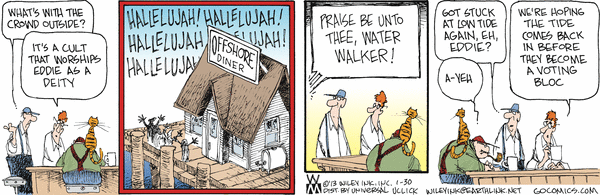
Here are some new theories about how Jesus actually walked on water, from the biologist Jerry Coyne, and his acolytes. Isn't it wonderful that we live in a day and age in which so many skeptical geniuses grace our shores, that they can produce such brilliant solutions to old puzzles, at the drop of a hat, or a purring in the ear from Sky Cat?
(1) Jesus was a space alien.
(2) He was the real fisherman, and knew where the rocks were; the disciples were actually the carpenters.
(2B) The disciples who were carpenters were, however, good enough sailors that they could maneuver between all those rocks -- without noticing that the rocks (perhaps made of transparent obsidian) were there.
(3) Jesus was walking on stilts. They were made of glass or aluminum, however, so they didn't float when Jesus jumped into the boat. (Jesus was a bit ahead of his time, technologically -- combine with (1) as needed.)
(4) The tide was out. This itself was a miracle, since the Sea of Galilee does not experience very large tides, but this happens occasionally when the wormhole that transported Jesus (see #1) nears the Earth. The disciples, again, being dumb carpenters, did not notice.
The moral of this story seems to be: mock, and the world mocks with you. Think, and you think alone.
Friday, February 01, 2013
How Jesus Liberates Women VII: Acts of the Apostles
Over the past year and a half, I have been developing a series making the case that the Gospel of Jesus has done more than anything to raise the status of women, not only in "Christian" countries, but around the world.
I have often written on this subject in the past. In 2000, I began to make a case for how the Gospel helps women in Chapter Three of Jesus and the Religions of Man, a chapter about which NPR contributor Frederica Matthewes-Green said, "David Marshall takes cultural analysis several levels deeper, and in prose that is several levels higher, than we've come to expect. The result is not only enlightening but also a great deal of fun to read." In that chapter, I relied partly on a detailed United Nations survey of the status of women in 99 countries around the world, and partly on my own experience and observations as a missionary in East Asia. Seven years later, in The Truth about Jesus and the 'Lost Gospels,' I compared the kind, respectful, and liberating (but often challenging) treatment Jesus gives women in the gospels, to the sometimes rather psychodelic amorality of the Gnostic "Gospels," which Dan Brown and a forest of scholars (like the recently embarrassed Karen King) praise to High Heaven, for Lord knows what reason.
Our blog series has gone like this so far: (1) Response to some cryptic nonsense from John Loftus about how Christianity imprisons women, and my challenge to him to debate the issue. Loftus demurred in accepting that challenge, but his followers demanded that I prove my counter-proposal ("Jesus liberates women") anyway. Those challenges might be viewed as the efficient though not final cause of this series. (2) I then explained how the argument began, and how I proposed to make my case. (3) I described my encounter, as a young man, with the sex slave trade in Asia, and how the Gospel inspired me to respond. (4) I analyzed a sweeping international study by the United Nations, and what it showed about the correlation between Christian influence (and of other religions) and the status of women in 99 countries around the world, comprising some 97% of the world's population. (5) I argued that there is a body of historical evidence that helps explain that correlation as having been caused by the influence of Jesus Christ and the Gospel. (6) I analyzed every saying in the gospels baring on women, gender roles, and how men and women should treat one another, arguing that Jesus is the most plausible source of human progress in this area. (7) I then indulged myself by describing the ten dumbest responses to my arguments. (Hundreds of responses had been posted by this time, here, on Amazon, on Pharyngula, and I think on Loftus' site.)
And that's as far as we have gotten, so far. The latest of these was posted more than a year ago.
Two things that I still need to do are (a) answer the more serious challenges to my argument, and (b) take the rest of the New Testament into account, somehow.
Since Christianity is by definition focused on Christ, who is the interpretive focus of the Bible for Christians, I do insist that the gospels should be our primary source from which to decide how Christians should view women. Furthermore, since the overriding historical correlation that we have already seen ties biblical influence to an unusually HIGH status for women, rather than a low status, and since I have already given historical warrant for thinking that the Gospel is a plausible causal agent in that transformation, our main question in reading the Bible should be, "How can we explain the influence that actually dominates the historical record? What in the Bible might lead men and women who treasure the Bible to institute the reforms that actually did occur, and that have had such a huge impact in improving the lives of billions of women?"
In Jesus, we find someone who could, and apparently did, have a vast, liberating effect.
No matter what we find in the rest of the Bible, these are the primary facts, and they cannot be negated.
Nevertheless, every tradition is complicated. Certainly there have been numerous acts of misogeny (and most other forms of disgrace) in Christian history. Some of that misogeny or unjustice appears systematic. Some is callous, cruel, and has resulted in the deaths of women. In every natural river (if it is not a concrete culvert with smooth banks), there are counter-currents. It would be a continuing miracle if Christians never used the words of Scripture to oppress, and not a miracle the Bible itself leads us to expect.
But some of that injustice towards women claims warrant from the Bible.
The burning of witches is one example that skeptics frequently bring up. The Old Testament does, in fact, contain a verse that says, "You will not allow a witch to live." And in fact, three quarters of "witches" burnt to death during the Renaissance (not the "Dark Ages," that is a myth) were women.
So some of the strongest historical objections to my thesis are tied to textual objections. There are verses, elsewhere in the New Testament, that cause feminists and most modern men to wince. "What is that doing here?" "Are women really supposed to shut up in church, then meekly ask their men-folk after the service what it all means, as Paul seems to say, in I Corinthians?" "In light of these verses, can the biblical view of gender roles really be seen as both coherent and progressive?"
As I continue this series, I will, therefore, consider what the rest of the New Testament has to say about the status of women. (And also hopefully get to some of the better objections.)
My purpose now is not to prove that the Gospel of Jesus was revolutionary, or that historically, it brought about radical positive changes in relations between the sexes. I regard that as having been demonstrated beyond any reasonable doubt. Until better arguments are made against earlier posts, which are foundational to my argument, I regard those claims now as established facts.
Nor is my purpose to prove the inspiration or inerrancy of Scripture. If St. Paul really did say some dumb things, if he revealed himself at times to be a product of his times, that will not derail my argument. But such counter-currents may make the river of biblical influence more hazardous to navigate. One may still plausibly argue that it is better to take a modern road to the New Sexual Utopia (however those notions might be secretly influenced by bibilical teaching) instead of reading the Bible and trying to follow it directly.
We go on, first, to the Acts of the Apostles.
Women in Acts
Acts of the Apostles provides an endlessly fascinating photo album of the early Church, full of humorous snapshots, travel pictures from around the so-called Greco-Roman world (which is far more complex than that duality), numerous historically-verified observations about life around the big pond, and a rip-roaring missions story that Christians have always taken as normative. (The popular Perspectives on the World Christian Movement classes include two lectures on Acts, which I have sometimes had the privilege to give.)
Acts is usually not central to debates over the role of women in early Christianity. On the one hand, it doesn't show Jesus saving a woman about to be stoned for adultery, or telling Mary that she has "chosen the better part," like the gospels. On the other hand, none of the skeptics' favorite verses about keeping silent in church appear in this book, either. Luke does not focus on gender issues as much in his second work as in his first -- or perhaps the difference is that Jesus plays only a cameo role in Acts.
But there is a lot of interesting material about women, if you read carefully.
First, a few general observations that seem to reflect the society, rather than show how the Gospel might serve to change it:
(1) Acts reflects the patriarchal nature of the societies he describes by commonly using such terms as "brothers" and "fathers" to refer to a community at large, either Jewish society (7), or the young Christian church. However, it sometimes emerges that he is including women in these broad general terms, as we still do sometimes with the generic term "men" for "humanity." (1:13-14)
(2) Women are frequently involved in the story, both as heroines and as villainesses, though a bit less often than men. Sons and daughters will prophesy (2:17). Ananias and Sapphira sin in the same way, and are judged equally (5:1-10). After successful preaching, "The Jews" stir up "devout women" and "outstanding men" of Pisidian Antioch against Paul and Barnabas. Paul imprisoned men AND women, Luke points out twice in his own voice (8:3, 9:2) and once in Paul's voice (22:4).
(3) No one seems surprised to find Bernice presiding at the trial of Paul with her husband (25:30), or Lydia doing a thriving textile business (16).
Now let's look at several stories in more detail, which do suggest an emerging Christian stance towards women, which may be considered normative, because it is canonical.
(4) In Acts One, Jesus' surviving disciples are praying in the Upper Room in Jerusalem. Luke lists the male apostles, then adds "together with the women and Mary the mother of John, and with his brothers."
Clearly, Luke noticed gender. Leading male disciples had a special role in the early Church, and were recognized as figures of (very fallible) authority. Women also participate in meetings, and prominent women are also often mentioned by name.
(5) Acts Seven describes a conflict over the care of widows that divides not between genders, but ethnically. Hellenistic Jews complained that their widows were being disciminated against at meal time. So the apostles appointed seven men -- elders -- to take care of the Church's practical administration, leaving the Twelve to concentrate on spiritual matters.
Everyone in this story takes it for granted that the Church is responsible to care for needy widows, who would have been a large class in the ancient world, with older men marrying younger women, and a high mortality rate. In The Rise of Christianity, Rodney Stark spends a chapter describing the impact of such charitable works on the early Church. It may be that many widows became Christians precisely because of the kindness shown them, or which they hoped to receive. Economic support gave women the freedom to not marry again, or worse become prostitutes.
(6) In Acts Nine, a female disciple named Tabitha makes an appearance. She is described as "a woman full of good deeds and acts of charity." She dies, Peter raises her to life, and then presents her to "all the saints and widows."
(7) Three chapters later, Luke tells one of several humorous anecdotes in his book, which probably made the rounds of the early church for some time. Peter is rescued from prison by an angel in response to prayer. He makes his way to the home of Mary, where the Christians are gathered to pray for him, one presumes for his release. He knocks on the door, and a girl named Rhoda comes to answer. She's so excited to see him, that she runs into the prayer meeting and forgets to open the door.
"He's here! He's here!"
"Who's here, Rhody?"
"It's Peter!"
"No, Rhody, sorry, but Pete is in jail. It must be someone else."
"I tell you Peter is knocking on the front door right now!"
"Are you nuts? He was just hauled off to the clinker, we witnessed it with our own eyes."
"No, really! I swear it's the truth!" (She "insisted up and down that it was so." One can almost see her jumping up and down, with tears in her eyes.)
"Maybe she saw the man's ghost?"
Then someone finally opens the door for poor Peter, standing out in the cold, and wondering if his brothers and sisters had held a coup d'etat while he was gone, and put someone else in charge.
Rhoda no doubt never lived that one down. But it is remarkable that the Church was so honest in relating its own failure to believe.
For our purposes, this story demonstrates two interesting facts. First, we have an echo of the Resurrection story itself, in which women were also the first to relate the rebirth of Jesus. Luke, or the Holy Spirit, does seem to be trying to tell people something.
Second, all this takes place at the home of "Mary, the mother of John-Mark." That's where the church was meeting. So women not only own property, one even seems to own the first church.
(7) In Acts 15, James offers his opinion that Jewish Christians should not trouble Gentiles with circumcision, but only ask them to abstain from eating food offered to idols, blood, strangled animals, and unchastity.
Two points, again. First, if the new community of God's people is not to be identified with a ritual limited to males, that seems to expand the franchise, making faith inherently more inclusive. (The alternative, of circumcising women along with the men, I think males and females can agree in retrospect would have been less optimal. This is not one of those customs people outside the culture take up for fun, like lacrosse or Monopoly.)
Second, as John 8 shows, women tended to suffer more from unchastity and its consequences than men. Emphasing chastity focused sexual desires on marriage, which prevents diseases, single motherhood, attendent poverty, and reprisals by an offended society. (That's just for the women, of course. Children usually benefit from having two parents, perhaps even more -- and half the children are girls. For men, in some cases it might have made things easier, too, in others, more difficult.)
(8) In Acts 16, Timothy is introduced as the son of a "believing Jewess," and a Greek father.
(9) Luke then tells two parallel stories, of a strong woman who helps the Church, and a very strange story of a weak woman who is helped by it.
This part of Acts is told in the first-person plural. (Often thought to refer to passages in which Luke writes about his own experiences traveling with Paul & Co.) "We" go down to the river in Philippi where "we" understand people habitually come to worship. We meet a businesswoman named Lydia, who is in the textile trade, a dealer in purple cloth. "She and her family" are baptised, and she invites our missions party to stay at her home.
Going to another prayer meeting (which emphasizes the parallel and contrast), the party meets a slave girl (16;16), who is being exploited for her psychic or demonic "gifts" of fortune-telling. Paul becomes annoyed at her ceaseless prattling, and tells the demons to come out of the girl. The demons leave, and the girl's masters (she apparently endures more than one human as well as demonic parasite) become enraged at their financial loss. Paul and Silas are flogged and imprisoned. While they are singing in prison, an earthquake occurs. Impressed by how they react to the earthquake (and perhaps by the rest of the week's events), the jailor converts, and helps his Christian jail birds take care of their injuries. On the way out of town, Paul's party visits "brothers" at Lydia's home (16:40), and encourage them.
So here again, we have a house church owned by a woman. Furthermore, just as the jailor's family converts to Christianity with him, so does Lydia's family convert with her. So apparently spiritual leadership can indeed come from women in a family as well as in the Church.
The liberation of the slave girl reminds me of my own work in combatting the sex slave trade in Asia. The parallel seems remarkably close: one girl owned and exploited by multiple adults for a spiritually-damaging faculty by which they make money, and who are moved to anger and violence when Christ liberates her and disrupts their cash flow.
(10) A Jewish couple named Aquila and Priscilla work with Paul in Chapter 18. Together, they instruct the young convert Apollos ("explained the way of God more accurately to him"). So it seems that whatever practices were adopted later, in the early Church, sometimes women did instruct men spiritually. And well, too: Apollos became an important figure in the early Church.
(11) Finally, as if to show that Lydia and Priscilla were no flukes, in Acts 21 we meet Philip the Evangelist, one of the Seven chosen earlier in Acts, who "had four virgin daughters who prophecied." (9) In the context -- Luke then relates a public prophecy about Paul's own coming demise, which he accepts -- there seems no reason to assume they only prophecied when the men were out of the house.
Conclusions: Acts of the Apostles shows the early Christian church, inspired and guided by the Holy Spirit, further developing the legacy of liberation that Jesus began. Women are not discouraged from owning property, teaching, hosting church meetings, or even speaking the Word of the Lord. The Church aids women in need, financially, physically, and spiritually. Nowhere in Acts are women berated or consigned to some inferior class, though the named leaders of the church are male. The fact that those who first encountered Jesus after his resurrection were female turns out to be neither an anomaly nor incidental to the story: it happens again with Peter and Rhoda. Paul and Silas risk their ministry, and also their necks, by liberating a slave girl from exploitation.
All in all the Book of Acts proves a worthy chapter in the chronicle of liberation that the Gospel has brought to women around the world. And it shows that the changes Jesus wrought, as recorded in the gospels, had begun to gather steam.
I have often written on this subject in the past. In 2000, I began to make a case for how the Gospel helps women in Chapter Three of Jesus and the Religions of Man, a chapter about which NPR contributor Frederica Matthewes-Green said, "David Marshall takes cultural analysis several levels deeper, and in prose that is several levels higher, than we've come to expect. The result is not only enlightening but also a great deal of fun to read." In that chapter, I relied partly on a detailed United Nations survey of the status of women in 99 countries around the world, and partly on my own experience and observations as a missionary in East Asia. Seven years later, in The Truth about Jesus and the 'Lost Gospels,' I compared the kind, respectful, and liberating (but often challenging) treatment Jesus gives women in the gospels, to the sometimes rather psychodelic amorality of the Gnostic "Gospels," which Dan Brown and a forest of scholars (like the recently embarrassed Karen King) praise to High Heaven, for Lord knows what reason.
Our blog series has gone like this so far: (1) Response to some cryptic nonsense from John Loftus about how Christianity imprisons women, and my challenge to him to debate the issue. Loftus demurred in accepting that challenge, but his followers demanded that I prove my counter-proposal ("Jesus liberates women") anyway. Those challenges might be viewed as the efficient though not final cause of this series. (2) I then explained how the argument began, and how I proposed to make my case. (3) I described my encounter, as a young man, with the sex slave trade in Asia, and how the Gospel inspired me to respond. (4) I analyzed a sweeping international study by the United Nations, and what it showed about the correlation between Christian influence (and of other religions) and the status of women in 99 countries around the world, comprising some 97% of the world's population. (5) I argued that there is a body of historical evidence that helps explain that correlation as having been caused by the influence of Jesus Christ and the Gospel. (6) I analyzed every saying in the gospels baring on women, gender roles, and how men and women should treat one another, arguing that Jesus is the most plausible source of human progress in this area. (7) I then indulged myself by describing the ten dumbest responses to my arguments. (Hundreds of responses had been posted by this time, here, on Amazon, on Pharyngula, and I think on Loftus' site.)
And that's as far as we have gotten, so far. The latest of these was posted more than a year ago.
Two things that I still need to do are (a) answer the more serious challenges to my argument, and (b) take the rest of the New Testament into account, somehow.
Since Christianity is by definition focused on Christ, who is the interpretive focus of the Bible for Christians, I do insist that the gospels should be our primary source from which to decide how Christians should view women. Furthermore, since the overriding historical correlation that we have already seen ties biblical influence to an unusually HIGH status for women, rather than a low status, and since I have already given historical warrant for thinking that the Gospel is a plausible causal agent in that transformation, our main question in reading the Bible should be, "How can we explain the influence that actually dominates the historical record? What in the Bible might lead men and women who treasure the Bible to institute the reforms that actually did occur, and that have had such a huge impact in improving the lives of billions of women?"
In Jesus, we find someone who could, and apparently did, have a vast, liberating effect.
No matter what we find in the rest of the Bible, these are the primary facts, and they cannot be negated.
Nevertheless, every tradition is complicated. Certainly there have been numerous acts of misogeny (and most other forms of disgrace) in Christian history. Some of that misogeny or unjustice appears systematic. Some is callous, cruel, and has resulted in the deaths of women. In every natural river (if it is not a concrete culvert with smooth banks), there are counter-currents. It would be a continuing miracle if Christians never used the words of Scripture to oppress, and not a miracle the Bible itself leads us to expect.
But some of that injustice towards women claims warrant from the Bible.
The burning of witches is one example that skeptics frequently bring up. The Old Testament does, in fact, contain a verse that says, "You will not allow a witch to live." And in fact, three quarters of "witches" burnt to death during the Renaissance (not the "Dark Ages," that is a myth) were women.
So some of the strongest historical objections to my thesis are tied to textual objections. There are verses, elsewhere in the New Testament, that cause feminists and most modern men to wince. "What is that doing here?" "Are women really supposed to shut up in church, then meekly ask their men-folk after the service what it all means, as Paul seems to say, in I Corinthians?" "In light of these verses, can the biblical view of gender roles really be seen as both coherent and progressive?"
As I continue this series, I will, therefore, consider what the rest of the New Testament has to say about the status of women. (And also hopefully get to some of the better objections.)
My purpose now is not to prove that the Gospel of Jesus was revolutionary, or that historically, it brought about radical positive changes in relations between the sexes. I regard that as having been demonstrated beyond any reasonable doubt. Until better arguments are made against earlier posts, which are foundational to my argument, I regard those claims now as established facts.
Nor is my purpose to prove the inspiration or inerrancy of Scripture. If St. Paul really did say some dumb things, if he revealed himself at times to be a product of his times, that will not derail my argument. But such counter-currents may make the river of biblical influence more hazardous to navigate. One may still plausibly argue that it is better to take a modern road to the New Sexual Utopia (however those notions might be secretly influenced by bibilical teaching) instead of reading the Bible and trying to follow it directly.
We go on, first, to the Acts of the Apostles.
Women in Acts
Acts of the Apostles provides an endlessly fascinating photo album of the early Church, full of humorous snapshots, travel pictures from around the so-called Greco-Roman world (which is far more complex than that duality), numerous historically-verified observations about life around the big pond, and a rip-roaring missions story that Christians have always taken as normative. (The popular Perspectives on the World Christian Movement classes include two lectures on Acts, which I have sometimes had the privilege to give.)
Acts is usually not central to debates over the role of women in early Christianity. On the one hand, it doesn't show Jesus saving a woman about to be stoned for adultery, or telling Mary that she has "chosen the better part," like the gospels. On the other hand, none of the skeptics' favorite verses about keeping silent in church appear in this book, either. Luke does not focus on gender issues as much in his second work as in his first -- or perhaps the difference is that Jesus plays only a cameo role in Acts.
But there is a lot of interesting material about women, if you read carefully.
First, a few general observations that seem to reflect the society, rather than show how the Gospel might serve to change it:
(1) Acts reflects the patriarchal nature of the societies he describes by commonly using such terms as "brothers" and "fathers" to refer to a community at large, either Jewish society (7), or the young Christian church. However, it sometimes emerges that he is including women in these broad general terms, as we still do sometimes with the generic term "men" for "humanity." (1:13-14)
(2) Women are frequently involved in the story, both as heroines and as villainesses, though a bit less often than men. Sons and daughters will prophesy (2:17). Ananias and Sapphira sin in the same way, and are judged equally (5:1-10). After successful preaching, "The Jews" stir up "devout women" and "outstanding men" of Pisidian Antioch against Paul and Barnabas. Paul imprisoned men AND women, Luke points out twice in his own voice (8:3, 9:2) and once in Paul's voice (22:4).
(3) No one seems surprised to find Bernice presiding at the trial of Paul with her husband (25:30), or Lydia doing a thriving textile business (16).
Now let's look at several stories in more detail, which do suggest an emerging Christian stance towards women, which may be considered normative, because it is canonical.
(4) In Acts One, Jesus' surviving disciples are praying in the Upper Room in Jerusalem. Luke lists the male apostles, then adds "together with the women and Mary the mother of John, and with his brothers."
Clearly, Luke noticed gender. Leading male disciples had a special role in the early Church, and were recognized as figures of (very fallible) authority. Women also participate in meetings, and prominent women are also often mentioned by name.
(5) Acts Seven describes a conflict over the care of widows that divides not between genders, but ethnically. Hellenistic Jews complained that their widows were being disciminated against at meal time. So the apostles appointed seven men -- elders -- to take care of the Church's practical administration, leaving the Twelve to concentrate on spiritual matters.
Everyone in this story takes it for granted that the Church is responsible to care for needy widows, who would have been a large class in the ancient world, with older men marrying younger women, and a high mortality rate. In The Rise of Christianity, Rodney Stark spends a chapter describing the impact of such charitable works on the early Church. It may be that many widows became Christians precisely because of the kindness shown them, or which they hoped to receive. Economic support gave women the freedom to not marry again, or worse become prostitutes.
(6) In Acts Nine, a female disciple named Tabitha makes an appearance. She is described as "a woman full of good deeds and acts of charity." She dies, Peter raises her to life, and then presents her to "all the saints and widows."
(7) Three chapters later, Luke tells one of several humorous anecdotes in his book, which probably made the rounds of the early church for some time. Peter is rescued from prison by an angel in response to prayer. He makes his way to the home of Mary, where the Christians are gathered to pray for him, one presumes for his release. He knocks on the door, and a girl named Rhoda comes to answer. She's so excited to see him, that she runs into the prayer meeting and forgets to open the door.
"He's here! He's here!"
"Who's here, Rhody?"
"It's Peter!"
"No, Rhody, sorry, but Pete is in jail. It must be someone else."
"I tell you Peter is knocking on the front door right now!"
"Are you nuts? He was just hauled off to the clinker, we witnessed it with our own eyes."
"No, really! I swear it's the truth!" (She "insisted up and down that it was so." One can almost see her jumping up and down, with tears in her eyes.)
"Maybe she saw the man's ghost?"
Then someone finally opens the door for poor Peter, standing out in the cold, and wondering if his brothers and sisters had held a coup d'etat while he was gone, and put someone else in charge.
Rhoda no doubt never lived that one down. But it is remarkable that the Church was so honest in relating its own failure to believe.
For our purposes, this story demonstrates two interesting facts. First, we have an echo of the Resurrection story itself, in which women were also the first to relate the rebirth of Jesus. Luke, or the Holy Spirit, does seem to be trying to tell people something.
Second, all this takes place at the home of "Mary, the mother of John-Mark." That's where the church was meeting. So women not only own property, one even seems to own the first church.
(7) In Acts 15, James offers his opinion that Jewish Christians should not trouble Gentiles with circumcision, but only ask them to abstain from eating food offered to idols, blood, strangled animals, and unchastity.
Two points, again. First, if the new community of God's people is not to be identified with a ritual limited to males, that seems to expand the franchise, making faith inherently more inclusive. (The alternative, of circumcising women along with the men, I think males and females can agree in retrospect would have been less optimal. This is not one of those customs people outside the culture take up for fun, like lacrosse or Monopoly.)
Second, as John 8 shows, women tended to suffer more from unchastity and its consequences than men. Emphasing chastity focused sexual desires on marriage, which prevents diseases, single motherhood, attendent poverty, and reprisals by an offended society. (That's just for the women, of course. Children usually benefit from having two parents, perhaps even more -- and half the children are girls. For men, in some cases it might have made things easier, too, in others, more difficult.)
(8) In Acts 16, Timothy is introduced as the son of a "believing Jewess," and a Greek father.
(9) Luke then tells two parallel stories, of a strong woman who helps the Church, and a very strange story of a weak woman who is helped by it.
This part of Acts is told in the first-person plural. (Often thought to refer to passages in which Luke writes about his own experiences traveling with Paul & Co.) "We" go down to the river in Philippi where "we" understand people habitually come to worship. We meet a businesswoman named Lydia, who is in the textile trade, a dealer in purple cloth. "She and her family" are baptised, and she invites our missions party to stay at her home.
Going to another prayer meeting (which emphasizes the parallel and contrast), the party meets a slave girl (16;16), who is being exploited for her psychic or demonic "gifts" of fortune-telling. Paul becomes annoyed at her ceaseless prattling, and tells the demons to come out of the girl. The demons leave, and the girl's masters (she apparently endures more than one human as well as demonic parasite) become enraged at their financial loss. Paul and Silas are flogged and imprisoned. While they are singing in prison, an earthquake occurs. Impressed by how they react to the earthquake (and perhaps by the rest of the week's events), the jailor converts, and helps his Christian jail birds take care of their injuries. On the way out of town, Paul's party visits "brothers" at Lydia's home (16:40), and encourage them.
So here again, we have a house church owned by a woman. Furthermore, just as the jailor's family converts to Christianity with him, so does Lydia's family convert with her. So apparently spiritual leadership can indeed come from women in a family as well as in the Church.
The liberation of the slave girl reminds me of my own work in combatting the sex slave trade in Asia. The parallel seems remarkably close: one girl owned and exploited by multiple adults for a spiritually-damaging faculty by which they make money, and who are moved to anger and violence when Christ liberates her and disrupts their cash flow.
(10) A Jewish couple named Aquila and Priscilla work with Paul in Chapter 18. Together, they instruct the young convert Apollos ("explained the way of God more accurately to him"). So it seems that whatever practices were adopted later, in the early Church, sometimes women did instruct men spiritually. And well, too: Apollos became an important figure in the early Church.
(11) Finally, as if to show that Lydia and Priscilla were no flukes, in Acts 21 we meet Philip the Evangelist, one of the Seven chosen earlier in Acts, who "had four virgin daughters who prophecied." (9) In the context -- Luke then relates a public prophecy about Paul's own coming demise, which he accepts -- there seems no reason to assume they only prophecied when the men were out of the house.
Conclusions: Acts of the Apostles shows the early Christian church, inspired and guided by the Holy Spirit, further developing the legacy of liberation that Jesus began. Women are not discouraged from owning property, teaching, hosting church meetings, or even speaking the Word of the Lord. The Church aids women in need, financially, physically, and spiritually. Nowhere in Acts are women berated or consigned to some inferior class, though the named leaders of the church are male. The fact that those who first encountered Jesus after his resurrection were female turns out to be neither an anomaly nor incidental to the story: it happens again with Peter and Rhoda. Paul and Silas risk their ministry, and also their necks, by liberating a slave girl from exploitation.
All in all the Book of Acts proves a worthy chapter in the chronicle of liberation that the Gospel has brought to women around the world. And it shows that the changes Jesus wrought, as recorded in the gospels, had begun to gather steam.
Tuesday, January 29, 2013
Carrier Debate: Let the Trash-Talking Begin!
Richard Carrier has, happily, agreed to debate me in two weeks, at the University of Alabama--Huntsville. I'm hoping this will be a civil, ideally even friendly encounter, not to mention an enlightening one. I think it's a good idea to answer objections and criticisms as they arise, though, and will do so as the need arises here. (Also after the debate, if there is time, and if other issues need to be addressed.)
Richard posted notice of our debate on his website. One of his followers, calling him or herself Roo Bookaroo, then posted the following criticism:
David Marshall’s name pops up in so many reviews or comments to reviews about Amazon books, that it would be instructive to give us a rundown on this writer, his resume, his strengths and his weaknesses (I was able to spot only weaknesses), his stand, and what degree of credibility we can attribute to him (beyond my too subjective evaluation).
Too often he seems to write a review or a comment to a review without having read the book, only to expatiate on his own credo.
I, for one, had come to the conclusion that his Amazon writings were not only tendentious, but empty of real analysis or authentic critique.
You likely know about this writer much more than we do, and would be willing to draw a portrait of him as a man and as a critic.
Roo is right to describe his / her perspective as "subjective," but that's only the half of it -- they are objectively wrong.
Reviewing and talking about books on Amazon has, indeed, been one of my hobbies for many years. But in fact, of the 300 or so book reviews I've posted on Amazon (aside from print reviews), the vast majority of books I've read cover-to-cover. There were only two or three instances, in the past 14 years, in which the book was so flagrantly awful, that I felt justified in reviewing it after reading just a chapter or two. One does not need to dive into a cesspool to recognize it stinks. But the rest, yes I do read, usually to the sometimes bitter end, but at least what I perceive as the meat of its argument.
And no, I don't review books to "expiate on my credo." This is obvious to any honest observer. I love (or hate) books for themselves, and often give "thumbs up" reviews to those by people I disagree with, and "thumbs down" reviews to books by my fellow Christians or Republicans or whatever the cause might be.
Reviewing and talking about books on Amazon has, indeed, been one of my hobbies for many years. But in fact, of the 300 or so book reviews I've posted on Amazon (aside from print reviews), the vast majority of books I've read cover-to-cover. There were only two or three instances, in the past 14 years, in which the book was so flagrantly awful, that I felt justified in reviewing it after reading just a chapter or two. One does not need to dive into a cesspool to recognize it stinks. But the rest, yes I do read, usually to the sometimes bitter end, but at least what I perceive as the meat of its argument.
And no, I don't review books to "expiate on my credo." This is obvious to any honest observer. I love (or hate) books for themselves, and often give "thumbs up" reviews to those by people I disagree with, and "thumbs down" reviews to books by my fellow Christians or Republicans or whatever the cause might be.
As for the quality of my reviews, so far they have garnered a total of about 8000 "helps" votes. This would be enough, if they were all in one group, to put me about 200 among Amazon's millions of reviewers. It's a good bet I'd be among the top 20, among reviewers of serious books. And these are often reviews of the most controversial books of our time, and I often strongly contradict what other reviewers say about a given book.
Thoughtful books attract thoughtful people, and my reviews would not earn that much appreciation, I don't think, if they were as dogmatic and empty as Roo claims. Are reviews like this, this, or this really "tendentious" and "empty of real analysis or authentic critique?"
An eminent New Testament scholar wrote me after reading some of the early ones nine years ago:
I enjoyed reading all 23 of your reviews for Amazon.com! You write well. I found them all interesting and some especially helpful. I especially appreciated your review of Elaine Pagels' Beyond Belief . . . and P Jenkins' Hidden Gospels. Also the Jesus Seminar stuff.
It turned out this scholar had been invited to join the Jesus Seminar himself. He liked my stuff enough that he has invited me up to Canada (so far) four times, to speak in various forums.
I've enjoyed reviews on Amazon by many thoughtful readers, some of them very skillful and insightful writers in their own right. But I do think my reviews can hold their own.
As for comments about reviews, customers don't need to read the book to post questions or observations below a book review, as long as you don't pretend you have read the book. That's a completely different issue, and nothing to criticize at all.
More criticisms have recently been posted on Carrier's site, a few of them more interesting than mere trash-talk. If I have time (things have been humming lately), I'll discuss them a bit.
I enjoyed reading all 23 of your reviews for Amazon.com! You write well. I found them all interesting and some especially helpful. I especially appreciated your review of Elaine Pagels' Beyond Belief . . . and P Jenkins' Hidden Gospels. Also the Jesus Seminar stuff.
It turned out this scholar had been invited to join the Jesus Seminar himself. He liked my stuff enough that he has invited me up to Canada (so far) four times, to speak in various forums.
I've enjoyed reviews on Amazon by many thoughtful readers, some of them very skillful and insightful writers in their own right. But I do think my reviews can hold their own.
As for comments about reviews, customers don't need to read the book to post questions or observations below a book review, as long as you don't pretend you have read the book. That's a completely different issue, and nothing to criticize at all.
More criticisms have recently been posted on Carrier's site, a few of them more interesting than mere trash-talk. If I have time (things have been humming lately), I'll discuss them a bit.
Monday, January 28, 2013
Vancouver Missionsfest
Just got back home from three days at Missionsfest Vancouver. It seemed like a long trip, especially last night driving through the rain on dark, unknown highways (I was staying east of Vancouver, and they didn't seem to have any useful signs). Apparently I had too many things on my mind, because I was misplacing things right and left -- my passport (no idea where it went, or how it escaped my grasp), the cord and battery to the computer I brought, my flash drive.
I spoke three times, on different subjects. Both seminars were packed: on World Religions, and on "How Christianity Fulfills the Chinese Culture." Lots of questions, especially in the first seminar. Yesterday I also spoke in a charismatic church in Burnaby on "Gamble on Jesus." Lots of interesting people came up to speak both before and after the morning service -- a librarian at a seminary, a man involved in ministry with a very critical view of pastors and church, a older fellow with a ministry of prayer and healing -- all that talking may have been a contributing factor to my forgetfulness. Things have been busy lately, with deep layers of multi-tasking under the surface layers of multi-tasking. (I was going to start a sentence listing some of the things I am involved in doing right now, but realized that might be too ambitious an undertaking for this evening. Maybe I'll read a Russian novel instead.)
I was hoping to take in some seminars myself, but the only one I was able to attend was by the evangelical demographer, Patrick Johnstone, on "the future of the Global Church." He projected that by 2050 there will be quite a few Christians around the world, even more than there are today. His talk was very interesting, and a lot of what he said made sense -- he obviously knew his stuff. But I have my doubts about predicting what people will choose to believe 40 years from now. (Will humans even still be in charge?) Who in 1970 would have predicted the fall of the Evil Empire? Who would have predicted the growth of the Christian faith in China, or the beginnings of the house church movement in Iran? Who would have predicted the plunge in birth rate even in so many non-western countries?
I challenged Johnstone on this issue a little. His response was, no, we can't predict disasters, but human trends are pretty predictable. I let it go at that, not believing it very much.
Even if man were predictable (not so much), machines will change things -- and so might God, whose plans we cannot claim to foreknow, without revelation. But divine oracles are not a normal part of social science. As every level-headed person knows, 97.6% of what we say about the future turns out to be pseudo-scientific hogwash.
Having missed seminars on Islam and on persecuted Christians by a few minutes, I walked along the waterfront to Stanley Park. This is one of the ritziest parts of Canada, and I was impressed by the inventive and attractive architecture, mostly waterfront or near waterfront condos: one shaped like a sail, others in blue and green and pink glass. (The Convention Center itself is formed like a giant sailing ship with its bow pointing out into the harbor, with a sea plane airport on one side, and a couple terminals on the other.) One building advertised itself as "as green as you can be" because it had an acre or so of tall brown grass on its roof -- which no doubt cost millions of dollars, that could have fed a mid-sized African town for a year. This struck me as self-congratulatory preening. British Columbia is covered with tens of millions of trees that plant themselves, and never make a cry about their hue.
But Vancouver really is a beautiful and fascinating city -- the latter quality arising from the multiplicity of ethnic groups, the city's complex geography, with mountains and ski areas rising across its excellent harbor, and the good use city planners have put it to.
I have to confess Vancouver has, in some ways, done better lately with its geographical assets than its twin city to the south. Whereas Seattle's downtown library, designed by a famous European architect, feels like a cubist's nightmare about to topple over onto pedestrians walking beneath, Vancouver opted for a classical style, a comfortable building in tan rock which creates social space and a sense of community by its welcoming style. Seattle's convention centre is reasonably impressive, and Freeway Park spanning I5 improves the city, but neither its location nor its beauty -- well that word won't do, its aesthetics -- can at all compare with Vancouver's lovely sailing ship into the harbor. Vancouver has even managed, it seems, to avoid most (not all) ugly modernist public art: I noticed instead an attractive killer whale rising vertically in rectangular blocks in a square facing the bay.
Sky Train is much nicer than our new subway is looking to be, not buried underground like the tombs of the kings. And Vancouver's policy of catering to immigrants with money or skills pays off in the character of the community as well.
Missionsfest is also an impressive innovation, which Seattle and other cities are copying. Being busy, I didn't have time to meet or hear from as many people as I would have liked. Probably the most interesting meeting of the weekend for me was talking with a woman at a booth whose mother runs three orphanages, including for some kids with AIDS, in Cambodia. I asked her questions, and she told me stories, very forthright about the challenges (different drug cocktails for levels of illness, the dirth of good men in a nation wracked so long by war, working with village leaders, how to avoid the notice of the mafia), for about half an hour. I felt like I had gotten to know her obviously very spunky mother as well, by the time I walked away. Maybe I'll say more about them later.
A kind Canadian couple a little older than I took me in for the weekend. They lived on the 11th floor of a condo overlooking the Fraser River, with shipping moving up and down it, and trains sounding off below us in the middle of the night, just a few minutes walk from the Sky Train station. They'd just sold their car and were depending on public transportation -- if they really wanted to go somewhere, they explained, they could always rent a car. One of his hobbies -- he used to be a school administrator -- is to go around town and check on graffiti, making sure it gets cleaned up. They were missions-minded people, readers of Madeline D'Lengle and Tolstoy, and he was a cross-country skier, and we did not find it hard to find things to talk about.
I spoke three times, on different subjects. Both seminars were packed: on World Religions, and on "How Christianity Fulfills the Chinese Culture." Lots of questions, especially in the first seminar. Yesterday I also spoke in a charismatic church in Burnaby on "Gamble on Jesus." Lots of interesting people came up to speak both before and after the morning service -- a librarian at a seminary, a man involved in ministry with a very critical view of pastors and church, a older fellow with a ministry of prayer and healing -- all that talking may have been a contributing factor to my forgetfulness. Things have been busy lately, with deep layers of multi-tasking under the surface layers of multi-tasking. (I was going to start a sentence listing some of the things I am involved in doing right now, but realized that might be too ambitious an undertaking for this evening. Maybe I'll read a Russian novel instead.)
I was hoping to take in some seminars myself, but the only one I was able to attend was by the evangelical demographer, Patrick Johnstone, on "the future of the Global Church." He projected that by 2050 there will be quite a few Christians around the world, even more than there are today. His talk was very interesting, and a lot of what he said made sense -- he obviously knew his stuff. But I have my doubts about predicting what people will choose to believe 40 years from now. (Will humans even still be in charge?) Who in 1970 would have predicted the fall of the Evil Empire? Who would have predicted the growth of the Christian faith in China, or the beginnings of the house church movement in Iran? Who would have predicted the plunge in birth rate even in so many non-western countries?
I challenged Johnstone on this issue a little. His response was, no, we can't predict disasters, but human trends are pretty predictable. I let it go at that, not believing it very much.
Even if man were predictable (not so much), machines will change things -- and so might God, whose plans we cannot claim to foreknow, without revelation. But divine oracles are not a normal part of social science. As every level-headed person knows, 97.6% of what we say about the future turns out to be pseudo-scientific hogwash.
Having missed seminars on Islam and on persecuted Christians by a few minutes, I walked along the waterfront to Stanley Park. This is one of the ritziest parts of Canada, and I was impressed by the inventive and attractive architecture, mostly waterfront or near waterfront condos: one shaped like a sail, others in blue and green and pink glass. (The Convention Center itself is formed like a giant sailing ship with its bow pointing out into the harbor, with a sea plane airport on one side, and a couple terminals on the other.) One building advertised itself as "as green as you can be" because it had an acre or so of tall brown grass on its roof -- which no doubt cost millions of dollars, that could have fed a mid-sized African town for a year. This struck me as self-congratulatory preening. British Columbia is covered with tens of millions of trees that plant themselves, and never make a cry about their hue.
But Vancouver really is a beautiful and fascinating city -- the latter quality arising from the multiplicity of ethnic groups, the city's complex geography, with mountains and ski areas rising across its excellent harbor, and the good use city planners have put it to.
I have to confess Vancouver has, in some ways, done better lately with its geographical assets than its twin city to the south. Whereas Seattle's downtown library, designed by a famous European architect, feels like a cubist's nightmare about to topple over onto pedestrians walking beneath, Vancouver opted for a classical style, a comfortable building in tan rock which creates social space and a sense of community by its welcoming style. Seattle's convention centre is reasonably impressive, and Freeway Park spanning I5 improves the city, but neither its location nor its beauty -- well that word won't do, its aesthetics -- can at all compare with Vancouver's lovely sailing ship into the harbor. Vancouver has even managed, it seems, to avoid most (not all) ugly modernist public art: I noticed instead an attractive killer whale rising vertically in rectangular blocks in a square facing the bay.
Sky Train is much nicer than our new subway is looking to be, not buried underground like the tombs of the kings. And Vancouver's policy of catering to immigrants with money or skills pays off in the character of the community as well.
Missionsfest is also an impressive innovation, which Seattle and other cities are copying. Being busy, I didn't have time to meet or hear from as many people as I would have liked. Probably the most interesting meeting of the weekend for me was talking with a woman at a booth whose mother runs three orphanages, including for some kids with AIDS, in Cambodia. I asked her questions, and she told me stories, very forthright about the challenges (different drug cocktails for levels of illness, the dirth of good men in a nation wracked so long by war, working with village leaders, how to avoid the notice of the mafia), for about half an hour. I felt like I had gotten to know her obviously very spunky mother as well, by the time I walked away. Maybe I'll say more about them later.
A kind Canadian couple a little older than I took me in for the weekend. They lived on the 11th floor of a condo overlooking the Fraser River, with shipping moving up and down it, and trains sounding off below us in the middle of the night, just a few minutes walk from the Sky Train station. They'd just sold their car and were depending on public transportation -- if they really wanted to go somewhere, they explained, they could always rent a car. One of his hobbies -- he used to be a school administrator -- is to go around town and check on graffiti, making sure it gets cleaned up. They were missions-minded people, readers of Madeline D'Lengle and Tolstoy, and he was a cross-country skier, and we did not find it hard to find things to talk about.
Tuesday, January 22, 2013
Loftus vs. Carrier, Science vs. History
About a month ago, John Loftus picked something I said about science and history as his "quote of the day," which in this case meant, silly Christian comment to mock:
Actually, John, I would say that almost all scientific evidence COMES TO US as historical evidence. Science is, in effect, almost a branch of history, as it transmits knowable and systematically collected and interpretted facts to our brains.
John tossed the first stone (I think it was pumice) at this construct:
What then? Does the fact that you're not a scientist, and therefore have to trust what scientists say, entail that you don't have to trust science when it contradicts what you find in an ancient pre-scientific holy book based on the supposed historical evidence? Historians do not have at their disposal very much evidence to go on in many instances, especially the farther back in time they go. A miracle cannot be investigated scientifically since if it happened then the past is non-repeatable. Science however, progresses in the present with experiments that can be replicated in any lab anywhere on the planet. The only reason you want to bring science down to the level of the historian's very difficult but honorable craft is because you need to believe your faith-history is on an equal par with scientific results, only you place it above science because you say science is a branch of history, and not the other way around. You are therefore an ignorant science denier. You could become informed. You could visit a lab. You could notice the consensus of scientists on a vast number of areas. But no, you'd rather stay in your ignorance in order to believe in talking asses and that a sun stopped and moved backward up the stairs. Science or faith it is, and you choose faith. I choose science. The divide could never be more clearer.
John's acolytes duly followed by tossing their own varigated pebbles at the accused.
I have to admit, John had my number, here. Yes indeed, he read me right. I do indeed think it follows that science is incapable of disproving miracles, because they are non-repeatable. I also think science is utterly incapable of disproving the claim that Washington crossed the Delaware, Spartans fought at Thermypolae, or that I took an 8th Grade science class in Skagway, Alaska. None of these events are repeatable. Science is completely incapable of proving or disproving that they ever happened -- neither physics, nor glaciology, nor radiology, nor chemistry, nor even biology. Yet shameless curmudgeon that I am, I claim without a qualm of trepidation that all these events really did occur.
Furthermore, I also claim that almost all scientific facts I or you know, come from other people, who discovered, gathered, systemetized, and reported those facts historically.
Does that make me an "ignorant science denier?" (One who, moreover, has never visited a lab? Though I think I remember dissecting a turtle in that science class -- in fact I owned its shell for many years?)
Does it leave us with a brutually stark choice between "science or faith?" A clear divide, like light and darkness, virtue and sin, Republican and Democrat, writers who contribute to my Faith Seeking Understanding vs. writers who contribute to John's Debunking Christianity?
Well, no, it does not.
Or if it does, as I recently noticed, it leaves one of John's favorite and most profligrate contributors, Richard Carrier, in the utter, outer darkness and gloom:
In truth, science is actually subordinate to history, as it relies on historical documents and testimony for most of its conclusions (especially historical records of past experiments, observations, and data). Carrier, Proving History, 48
Dang if it doesn't look to me as if Carrier wasn't also claiming that scientific facts are known by means of history, yet (somehow) without sinning.
Since we both now appear to be "ignorant science deniers," should I ask Carrier to write a chapter for my next book? Or should Loftus invite me?
Actually, John, I would say that almost all scientific evidence COMES TO US as historical evidence. Science is, in effect, almost a branch of history, as it transmits knowable and systematically collected and interpretted facts to our brains.
John tossed the first stone (I think it was pumice) at this construct:
What then? Does the fact that you're not a scientist, and therefore have to trust what scientists say, entail that you don't have to trust science when it contradicts what you find in an ancient pre-scientific holy book based on the supposed historical evidence? Historians do not have at their disposal very much evidence to go on in many instances, especially the farther back in time they go. A miracle cannot be investigated scientifically since if it happened then the past is non-repeatable. Science however, progresses in the present with experiments that can be replicated in any lab anywhere on the planet. The only reason you want to bring science down to the level of the historian's very difficult but honorable craft is because you need to believe your faith-history is on an equal par with scientific results, only you place it above science because you say science is a branch of history, and not the other way around. You are therefore an ignorant science denier. You could become informed. You could visit a lab. You could notice the consensus of scientists on a vast number of areas. But no, you'd rather stay in your ignorance in order to believe in talking asses and that a sun stopped and moved backward up the stairs. Science or faith it is, and you choose faith. I choose science. The divide could never be more clearer.
John's acolytes duly followed by tossing their own varigated pebbles at the accused.
I have to admit, John had my number, here. Yes indeed, he read me right. I do indeed think it follows that science is incapable of disproving miracles, because they are non-repeatable. I also think science is utterly incapable of disproving the claim that Washington crossed the Delaware, Spartans fought at Thermypolae, or that I took an 8th Grade science class in Skagway, Alaska. None of these events are repeatable. Science is completely incapable of proving or disproving that they ever happened -- neither physics, nor glaciology, nor radiology, nor chemistry, nor even biology. Yet shameless curmudgeon that I am, I claim without a qualm of trepidation that all these events really did occur.
Furthermore, I also claim that almost all scientific facts I or you know, come from other people, who discovered, gathered, systemetized, and reported those facts historically.
Does that make me an "ignorant science denier?" (One who, moreover, has never visited a lab? Though I think I remember dissecting a turtle in that science class -- in fact I owned its shell for many years?)
Does it leave us with a brutually stark choice between "science or faith?" A clear divide, like light and darkness, virtue and sin, Republican and Democrat, writers who contribute to my Faith Seeking Understanding vs. writers who contribute to John's Debunking Christianity?
Well, no, it does not.
Or if it does, as I recently noticed, it leaves one of John's favorite and most profligrate contributors, Richard Carrier, in the utter, outer darkness and gloom:
In truth, science is actually subordinate to history, as it relies on historical documents and testimony for most of its conclusions (especially historical records of past experiments, observations, and data). Carrier, Proving History, 48
Dang if it doesn't look to me as if Carrier wasn't also claiming that scientific facts are known by means of history, yet (somehow) without sinning.
Since we both now appear to be "ignorant science deniers," should I ask Carrier to write a chapter for my next book? Or should Loftus invite me?
Subscribe to:
Posts (Atom)