Recently, reports of a study from Sunetra Gupta, professor of theoretical epidemiology at Oxford University, "went viral," claiming that the United Kingdom might not suffer so badly from Covid-19 because it already had achieved something called "herd immunity." The virus had already made the rounds and rendered enough people immune to it that it couldn't spread far or fast, like trying to start a wet log on fire.
Showing posts with label science. Show all posts
Showing posts with label science. Show all posts
Friday, April 03, 2020


Sunday, March 15, 2020
Covid-19: Why here? Why there?
(Most recent update May 15th.)
"It only takes a spark to get a fire going."
Fires burn down buildings as well as warm people up. Right now a fire called Covid-19 is setting nations ablaze.
Why does this disease break out in one city or nation, while merely simmer in another? In this article, I discuss fourteen popular theories.
"It only takes a spark to get a fire going."
Fires burn down buildings as well as warm people up. Right now a fire called Covid-19 is setting nations ablaze.
Why does this disease break out in one city or nation, while merely simmer in another? In this article, I discuss fourteen popular theories.
Saturday, February 04, 2017
Weather Underground Preaches Hysteria
Jeff Masters, at Weather Underground (a site I go to feed my addiction to winter), just posted a scathing critique of the Trump Administration for climate denial. Let's follow along, and separate the sunlight from the shade.
"Our planet has just experienced three consecutive warmest years on record—2014, 2015, and 2016—which has made it difficult to find politicians who continue to deny the reality of global warming and climate change. However, denial of climate science has shifted to a new tactic: to claim that the indisputable heating of the planet is primarily a natural phenomenon, and that there is major uncertainty among scientists on the issue."
Deniers have picked a "new tactic" because of three warm years? I've been saying this for a decade or so.
"These assertions are false. Based on the evidence, more than 97% of climate scientists have concluded that human-caused climate change is happening; scientists’ “best estimate” is that ALL of the global warming since 1950 has been human-caused, primarily through an increase in carbon dioxide due to the burning of fossil fuels."
The link Masters gives does not go directly to any survey of climate scientists, but to an Anthropogenic Global Warm cheer-leading page. That page does, however, provide a link to support that claim, which states:"The number of papers rejecting AGW [Anthropogenic, or human-caused, Global Warming] is a miniscule proportion of the published research, with the percentage slightly decreasing over time. Among papers expressing a position on AGW, an overwhelming percentage (97.2% based on self-ratings, 97.1% based on abstract ratings) endorses the scientific consensus on AGW.”
Which casts into doubt Jeff Master's credibility as a straight shooter, or as a thinker. It should be obvious that a survey of published papers "expressing a position on AGW" is quite different from "any survey of climate scientists." Doesn't Masters recognize the difference? If not, he shouldn't be talking about science. If so, well go to Confession this week and tell your priest you've been fooling readers, Mr. Masters.
One simply cannot conclude from the fact that most published papers expressing an opinion support strong AGW (if they do, let us not concede that too readily), that most scientists believe in it. There may be systematic bias among journal editors. They may be afraid to publish against the alleged "consensus." Or most likely of all, the expressing of an opinion is a self-selecting act: scientists who are unsure, are unlikely to express their views in a paper.
What is certain, it that Master's claim does not follow from his (hidden behind two links) premises. He has misrepresented his sources.
"Many prominent members of the Trump administration, who all have ties to the fossil fuel industry, have been making false claims about scientists’ understanding that global warming is human-caused. For example:"
We recognize that as "ad hominem." These men may have ties to the devil (in fact three of them represented states that produce fossil fuels), that would not disprove their points.
"During his hearing in January 2017 to become the new EPA administrator, Scott Pruitt claimed: 'There is a diverse range of views regarding the key drivers of our changing climate among scientists.'”
And no doubt there is -- 'diversity of opinions" is one of the chief cliches in almost every field of scholarship. If opinions on so complex a matter were not "diverse," then something rotten would be found in the state of science.
But Pruitt also said, "the climate is changing, and human activity contributes to that in some manner." Forgot to quote that part, didn't you, Mr. Masters?
"Former Exxon-Mobil CEO Rex Tillerson, who is now President Trump’s Secretary of State, claimed in his confirmation hearing: 'I agree with the consensus view that combustion of fossil fuels is a leading cause for increased concentrations of greenhouse gases in the atmosphere. I understand these gases to be a factor in rising temperatures, but I do not believe the scientific consensus supports their characterization as the ‘key’ factor.”
Nor has Pruitt shown otherwise.
"On the February 21, 2014, edition of MSNBC’s The Daily Rundown, host Chuck Todd asked future Vice President Mike Pence if he was “convinced that climate change is man-made.” Pence responded: “I don't know that that is a resolved issue in science today.” Pence similarly stated on the May 5, 2009, edition of MSNBC’s Hardball that “I think the science is very mixed on the subject of global warming.”
- Rick Perry, Trump’s nominee for Secretary of Energy, told the Senate Energy and Natural Resources committee in January: “I believe the climate is changing. I believe some of it's naturally occurring and some of it is caused by man-made activity.”
Well good! Sounds like Trump has wisely appointed some people with proper scientific caution to key positions.
What sort of dingbat would say that none of the climate change was caused by natural cycles or events? That sort of statement really would cast doubt on a public official's good sense.
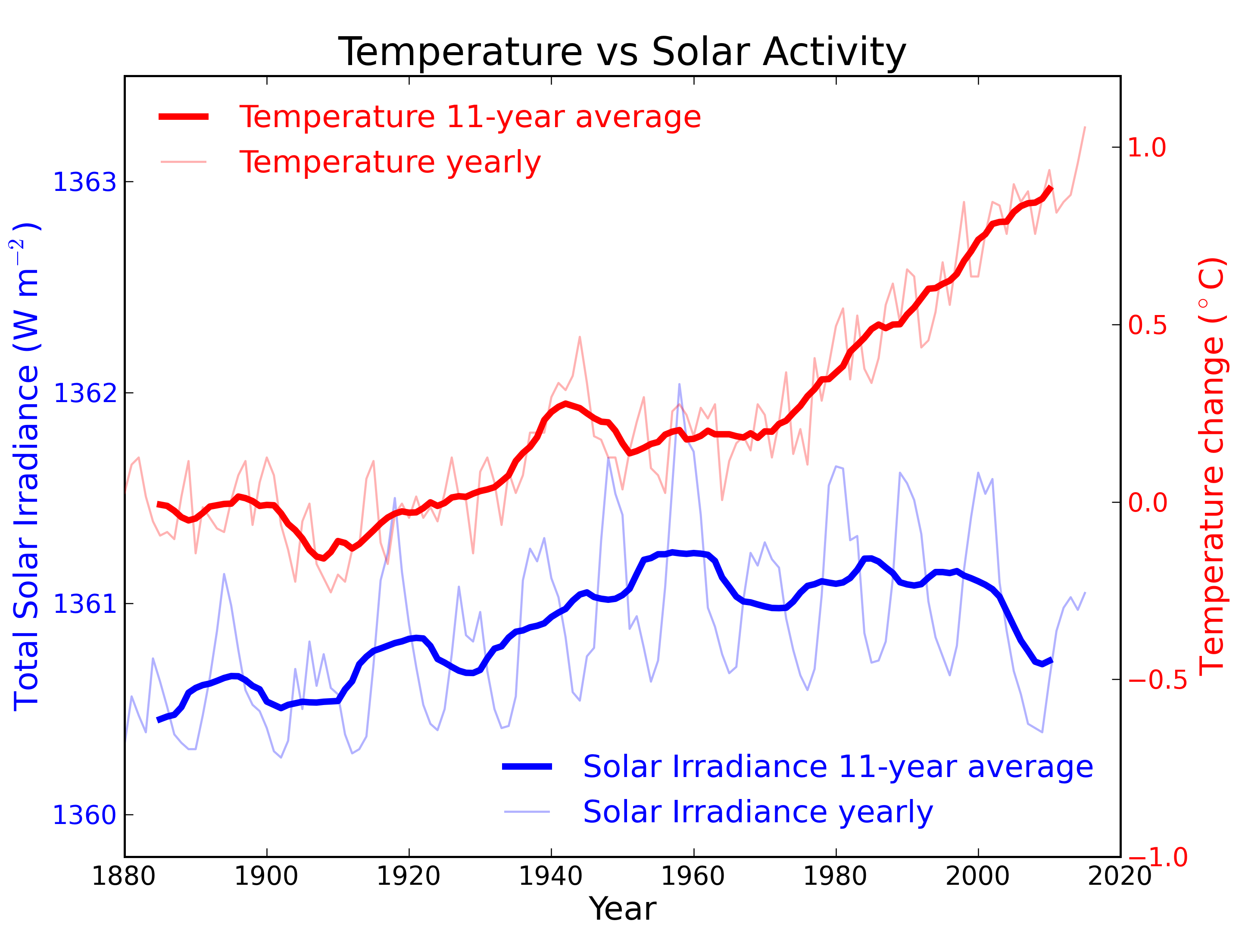
Figure 1. "Global annual temperatures up to the year 2015 (thin light red, with an 11-year moving average shown as a thick dark red line) have increased steadily, even though the total amount of energy from the sun (the annual Total Solar Irradiance, thin light blue, with an 11-year moving average shown as a thick dark blue line) has decreased slightly. Climate in past eras has seen many instances of global warming, which have been caused by an increase in heat-trapping gases like carbon dioxide or an increase in the amount of solar energy being absorbed by the Earth. Since solar energy cannot be to blame for the increase in global temperatures since 1950, scientists are confident that the steadily rising levels of heat trapping gases like carbon dioxide due to human activities is causing the observed global warming. Image credit: skepticalscience.com."
This is a kind of ink-blot test, it seems, or the "young and old women" sketch. I see a young woman -- what do you see?
What I see is a very slight increase in solar radiation -- about one part in 3000 -- from 1880 to 1960. Then it stays high until about 2000, as warming continues, until it drops over the past few years.
While I am not a climatologist, I would be surprised if solar radiation and CO2 were the only factors in determining atmospheric temperatures. But if I believed that those were the only factors (and I've seen many scientists name others), then I would say this graph seems to support the theory that solar radiation may be to blame for a good chunk of the warming. There are often lags between causes and effects, after all -- which is why December 21 is not the middle of winter, to pick an obvious example related to radiation, or why 12 noon is not usually the hottest time of day.
Let us consider some neglected background facts. Glaciers started melting in much of the world about the mid-1800s. (Including in the Mendenhall Valley outside of Juneau, where I went to school -- our home there had been covered by glaciers not too many decades before.) In the 19th Century -- and really, up until World War II -- carbon burning was a tiny fraction of what it is today. Hardly anyone had cars, and industrial output, even population, were fractional compared to today. Yet the globe was warming during those years -- years mostly left off this chart.
So clearly there was a lot of warming going on towards the left hand side of this chart, and beyond, little if any of which can be explained by AGW.
Shouldn't Masters have mentioned that?
"The best science says: ALL of the warming since 1950 is human-caused
"Based on the evidence, more than 97% of climate scientists have concluded that human-caused climate change is happening.
Masters gives the same fake link, which proves nothing of the sort.
"That’s about the same certainty with which scientists link smoking cigarettes to lung cancer."
This time Masters links to an article from Scientific American, which offers no such data.
"The latest 2013 Intergovernmental Panel on Climate Change (IPCC) report—the enormous consensus scientific summary of the science of climate change prepared once every six years--had this to say about the observed warming of Earth since 1950:
“The best estimate of the human-induced contribution to warming is similar to the observed warming over this period.”
"In other words, ALL of the observed warming after 1950 (0.6°C, 1.1°F) is due to humans. A total of 0.85°C (1.5°F) total global warming has been observed since 1880. The IPCC further quantified that human activity is extremely likely (at least 95% chance) to be responsible for more than half of Earth's temperature increase after 1950."
Masters conflates "best estimate" and "is similar to" with "all is." The IPCC is, to give it credit, rather more cautious. But even their estimate is consistent with most warming since, say, 1850 when the glaciers started retreating, being due to other causes.
And that has been my view for many years. Given the longer-term trend not since the 1950s but since the 1850s, and some respect for Occam, it seems to me likely that human activity has contributed between a third and a half of the global warming over the past 170 years.
Three more facts seem worth pondering.
First, the warming effect of CO2 is proportional to the square of its increase. In other words, the more you add, the less impact each unit of CO2 has in warming the atmosphere.
Second, rapid industrialization and the purchase of cars in the former "Third World" (including China and India) mean that CO2 release may increase rapidly enough to have some impact, despite (1).
 Third, at the same time, technology is improving, gas mileage getting better, and the disasters that AGW fear-mongers have predicted, show little sign of materializing, when you look at the facts objectively, and recognize that Al Gore won his Nobel Peace Prize from his friends in Oslo (where Weather Underground says it is snowing right now, by the way), mostly for waving his hands and tricking his viewers with fake claims. But those claims can all wait until Jeff Master's next scientifically-challenged post, which no doubt will warn of world-wide drought, or hurricanes in Maine, or the return of malaria to Siberia, or some other errant horse of the apocalypse.
"Our planet has just experienced three consecutive warmest years on record—2014, 2015, and 2016—which has made it difficult to find politicians who continue to deny the reality of global warming and climate change. However, denial of climate science has shifted to a new tactic: to claim that the indisputable heating of the planet is primarily a natural phenomenon, and that there is major uncertainty among scientists on the issue."
Deniers have picked a "new tactic" because of three warm years? I've been saying this for a decade or so.
"These assertions are false. Based on the evidence, more than 97% of climate scientists have concluded that human-caused climate change is happening; scientists’ “best estimate” is that ALL of the global warming since 1950 has been human-caused, primarily through an increase in carbon dioxide due to the burning of fossil fuels."
The link Masters gives does not go directly to any survey of climate scientists, but to an Anthropogenic Global Warm cheer-leading page. That page does, however, provide a link to support that claim, which states:"The number of papers rejecting AGW [Anthropogenic, or human-caused, Global Warming] is a miniscule proportion of the published research, with the percentage slightly decreasing over time. Among papers expressing a position on AGW, an overwhelming percentage (97.2% based on self-ratings, 97.1% based on abstract ratings) endorses the scientific consensus on AGW.”
Which casts into doubt Jeff Master's credibility as a straight shooter, or as a thinker. It should be obvious that a survey of published papers "expressing a position on AGW" is quite different from "any survey of climate scientists." Doesn't Masters recognize the difference? If not, he shouldn't be talking about science. If so, well go to Confession this week and tell your priest you've been fooling readers, Mr. Masters.
One simply cannot conclude from the fact that most published papers expressing an opinion support strong AGW (if they do, let us not concede that too readily), that most scientists believe in it. There may be systematic bias among journal editors. They may be afraid to publish against the alleged "consensus." Or most likely of all, the expressing of an opinion is a self-selecting act: scientists who are unsure, are unlikely to express their views in a paper.
What is certain, it that Master's claim does not follow from his (hidden behind two links) premises. He has misrepresented his sources.
"Many prominent members of the Trump administration, who all have ties to the fossil fuel industry, have been making false claims about scientists’ understanding that global warming is human-caused. For example:"
We recognize that as "ad hominem." These men may have ties to the devil (in fact three of them represented states that produce fossil fuels), that would not disprove their points.
"During his hearing in January 2017 to become the new EPA administrator, Scott Pruitt claimed: 'There is a diverse range of views regarding the key drivers of our changing climate among scientists.'”
And no doubt there is -- 'diversity of opinions" is one of the chief cliches in almost every field of scholarship. If opinions on so complex a matter were not "diverse," then something rotten would be found in the state of science.
But Pruitt also said, "the climate is changing, and human activity contributes to that in some manner." Forgot to quote that part, didn't you, Mr. Masters?
"Former Exxon-Mobil CEO Rex Tillerson, who is now President Trump’s Secretary of State, claimed in his confirmation hearing: 'I agree with the consensus view that combustion of fossil fuels is a leading cause for increased concentrations of greenhouse gases in the atmosphere. I understand these gases to be a factor in rising temperatures, but I do not believe the scientific consensus supports their characterization as the ‘key’ factor.”
Nor has Pruitt shown otherwise.
"On the February 21, 2014, edition of MSNBC’s The Daily Rundown, host Chuck Todd asked future Vice President Mike Pence if he was “convinced that climate change is man-made.” Pence responded: “I don't know that that is a resolved issue in science today.” Pence similarly stated on the May 5, 2009, edition of MSNBC’s Hardball that “I think the science is very mixed on the subject of global warming.”
- Rick Perry, Trump’s nominee for Secretary of Energy, told the Senate Energy and Natural Resources committee in January: “I believe the climate is changing. I believe some of it's naturally occurring and some of it is caused by man-made activity.”
Well good! Sounds like Trump has wisely appointed some people with proper scientific caution to key positions.
What sort of dingbat would say that none of the climate change was caused by natural cycles or events? That sort of statement really would cast doubt on a public official's good sense.
Figure 1. "Global annual temperatures up to the year 2015 (thin light red, with an 11-year moving average shown as a thick dark red line) have increased steadily, even though the total amount of energy from the sun (the annual Total Solar Irradiance, thin light blue, with an 11-year moving average shown as a thick dark blue line) has decreased slightly. Climate in past eras has seen many instances of global warming, which have been caused by an increase in heat-trapping gases like carbon dioxide or an increase in the amount of solar energy being absorbed by the Earth. Since solar energy cannot be to blame for the increase in global temperatures since 1950, scientists are confident that the steadily rising levels of heat trapping gases like carbon dioxide due to human activities is causing the observed global warming. Image credit: skepticalscience.com."
This is a kind of ink-blot test, it seems, or the "young and old women" sketch. I see a young woman -- what do you see?
What I see is a very slight increase in solar radiation -- about one part in 3000 -- from 1880 to 1960. Then it stays high until about 2000, as warming continues, until it drops over the past few years.
While I am not a climatologist, I would be surprised if solar radiation and CO2 were the only factors in determining atmospheric temperatures. But if I believed that those were the only factors (and I've seen many scientists name others), then I would say this graph seems to support the theory that solar radiation may be to blame for a good chunk of the warming. There are often lags between causes and effects, after all -- which is why December 21 is not the middle of winter, to pick an obvious example related to radiation, or why 12 noon is not usually the hottest time of day.
Let us consider some neglected background facts. Glaciers started melting in much of the world about the mid-1800s. (Including in the Mendenhall Valley outside of Juneau, where I went to school -- our home there had been covered by glaciers not too many decades before.) In the 19th Century -- and really, up until World War II -- carbon burning was a tiny fraction of what it is today. Hardly anyone had cars, and industrial output, even population, were fractional compared to today. Yet the globe was warming during those years -- years mostly left off this chart.
So clearly there was a lot of warming going on towards the left hand side of this chart, and beyond, little if any of which can be explained by AGW.
Shouldn't Masters have mentioned that?
"The best science says: ALL of the warming since 1950 is human-caused
"Based on the evidence, more than 97% of climate scientists have concluded that human-caused climate change is happening.
Masters gives the same fake link, which proves nothing of the sort.
"That’s about the same certainty with which scientists link smoking cigarettes to lung cancer."
This time Masters links to an article from Scientific American, which offers no such data.
"The latest 2013 Intergovernmental Panel on Climate Change (IPCC) report—the enormous consensus scientific summary of the science of climate change prepared once every six years--had this to say about the observed warming of Earth since 1950:
“The best estimate of the human-induced contribution to warming is similar to the observed warming over this period.”
"In other words, ALL of the observed warming after 1950 (0.6°C, 1.1°F) is due to humans. A total of 0.85°C (1.5°F) total global warming has been observed since 1880. The IPCC further quantified that human activity is extremely likely (at least 95% chance) to be responsible for more than half of Earth's temperature increase after 1950."
Masters conflates "best estimate" and "is similar to" with "all is." The IPCC is, to give it credit, rather more cautious. But even their estimate is consistent with most warming since, say, 1850 when the glaciers started retreating, being due to other causes.
And that has been my view for many years. Given the longer-term trend not since the 1950s but since the 1850s, and some respect for Occam, it seems to me likely that human activity has contributed between a third and a half of the global warming over the past 170 years.
Three more facts seem worth pondering.
First, the warming effect of CO2 is proportional to the square of its increase. In other words, the more you add, the less impact each unit of CO2 has in warming the atmosphere.
Second, rapid industrialization and the purchase of cars in the former "Third World" (including China and India) mean that CO2 release may increase rapidly enough to have some impact, despite (1).
Third, at the same time, technology is improving, gas mileage getting better, and the disasters that AGW fear-mongers have predicted, show little sign of materializing, when you look at the facts objectively, and recognize that Al Gore won his Nobel Peace Prize from his friends in Oslo (where Weather Underground says it is snowing right now, by the way), mostly for waving his hands and tricking his viewers with fake claims. But those claims can all wait until Jeff Master's next scientifically-challenged post, which no doubt will warn of world-wide drought, or hurricanes in Maine, or the return of malaria to Siberia, or some other errant horse of the apocalypse. Tuesday, December 29, 2015
How does John Loftus (or anyone) know anything?

Saturday, October 05, 2013
Don Page critiques TACT
Earlier this year, debating Richard Carrier, I introduced an argument for the existence of God that I have now christened TACT -- the Theistic Argument from Cultural Transcendence. In defending the argument against the subsequent attacks of Hector Avalos, I explained it in the following syllogism:
(a) If an understanding of God transcends a particular culture, it is much more likely to be true than if it does not.
(b) The idea of God does, in fact, transcend the Abrahamic tradition from which monotheism is often said to have arisen. It can, in fact, be found in many highly scattered and diverse cultures, where it must have arisen independently.
(c) Therefore God is much more likely to be real than religious ideas that are limited to one particular culture, or flow out from one localized source.
I then explained why I think this argument has some force in a later post, made a brief case for the first two premises, and defended the argument against criticism.
Recently I showed the first of those responses to several people, including the eminent quantum physicist Don Page, who kindly contributed a chapter to our book last year, Faith Seeking Understanding. I don't know if he read the last post or not, which perhaps I should have linked as well.
Anyway, Don replied with some helpfully critical comments. In this post I would like to consider his criticism, which focus on the first premise of TACT, and determine whether, in light of that criticism, we should consider that premise to be true.
I am not entirely satisfied with my response, yet, and admit that Don's critique carries some force. But while the argument still requires more thought, and critique from those who doubt it, as I'm pretty sure I'm missing something, I think the following will show that TACT at least potentially does carry some force, as well.
"The TACT is an interesting argument. Of course, if someone can also show that atheism developed independently in different cultures, the point that the concept of God also did would not be much evidence that it is the concept of God rather than atheism that is correct.
"In science, it is not clear to me whether an idea would be more reliable if it arose many times independently or whether it originated once and then was thought to be good by many people. In some sense special relativity is sort of an example of the former, with several people coming up with some of the basic ideas (though of course they all inherited a huge commonality in their background knowledge) and then with Einstein giving the most clear formulation of it (though special relativity would almost certainly have been fairly fully developed within a few years even if Einstein had not existed). General relativity is a more rare example of the latter, in that it was independently developed almost entirely by Einstein (though admittedly after Einstein explained his basic ideas to Hilbert, who was a much more able mathematician, Hilbert found a way to give the precise field equations Einstein was looking for a bit earlier than Einstein himself did with his less sophisticated mathematics). If Einstein had not developed general relativity, it almost certainly would have been developed eventually, but probably not for decades, as compared with months or just a few years for special relativity.
"Now special relativity has much more applicability (to everything moving at speeds not negligibly small compared with the speed of light) than general relativity (which is an important improvement over Newtonian gravity only when gravity is so strong that it does or potentially could produce free-fall velocities not negligibly small compared with the speed of light), so special relativity spread much more rapidly than general relativity, but once the ideas were understood and the experimental evidence came in, general relativity also became widely accepted, and people did not criticize it just because it essentially arose only once independently in human history.
"Of course, in science it is often easier to test ideas than in theology or philosophy (though now there are ideas of superstrings and multiverses that may take decades to test), so it perhaps matters less how they originate. But I don't yet clearly understand how it makes much difference for the question of whether or not theism is true that the concept of theism has arisen independently in several or many different cultures."
To which I briefly replied,
Thanks, Don. I appreciate a critical response. Of course, it is different to say a Being exists and transcends cultures, who may possibly reveal Himself, than to affirm an idea or scientific law that could conceivably be discovered (or overlooked) by people in different cultures. But no doubt further analysis and explanation is needed. Since you kindly offer the suggestion, I may indeed post your thoughts on my blog this week, and consider how my argument may or may not work in light of those objections.
Don then answered:
"I suppose one question is whether there is some significant difference in the way the idea of theism may arise from the way the idea of atheism may arise. If both are just hypotheses that arise among humans, the fact that many cultures have come up with both does not give much information as to which idea is better. But if some ideas of theism came from detailed specific revelations such as God's burning-bush revelation to Moses, then if the reports of this revelation can be trusted, to me it would seem to count a lot more than an idea of atheism that came without such a detailed specific revelation. In principle it seems much harder for no-god to reveal the truth of atheism than for God to reveal His existence, just as it is easier for a coelacanth to reveal its existence than for anything to reveal that a coelacanth does not exist.
"So for me what seems most important is the reliability of reports of specific revelations. If there are indeed reliable reports of such revelations in a larger number of independent cultures (reducing the risk that some people would falsely claim to have seen what they had heard reported that others had seen), that would seem to increase the evidence for these revelations actually to have happened, but if the reliable revelations are confined to a small number of cultures, and the rest just have hypotheses without clear evidence for them, then I don't see that the existence of these hypotheses that arise independently is much support for their truth (other than to say that perhaps one should not dismiss them as a priori highly improbable, as many seem to do today to avoid the bother of looking carefully at the historical evidence)."
These criticisms may indeed weigh against some construals of TACT, and helpfully challenge its first premise. I think, though, that there is more to TACT that an analogy to physical theory or even simple observation can bring out. To recognize that, let's begin by considering how we know things.
Roughly speaking, all our knowledge comes from four potential sources: (1) the mind, which discerns relations and logical connections, and stores memories; (2) the senses, which give the mind raw data on which to work, and tell us "what is out there;" (3) other people; (4) and superhuman beings, such as God, or perhaps, aliens. (We might also deduce that someone is at the door from the bark of the dog, whether we reduce Fido to (2), or elevate him to (3).)
If God exists, and Saint Paul is right in saying, "That which is known about God is evident within them, for God has made it evident to them," then one would expect knowledge of God to appear not just within one culture, but around the world. However, Paul goes on to say that while God's "eternal power and divine nature" are "clearly seen" through "what has been made," people "suppress the truth in unrighteousness."
So Christianity predicts that awareness of God would be nearly universal, though not overwhelming, but often or usually denied, even "suppressed," in favor of idolatry and sin.
If that is the pattern we actually find, that makes Christianity more likely to be true, for the predictive value of the anthropological model it postulates. (Compared, say, to David Hume and the New Atheists, who fail to predict such a pattern, and who in fact predict the opposite, that "God" will be absent in primitive cultures, or arise in an evolutionary manner.)
But this passage seems to leave open several possible ways in which God might "make it evident" that he exists:
(1) It may be that the laws of Nature are such that it is rational, or at least seems rational, to deduce the existence of a good and rational Creator and Law-Giver -- reliance mainly on the first two forms of knowledge. This seems to be the model Dr. Page assumes above.
If that is so, then given our dependence on other people for knowledge, the fact that rational people in many cultures do in fact deduce God, from a variety of premises, does lend some a priori support to the plausibility of theism. Of course, one would still need to check the cogency of the arguments they make, as Page reminds us. If we check those arguments, we may find that (a) some seem to work, (b) all seem to fail, or (c) we aren't sure about all of them. But even in the case of (b) or (c), it is reasonable to leave room for the possibility that we are missing something, especially when we find such brilliant people as Aquinas, Anselm, or Plantinga making such arguments. It is sensible for human beings to recognize our limits, recognize also that God may reveal himself rationally but inchoately through Nature, and that people in particular social environments, or liable to particular sins, may consequently be weakened in their capacity to follow certain rational lines of argument. And we may be among those people. For instance, I confess that I do not understand subtler versions of the Ontological Argument. So I take the fact that someone like Plantinga seems to find something in them, as a reason not to dismiss the argument too strongly.
If belief in God is deduced in diverse cultures, of course it is possible that all the people who deduce Him are wrong, just as all the people who see the sun go across the sky and deduce that the sun circles the Earth, are wrong. But God by hypothesis is rationally known through creation. And since God is clever, his revelation may be of such an inchoate rationality that it will bypass some of the "wise" yet rightly appeal to savages who watch sheep under the stars or run through the jungle (as Paul also seems to suggest). So I think it would still be intellectually encouraging to find that rational arguments for theism could hold their ground not only in the sorts of public debates William Lane Craig sports in, but also in diverse cultures.
Recall that the conclusion of TACT is not "God must exist." Rather, it is that theism is more plausible than are beliefs that arise in just one locality. I grant that if we construe TACT's first premise on (1), then Dr. Page's objection from the analogy to scientific theories carries some weight. But even so, biblical theism seems to predict the actual pattern that we find, and why arguments for God may be rational, simple, even almost self-evident, yet also be "plausibly deniable," and therefore not spread with the same overwhelming power among the cognoscenti as, say, the Special Theory of Relativity.
So even construing Paul's words on (1), I think TACT is somewhat successful -- also for other reasons to be given at the end of this post.
(2) It may also be that Paul means that God reveals himself to human beings directly, or to some human beings at some times, or to people whose hearts have been prepared, whose lives, like the lens of a telescope, have been adequately cleansed, one might say, or for whom God has some special mission. Perhaps that revelation is still what we call "general," a sense of awareness that is like a spiritual organ in our hearts, an "eye of faith," if you will, not blind faith but one that sees what is.
In that case, the fact that awareness of God appears in different cultures, would be analogous to the fact that people in many countries recognize a round moon. There may be some people with bad eyes who see two moons or just a blurry light in the sky - I'm heading in that direction. But the fact that people in hundreds of cultures do come to recognize a Creator God with a character like that set out in the Bible, would in that case be reason to think God is in fact real.
Of course, unlike the moon or physical laws, God is, by hypothesis, a person, and a person more intelligent than human beings. This means that the pattern of how He reveals Himself will follow some reason, but that reason we may or may not be able to discern, or perhaps we can discern it in some cases, to some extent, but not in others.
But the fact that empirical descriptions of the moon from different parts of Earth match, even if descriptions may differ, and people with bad eyes may not see it well, and poets may describe it strangely, is evidence that people are "seeing" the same real object. If we "perceive" God in a similar way, similarities across cultures do provide evidence for ontological reality.
(3) It may also be, as Dr. Page mentioned in his second e-mail, that God takes special action to reveal Himself to particular people around the world. Don Richardson describes several such apparent special revelations, and I have heard such accounts from other missionaries.
Given each of these possibilities, the fact that we do find awareness of God in hundreds of cultures around the world, I think does his existence more likely than it would be if we did not find such a phenomena. The fact that that knowledge is often obscured, even actively suppressed, actually fits the biblical pattern and therefore makes Christian faith more credible still.
However, this does not prove that God exists, because it may also be possible to explain this phenomena from a skeptical point of view. Given a misleading appearance, such as the apparent motion of the sun across the sky, people in many cultures may make similar but wrong deductions about that phenomena: the sun moves from east to west. Maybe people deduce God because the world "looks designed" but is not, the Blind Watchmaker has played a trick on us. Or maybe we are hard-wired to believe in Parental Authority, and go on believing as adults, setting that Ultimate Authority in the sky. (In which case, though, it is hard to understand why God seems relatively absent in some cultures.)
So I do not claim TACT is a conclusive argument. But as I pointed out in my final response to Avalos, it does seem to work on six levels, beginning again with the moon. In conclusion, let me rework those comments somewhat:
(1) First, there is the simple level of analysis by Durkheim, Dawkins, Dennett, and Carrier . . . If God does not transcend particular cultures, he is less likely to be real. This demonstrates the converse: if God does transcend particular cultures, he is more likely to be real. Some object that this commits the genetic fallacy, fallacious assuming that the origin of an idea determines its validity. (And this is what Dr. Page is getting at, too.)
This is complex, but sometimes the origin of an idea is very relevant to its plausibility.
Suppose you are in radio communication with different tribes on a planet too far away to tell if the planet has any natural satellites. You find out that the people dwell separately on 100 islands, separated by waters so rough they cannot cross them, speak different languages, and cannot communicate. (They just obtained radios by a US government "Welfare for Aliens" grant, from a passing space ship.) Suppose each tribe reported something different about the planet's satellites -- it has no moon, it has 50 moons, the moon is round, the moon is shaped like a donut, it's green, it's red, it's almost invisible, it fills half the sky. You might conclude that you know nothing sure about the planet's moons -- whether because of clouds, the inhabitants are blind, or they are inveterate liars.
Suppose, however, that half the tribes give similar but not exactly equal reports. The planet has two moons: one big, round, yellowish or light green, and smooth, the other small, reddish, elongated with large craters on the surface. (Though slightly different hues are named, and not everyone reports that smaller second moon.)
The other tribes give mixed and inconsistent reports, as in the first scenario.
In both cases, you are relying entirely on reports from "people" you don't know. But I think it's reasonable to believe what the second set of reports agree upon, even if you only find the first set confusing. You might suppose that those tribes which fail to report on the planet's two moons, live in areas subject to heavy cloud cover, or are run by paranoid North Korea type regimes and think you are planning an invasion from their planet's moon. (Or perhaps they were also given copies of Avatar by the passing space ship dubbed in local languages.) So they don't want you to know what their moons are like, and are shining you shamelessly.
(2) Second, there is Avalos' own implicit argument. If God does not transcend particular KINDS of cultures, "patriarchal" and all that, Avalos seems to imply that He is less likely to be real. From which it follows, since God DOES transcend particular kinds of culture, He is more likely to be real.
The point here is that religion is supposed, as above, to be the product of social evolution. From which it follows (and this is a very old idea) religions will reflect the character of the tribes in which they arise. The Chinese Heaven will be bureaucratic. (As indeed it is, in Journey to the West.) The Greek Olympus will be crowded with quarreling, skirt-chasing gods (as in the Iliad). Amazon tribes will worship a jaguar, and North American tribes, a coyote.
So an idea of God that arises in many different kinds of culture, independent of the variety of political systems, is more likely to be true than theologies that can be explained by peculiar systems.
(3) Third, there is the simple predictive element. St. Paul predicts that God will transcend cultures. David Hume strongly denies it. Paul is right, Hume (despite the advantage of 1700 years) is wrong.
This is startling, especially when you consider Hume's brilliance, as well as his knowledge of a wider spectrum of human cultures. Again, it might be that both were too ignorant of science and anthropology for us to bother with their primitive theories. But modern atheists who do seem to know science well, like Richard Dawkins, still get this wrong, while Paul and St. Augustine get it right.
(4) Fourth, there is the complex predictive element. St. Paul predicts that while God will be widely known, he will also be widely denied, and idolatry and worship of "the creature" will be practiced. Paul saw that all around him, but he had no way of knowing it would also be true in South America and Mongolia.
Let's return to our Island Planet analogy. Suppose your astronomer friends predict, given the planet's aquatic habitat, that the sky will only be clearly visible from about half the planet, with clouds almost permanently obscuring the heavens the rest of the time. Suppose they also tell you that if the planet has a moon, it will be in tidal lock with the planet. So even when the moon is visible, through obscuring vapors, from some angles it might appear through a sunset glow, which is deep crimson on that planet, and will be elongated by atmospheric refraction. (That being the only time of year that the vapors clear.) Furthermore, the moon will be invisible from much of the planet, but an asteroid belt might be visible for creatures with eagle eyes. And not having seen a "moon," people speaking their language naturally use the word for "asteroid" that you mistake as meaning "moon."
Paul's anthropology similarly seems to predict, not just "God" simply, but a common but obscured and often twisted concept of God, along with lesser beings that may be mistaken for him. This greater detail in prediction thus renders the Christian model of religions not weaker, but far stronger, and can be construed as evidence for the truth of Christian anthropology.
(5) Fifth, there is the fact that God is seen as transcending particular cultures, even by those within those transcended cultures. Durkheim admits that Australian tribes recognized "God" as belonging to more than just their own tribes. Readers of the Chinese Classics and oracle bones find evidence for this in ancient China as well . . .
(6) Sixth (and here things may get downright scary for skeptics), there is Don Richardson's observation that the "God" of pagan cultures often seems to prepare his believers to welcome the Good News of Jesus Christ. (He relates the story in Eternity in Their Hearts.)
(a) If an understanding of God transcends a particular culture, it is much more likely to be true than if it does not.
(b) The idea of God does, in fact, transcend the Abrahamic tradition from which monotheism is often said to have arisen. It can, in fact, be found in many highly scattered and diverse cultures, where it must have arisen independently.
(c) Therefore God is much more likely to be real than religious ideas that are limited to one particular culture, or flow out from one localized source.
I then explained why I think this argument has some force in a later post, made a brief case for the first two premises, and defended the argument against criticism.
Recently I showed the first of those responses to several people, including the eminent quantum physicist Don Page, who kindly contributed a chapter to our book last year, Faith Seeking Understanding. I don't know if he read the last post or not, which perhaps I should have linked as well.
Anyway, Don replied with some helpfully critical comments. In this post I would like to consider his criticism, which focus on the first premise of TACT, and determine whether, in light of that criticism, we should consider that premise to be true.
I am not entirely satisfied with my response, yet, and admit that Don's critique carries some force. But while the argument still requires more thought, and critique from those who doubt it, as I'm pretty sure I'm missing something, I think the following will show that TACT at least potentially does carry some force, as well.
"The TACT is an interesting argument. Of course, if someone can also show that atheism developed independently in different cultures, the point that the concept of God also did would not be much evidence that it is the concept of God rather than atheism that is correct.
"In science, it is not clear to me whether an idea would be more reliable if it arose many times independently or whether it originated once and then was thought to be good by many people. In some sense special relativity is sort of an example of the former, with several people coming up with some of the basic ideas (though of course they all inherited a huge commonality in their background knowledge) and then with Einstein giving the most clear formulation of it (though special relativity would almost certainly have been fairly fully developed within a few years even if Einstein had not existed). General relativity is a more rare example of the latter, in that it was independently developed almost entirely by Einstein (though admittedly after Einstein explained his basic ideas to Hilbert, who was a much more able mathematician, Hilbert found a way to give the precise field equations Einstein was looking for a bit earlier than Einstein himself did with his less sophisticated mathematics). If Einstein had not developed general relativity, it almost certainly would have been developed eventually, but probably not for decades, as compared with months or just a few years for special relativity.
"Now special relativity has much more applicability (to everything moving at speeds not negligibly small compared with the speed of light) than general relativity (which is an important improvement over Newtonian gravity only when gravity is so strong that it does or potentially could produce free-fall velocities not negligibly small compared with the speed of light), so special relativity spread much more rapidly than general relativity, but once the ideas were understood and the experimental evidence came in, general relativity also became widely accepted, and people did not criticize it just because it essentially arose only once independently in human history.
"Of course, in science it is often easier to test ideas than in theology or philosophy (though now there are ideas of superstrings and multiverses that may take decades to test), so it perhaps matters less how they originate. But I don't yet clearly understand how it makes much difference for the question of whether or not theism is true that the concept of theism has arisen independently in several or many different cultures."
To which I briefly replied,
Thanks, Don. I appreciate a critical response. Of course, it is different to say a Being exists and transcends cultures, who may possibly reveal Himself, than to affirm an idea or scientific law that could conceivably be discovered (or overlooked) by people in different cultures. But no doubt further analysis and explanation is needed. Since you kindly offer the suggestion, I may indeed post your thoughts on my blog this week, and consider how my argument may or may not work in light of those objections.
Don then answered:
"I suppose one question is whether there is some significant difference in the way the idea of theism may arise from the way the idea of atheism may arise. If both are just hypotheses that arise among humans, the fact that many cultures have come up with both does not give much information as to which idea is better. But if some ideas of theism came from detailed specific revelations such as God's burning-bush revelation to Moses, then if the reports of this revelation can be trusted, to me it would seem to count a lot more than an idea of atheism that came without such a detailed specific revelation. In principle it seems much harder for no-god to reveal the truth of atheism than for God to reveal His existence, just as it is easier for a coelacanth to reveal its existence than for anything to reveal that a coelacanth does not exist.
"So for me what seems most important is the reliability of reports of specific revelations. If there are indeed reliable reports of such revelations in a larger number of independent cultures (reducing the risk that some people would falsely claim to have seen what they had heard reported that others had seen), that would seem to increase the evidence for these revelations actually to have happened, but if the reliable revelations are confined to a small number of cultures, and the rest just have hypotheses without clear evidence for them, then I don't see that the existence of these hypotheses that arise independently is much support for their truth (other than to say that perhaps one should not dismiss them as a priori highly improbable, as many seem to do today to avoid the bother of looking carefully at the historical evidence)."
These criticisms may indeed weigh against some construals of TACT, and helpfully challenge its first premise. I think, though, that there is more to TACT that an analogy to physical theory or even simple observation can bring out. To recognize that, let's begin by considering how we know things.
Roughly speaking, all our knowledge comes from four potential sources: (1) the mind, which discerns relations and logical connections, and stores memories; (2) the senses, which give the mind raw data on which to work, and tell us "what is out there;" (3) other people; (4) and superhuman beings, such as God, or perhaps, aliens. (We might also deduce that someone is at the door from the bark of the dog, whether we reduce Fido to (2), or elevate him to (3).)
If God exists, and Saint Paul is right in saying, "That which is known about God is evident within them, for God has made it evident to them," then one would expect knowledge of God to appear not just within one culture, but around the world. However, Paul goes on to say that while God's "eternal power and divine nature" are "clearly seen" through "what has been made," people "suppress the truth in unrighteousness."
So Christianity predicts that awareness of God would be nearly universal, though not overwhelming, but often or usually denied, even "suppressed," in favor of idolatry and sin.
If that is the pattern we actually find, that makes Christianity more likely to be true, for the predictive value of the anthropological model it postulates. (Compared, say, to David Hume and the New Atheists, who fail to predict such a pattern, and who in fact predict the opposite, that "God" will be absent in primitive cultures, or arise in an evolutionary manner.)
But this passage seems to leave open several possible ways in which God might "make it evident" that he exists:
(1) It may be that the laws of Nature are such that it is rational, or at least seems rational, to deduce the existence of a good and rational Creator and Law-Giver -- reliance mainly on the first two forms of knowledge. This seems to be the model Dr. Page assumes above.
If that is so, then given our dependence on other people for knowledge, the fact that rational people in many cultures do in fact deduce God, from a variety of premises, does lend some a priori support to the plausibility of theism. Of course, one would still need to check the cogency of the arguments they make, as Page reminds us. If we check those arguments, we may find that (a) some seem to work, (b) all seem to fail, or (c) we aren't sure about all of them. But even in the case of (b) or (c), it is reasonable to leave room for the possibility that we are missing something, especially when we find such brilliant people as Aquinas, Anselm, or Plantinga making such arguments. It is sensible for human beings to recognize our limits, recognize also that God may reveal himself rationally but inchoately through Nature, and that people in particular social environments, or liable to particular sins, may consequently be weakened in their capacity to follow certain rational lines of argument. And we may be among those people. For instance, I confess that I do not understand subtler versions of the Ontological Argument. So I take the fact that someone like Plantinga seems to find something in them, as a reason not to dismiss the argument too strongly.
If belief in God is deduced in diverse cultures, of course it is possible that all the people who deduce Him are wrong, just as all the people who see the sun go across the sky and deduce that the sun circles the Earth, are wrong. But God by hypothesis is rationally known through creation. And since God is clever, his revelation may be of such an inchoate rationality that it will bypass some of the "wise" yet rightly appeal to savages who watch sheep under the stars or run through the jungle (as Paul also seems to suggest). So I think it would still be intellectually encouraging to find that rational arguments for theism could hold their ground not only in the sorts of public debates William Lane Craig sports in, but also in diverse cultures.
Recall that the conclusion of TACT is not "God must exist." Rather, it is that theism is more plausible than are beliefs that arise in just one locality. I grant that if we construe TACT's first premise on (1), then Dr. Page's objection from the analogy to scientific theories carries some weight. But even so, biblical theism seems to predict the actual pattern that we find, and why arguments for God may be rational, simple, even almost self-evident, yet also be "plausibly deniable," and therefore not spread with the same overwhelming power among the cognoscenti as, say, the Special Theory of Relativity.
So even construing Paul's words on (1), I think TACT is somewhat successful -- also for other reasons to be given at the end of this post.
(2) It may also be that Paul means that God reveals himself to human beings directly, or to some human beings at some times, or to people whose hearts have been prepared, whose lives, like the lens of a telescope, have been adequately cleansed, one might say, or for whom God has some special mission. Perhaps that revelation is still what we call "general," a sense of awareness that is like a spiritual organ in our hearts, an "eye of faith," if you will, not blind faith but one that sees what is.
In that case, the fact that awareness of God appears in different cultures, would be analogous to the fact that people in many countries recognize a round moon. There may be some people with bad eyes who see two moons or just a blurry light in the sky - I'm heading in that direction. But the fact that people in hundreds of cultures do come to recognize a Creator God with a character like that set out in the Bible, would in that case be reason to think God is in fact real.
Of course, unlike the moon or physical laws, God is, by hypothesis, a person, and a person more intelligent than human beings. This means that the pattern of how He reveals Himself will follow some reason, but that reason we may or may not be able to discern, or perhaps we can discern it in some cases, to some extent, but not in others.
But the fact that empirical descriptions of the moon from different parts of Earth match, even if descriptions may differ, and people with bad eyes may not see it well, and poets may describe it strangely, is evidence that people are "seeing" the same real object. If we "perceive" God in a similar way, similarities across cultures do provide evidence for ontological reality.
(3) It may also be, as Dr. Page mentioned in his second e-mail, that God takes special action to reveal Himself to particular people around the world. Don Richardson describes several such apparent special revelations, and I have heard such accounts from other missionaries.
Given each of these possibilities, the fact that we do find awareness of God in hundreds of cultures around the world, I think does his existence more likely than it would be if we did not find such a phenomena. The fact that that knowledge is often obscured, even actively suppressed, actually fits the biblical pattern and therefore makes Christian faith more credible still.
However, this does not prove that God exists, because it may also be possible to explain this phenomena from a skeptical point of view. Given a misleading appearance, such as the apparent motion of the sun across the sky, people in many cultures may make similar but wrong deductions about that phenomena: the sun moves from east to west. Maybe people deduce God because the world "looks designed" but is not, the Blind Watchmaker has played a trick on us. Or maybe we are hard-wired to believe in Parental Authority, and go on believing as adults, setting that Ultimate Authority in the sky. (In which case, though, it is hard to understand why God seems relatively absent in some cultures.)
So I do not claim TACT is a conclusive argument. But as I pointed out in my final response to Avalos, it does seem to work on six levels, beginning again with the moon. In conclusion, let me rework those comments somewhat:
(1) First, there is the simple level of analysis by Durkheim, Dawkins, Dennett, and Carrier . . . If God does not transcend particular cultures, he is less likely to be real. This demonstrates the converse: if God does transcend particular cultures, he is more likely to be real. Some object that this commits the genetic fallacy, fallacious assuming that the origin of an idea determines its validity. (And this is what Dr. Page is getting at, too.)
This is complex, but sometimes the origin of an idea is very relevant to its plausibility.
Suppose you are in radio communication with different tribes on a planet too far away to tell if the planet has any natural satellites. You find out that the people dwell separately on 100 islands, separated by waters so rough they cannot cross them, speak different languages, and cannot communicate. (They just obtained radios by a US government "Welfare for Aliens" grant, from a passing space ship.) Suppose each tribe reported something different about the planet's satellites -- it has no moon, it has 50 moons, the moon is round, the moon is shaped like a donut, it's green, it's red, it's almost invisible, it fills half the sky. You might conclude that you know nothing sure about the planet's moons -- whether because of clouds, the inhabitants are blind, or they are inveterate liars.
Suppose, however, that half the tribes give similar but not exactly equal reports. The planet has two moons: one big, round, yellowish or light green, and smooth, the other small, reddish, elongated with large craters on the surface. (Though slightly different hues are named, and not everyone reports that smaller second moon.)
The other tribes give mixed and inconsistent reports, as in the first scenario.
In both cases, you are relying entirely on reports from "people" you don't know. But I think it's reasonable to believe what the second set of reports agree upon, even if you only find the first set confusing. You might suppose that those tribes which fail to report on the planet's two moons, live in areas subject to heavy cloud cover, or are run by paranoid North Korea type regimes and think you are planning an invasion from their planet's moon. (Or perhaps they were also given copies of Avatar by the passing space ship dubbed in local languages.) So they don't want you to know what their moons are like, and are shining you shamelessly.
(2) Second, there is Avalos' own implicit argument. If God does not transcend particular KINDS of cultures, "patriarchal" and all that, Avalos seems to imply that He is less likely to be real. From which it follows, since God DOES transcend particular kinds of culture, He is more likely to be real.
The point here is that religion is supposed, as above, to be the product of social evolution. From which it follows (and this is a very old idea) religions will reflect the character of the tribes in which they arise. The Chinese Heaven will be bureaucratic. (As indeed it is, in Journey to the West.) The Greek Olympus will be crowded with quarreling, skirt-chasing gods (as in the Iliad). Amazon tribes will worship a jaguar, and North American tribes, a coyote.
So an idea of God that arises in many different kinds of culture, independent of the variety of political systems, is more likely to be true than theologies that can be explained by peculiar systems.
(3) Third, there is the simple predictive element. St. Paul predicts that God will transcend cultures. David Hume strongly denies it. Paul is right, Hume (despite the advantage of 1700 years) is wrong.
This is startling, especially when you consider Hume's brilliance, as well as his knowledge of a wider spectrum of human cultures. Again, it might be that both were too ignorant of science and anthropology for us to bother with their primitive theories. But modern atheists who do seem to know science well, like Richard Dawkins, still get this wrong, while Paul and St. Augustine get it right.
(4) Fourth, there is the complex predictive element. St. Paul predicts that while God will be widely known, he will also be widely denied, and idolatry and worship of "the creature" will be practiced. Paul saw that all around him, but he had no way of knowing it would also be true in South America and Mongolia.
Let's return to our Island Planet analogy. Suppose your astronomer friends predict, given the planet's aquatic habitat, that the sky will only be clearly visible from about half the planet, with clouds almost permanently obscuring the heavens the rest of the time. Suppose they also tell you that if the planet has a moon, it will be in tidal lock with the planet. So even when the moon is visible, through obscuring vapors, from some angles it might appear through a sunset glow, which is deep crimson on that planet, and will be elongated by atmospheric refraction. (That being the only time of year that the vapors clear.) Furthermore, the moon will be invisible from much of the planet, but an asteroid belt might be visible for creatures with eagle eyes. And not having seen a "moon," people speaking their language naturally use the word for "asteroid" that you mistake as meaning "moon."
Paul's anthropology similarly seems to predict, not just "God" simply, but a common but obscured and often twisted concept of God, along with lesser beings that may be mistaken for him. This greater detail in prediction thus renders the Christian model of religions not weaker, but far stronger, and can be construed as evidence for the truth of Christian anthropology.
(5) Fifth, there is the fact that God is seen as transcending particular cultures, even by those within those transcended cultures. Durkheim admits that Australian tribes recognized "God" as belonging to more than just their own tribes. Readers of the Chinese Classics and oracle bones find evidence for this in ancient China as well . . .
(6) Sixth (and here things may get downright scary for skeptics), there is Don Richardson's observation that the "God" of pagan cultures often seems to prepare his believers to welcome the Good News of Jesus Christ. (He relates the story in Eternity in Their Hearts.)
Wednesday, September 25, 2013
Did Michael Behe Admit that Astrology is Science?
 The vast ranks of those who despise Intelligent Design are made up of frustrated Perry Mason fans, I think, pining for real-life court-room drama. Thus the popularity of pseudo-historical dramas like Inherit the Wind, and numerous references to the 2005 Dover Trial and the heroic Judge Jones, who ruled that Intelligent Design is not science, thus single-handedly saving the tattered remains of American democracy from conquest by IDiot zombies growling, squinting scared faces, and scaling the sacred fences of public education. Since folks who tell such horror stories are seldom historians, the tales grow into urban legends quickly (radical New Testament scholars appear to be right in supposing this can happen almost overnight), and live on in mutated form as enduringly as the dawn redwood.
One such legend is that in order to classify Intelligent Design as a scientific theory, in his testimony in the quasi-mythical Dover courtroom, Michael Behe admitted that astrology is science, too. And since astrology is manifest nonsense, not real science, obviously ID must be nonsense, too, worthy of all scoffing. Here's one succinct form in which I recently encountered this urban myth:
"The problem is that Intelligent Design is not science. Even Michael Behe admitted in the Kitzmiller trial that for ID to be considered science, then astrology would have to be considered science."
 |
| "Yes! I admit it! ID is witchcraft!" |
Let's read the transcript, obtained from Talk Origins, and see what really happened, and what Behe really admitted.
I'll highlight phrases that prove key, and provide occasional commentary.
Friday, June 28, 2013
Darwin's Doubt: six prejudices.

Flame wars between Darwinists and fans of Intelligent Design seem to be one way God teaches America science. So with Steve Meyer's new book, Darwin's Doubt, now off the presses, it is the season in which the kings go to war. Bombast rises like a smoke screen over the field of battle, lame and wounded arguments limp slowly to the rear, and explosions of high-octane vitriol are beginning to split the evening air. It is hard to tell, under the fog of war, who is advancing, and who retreating.
Especially since I haven't pressed the "Proceed to Checkout" button, yet.
But here are a few of my prejudices, since you can't find those anywhere else on the Internet (heh):
Wednesday, June 26, 2013
Are there atheists on mountains in New Guinea?
I'm reading EO Wilson's autobiography, Naturalist. He's a wonderful writer. A decided atheist, but
 then he looses this passage, from New Guinea. It is so beautiful, I just thought I'd share it, without any commentary or argument on my part:
A day's walk farther south, the two rivers converge to form the greater Mongi, which runs on to the sea at Butala. As I strolled back at dusk one day at the end of one of my final excursions, I watched the clouds clear over the entire Bulum Valley below me. I could then see unbroken forest rolling down to the river and beyond for fifteen kilometers to the lower slopes of the Rawlinson Range. All that domain was bathed in an aquamarine haze, whose filtered light turned the valley into what seemed to be a vast ocean pool. At the river's edge 300 meters below, a flock of sulfur-crested cockatoos circled in lazy flight over the treetops like brilliant white fish following bottom currents. Their cries and the faint roar of the distant river were the only sounds I could hear. My tenuous thoughts on evolution, about which I have felt such enthusiasm, were diminished in the presence of sublimity. I could remember the command on the fourth day of Creation, 'Let the waters teem with countless living creatures, and let birds fly above the earth across the vault of heaven.' (191-2)

A day's walk farther south, the two rivers converge to form the greater Mongi, which runs on to the sea at Butala. As I strolled back at dusk one day at the end of one of my final excursions, I watched the clouds clear over the entire Bulum Valley below me. I could then see unbroken forest rolling down to the river and beyond for fifteen kilometers to the lower slopes of the Rawlinson Range. All that domain was bathed in an aquamarine haze, whose filtered light turned the valley into what seemed to be a vast ocean pool. At the river's edge 300 meters below, a flock of sulfur-crested cockatoos circled in lazy flight over the treetops like brilliant white fish following bottom currents. Their cries and the faint roar of the distant river were the only sounds I could hear. My tenuous thoughts on evolution, about which I have felt such enthusiasm, were diminished in the presence of sublimity. I could remember the command on the fourth day of Creation, 'Let the waters teem with countless living creatures, and let birds fly above the earth across the vault of heaven.' (191-2)
Wednesday, June 12, 2013
Scientific Progress vs. Religious Progress?
 This graph, in case you were wondering, shows us how not to think rationally about religion and history.
 My response:
"What the graph shows is how little progress there has been in philosophy and general clear thinking among people who espouse scientism over the past 100 years.
"Science is a means of discovering facts and patterns of facts, comparable in that sense to history, mathematics, the Law, Wikipedia, gossip, and opening the window shades. These are the activities to which it should properly be compared.
"Religion is best understood as the set of "ultimate concerns" that people espouse. Ultimate concerns include views of reality that rely on different means of finding things out -- including all those listed above -- also existential commitment to truth of some sort, even if it's just the purported truth that "I've only got one life to live, so I'm going for the gusto!"
"So in that case, what ought to be compared is not "religion" with "science," but different religions -- Christianity, Pure Land Buddhism, Secular Humanism, Marxism-Leninism, Objectivism, Hedonism, Nihilism, etc -- with one another.
"And then, of course, there is the issue of cherry-picking and mockery as a substitute for genuine historical reasoning." (Click on the "History" icon below for my attempts here.)
.
Tuesday, March 05, 2013
Faith Plus: Christian discoveries for John Loftus.
John Loftus, in his on-line persona at least, seems determined to explore every nook and cranny of fuzzy thinking about Christianity. Take his post this morning contrasting the top-ten discoveries of science for 2012, with the allegedly shoddy record of religion in making new discoveries during the same year:
Tuesday, January 22, 2013
Loftus vs. Carrier, Science vs. History
About a month ago, John Loftus picked something I said about science and history as his "quote of the day," which in this case meant, silly Christian comment to mock:
Actually, John, I would say that almost all scientific evidence COMES TO US as historical evidence. Science is, in effect, almost a branch of history, as it transmits knowable and systematically collected and interpretted facts to our brains.
John tossed the first stone (I think it was pumice) at this construct:
What then? Does the fact that you're not a scientist, and therefore have to trust what scientists say, entail that you don't have to trust science when it contradicts what you find in an ancient pre-scientific holy book based on the supposed historical evidence? Historians do not have at their disposal very much evidence to go on in many instances, especially the farther back in time they go. A miracle cannot be investigated scientifically since if it happened then the past is non-repeatable. Science however, progresses in the present with experiments that can be replicated in any lab anywhere on the planet. The only reason you want to bring science down to the level of the historian's very difficult but honorable craft is because you need to believe your faith-history is on an equal par with scientific results, only you place it above science because you say science is a branch of history, and not the other way around. You are therefore an ignorant science denier. You could become informed. You could visit a lab. You could notice the consensus of scientists on a vast number of areas. But no, you'd rather stay in your ignorance in order to believe in talking asses and that a sun stopped and moved backward up the stairs. Science or faith it is, and you choose faith. I choose science. The divide could never be more clearer.
John's acolytes duly followed by tossing their own varigated pebbles at the accused.
I have to admit, John had my number, here. Yes indeed, he read me right. I do indeed think it follows that science is incapable of disproving miracles, because they are non-repeatable. I also think science is utterly incapable of disproving the claim that Washington crossed the Delaware, Spartans fought at Thermypolae, or that I took an 8th Grade science class in Skagway, Alaska. None of these events are repeatable. Science is completely incapable of proving or disproving that they ever happened -- neither physics, nor glaciology, nor radiology, nor chemistry, nor even biology. Yet shameless curmudgeon that I am, I claim without a qualm of trepidation that all these events really did occur.
Furthermore, I also claim that almost all scientific facts I or you know, come from other people, who discovered, gathered, systemetized, and reported those facts historically.
Does that make me an "ignorant science denier?" (One who, moreover, has never visited a lab? Though I think I remember dissecting a turtle in that science class -- in fact I owned its shell for many years?)
Does it leave us with a brutually stark choice between "science or faith?" A clear divide, like light and darkness, virtue and sin, Republican and Democrat, writers who contribute to my Faith Seeking Understanding vs. writers who contribute to John's Debunking Christianity?
Well, no, it does not.
Or if it does, as I recently noticed, it leaves one of John's favorite and most profligrate contributors, Richard Carrier, in the utter, outer darkness and gloom:
In truth, science is actually subordinate to history, as it relies on historical documents and testimony for most of its conclusions (especially historical records of past experiments, observations, and data). Carrier, Proving History, 48
Dang if it doesn't look to me as if Carrier wasn't also claiming that scientific facts are known by means of history, yet (somehow) without sinning.
Since we both now appear to be "ignorant science deniers," should I ask Carrier to write a chapter for my next book? Or should Loftus invite me?
Actually, John, I would say that almost all scientific evidence COMES TO US as historical evidence. Science is, in effect, almost a branch of history, as it transmits knowable and systematically collected and interpretted facts to our brains.
John tossed the first stone (I think it was pumice) at this construct:
What then? Does the fact that you're not a scientist, and therefore have to trust what scientists say, entail that you don't have to trust science when it contradicts what you find in an ancient pre-scientific holy book based on the supposed historical evidence? Historians do not have at their disposal very much evidence to go on in many instances, especially the farther back in time they go. A miracle cannot be investigated scientifically since if it happened then the past is non-repeatable. Science however, progresses in the present with experiments that can be replicated in any lab anywhere on the planet. The only reason you want to bring science down to the level of the historian's very difficult but honorable craft is because you need to believe your faith-history is on an equal par with scientific results, only you place it above science because you say science is a branch of history, and not the other way around. You are therefore an ignorant science denier. You could become informed. You could visit a lab. You could notice the consensus of scientists on a vast number of areas. But no, you'd rather stay in your ignorance in order to believe in talking asses and that a sun stopped and moved backward up the stairs. Science or faith it is, and you choose faith. I choose science. The divide could never be more clearer.
John's acolytes duly followed by tossing their own varigated pebbles at the accused.
I have to admit, John had my number, here. Yes indeed, he read me right. I do indeed think it follows that science is incapable of disproving miracles, because they are non-repeatable. I also think science is utterly incapable of disproving the claim that Washington crossed the Delaware, Spartans fought at Thermypolae, or that I took an 8th Grade science class in Skagway, Alaska. None of these events are repeatable. Science is completely incapable of proving or disproving that they ever happened -- neither physics, nor glaciology, nor radiology, nor chemistry, nor even biology. Yet shameless curmudgeon that I am, I claim without a qualm of trepidation that all these events really did occur.
Furthermore, I also claim that almost all scientific facts I or you know, come from other people, who discovered, gathered, systemetized, and reported those facts historically.
Does that make me an "ignorant science denier?" (One who, moreover, has never visited a lab? Though I think I remember dissecting a turtle in that science class -- in fact I owned its shell for many years?)
Does it leave us with a brutually stark choice between "science or faith?" A clear divide, like light and darkness, virtue and sin, Republican and Democrat, writers who contribute to my Faith Seeking Understanding vs. writers who contribute to John's Debunking Christianity?
Well, no, it does not.
Or if it does, as I recently noticed, it leaves one of John's favorite and most profligrate contributors, Richard Carrier, in the utter, outer darkness and gloom:
In truth, science is actually subordinate to history, as it relies on historical documents and testimony for most of its conclusions (especially historical records of past experiments, observations, and data). Carrier, Proving History, 48
Dang if it doesn't look to me as if Carrier wasn't also claiming that scientific facts are known by means of history, yet (somehow) without sinning.
Since we both now appear to be "ignorant science deniers," should I ask Carrier to write a chapter for my next book? Or should Loftus invite me?
Monday, January 14, 2013
No. 1 Amazon Review: Steve Meyer, Signature in the Cell
And here is is, my most popular book review on Amazon, out of 300-400 to date . . . Wouldn't be my first choice. But elections have consequences!
Signature in the Cell, DNA and the Evidence for Intelligent Design
Signature in the Cell, DNA and the Evidence for Intelligent Design
758 + / 131 -
I come to this book with two peeves, one pet, the other a
stray that is beginning to wear out its welcome.
My pet peeve is fanatics who attack ID out of ideological compulsion, rather than using the "think" cells hidden deep within their brains to evaluate and argue. That includes most of the reviewers who gave the book 1 or 2 stars so far. Meyer, we are told, is "lazy," a "creationist," "idiot," "fraud," and "liar" who hawks "error-prone" "snake-oil," "gobbledygook," "pseudo-science." We should read Richard Dawkins new Greatest Show on Earth instead (I did -- it isn't about the origin of life, you numbskulls). One "reviewer" blasts the book after reading four sentences, and gets 69 of 128 "helpful" votes. Another "reviews" the first few pages and calls Meyer a liar.
Hardly any negative reviews even try to point to any scientific errors. Two exceptions: reviews by A Miller and K. M. Sternberg are worth reading. Sternberg's is particularly eloquent. (Though having written a couple books on the historical Jesus, I tend to wonder about the objectivity, awareness, and / or good sense of someone who thinks there is no evidence for the life of Jesus!)
My second peeve is a growing dislike for the way Discovery Institute often packages its arguments. I visited DI a year ago when another ID book came out -- I won't name it, seeing no need to embarrass the author. His presentation essentially said, "Look at all the wonders of creation. How can evolution possibly explain all that?" When Q and A time came, I was the only one to ask any critical questions. "That sounds impressive, but why don't you engage the explanations evolutionary biologists offer for those features?" Like the talk, the book (he gave me a copy) simply ignored detailed arguments.
This book does much better. Meyer's critics to the contrary, he does offer detailed scientific and philosophical arguments. Signature is NOT mainly about evolution per se - it is about the origin of life. It is, therefore, not strictly parallel to Dawkins' books or arguments -- ID is in a sense broader than evolution as a theory, since it seeks to explain things that evolution does not.
My main beef is the book is too long. While many of Meyer's illustrations are interesting, he uses too many, and repeats himself too often. Meyer should chop out some of the remedial 7th Grade biology, cut some stories and the "I was in Akron when I thought A and in Baton Rouge when B occurred to me" stuff, and cut the book in half.
The first-person auto-biographical is overworked. No one thinks you're neutral, Stephen -- so just argue! Don't pretend your conversion to ID was purely scientific -- reasonable people understand that people act under a mixture of motives, and the unreasonable ones are not worth arguing with. Dawkins, Behe, Hawking, and Darwin for that matter write serious arguments without losing ordinary readers; models that Meyer could profitably shoot for.
But the issue here is the origin of life, and when Meyer finally gets to it, he argues it well, I think. The central chapters seem to cover most of the main issues well. He discusses different solutions, and explains fairly clearly why they do not work, and why some sort of design seems preferable. It is interesting that none of Meyer's critics here dispute those arguments. (Again, Miller and Sternberg come closest, but do not really engage his most important points.) I wish, however, that Meyer had expanded those central chapters, and discussed in more detail leading rival contemporary hypotheses.
Many of his secondary arguments work, too. I suppose one can't complain if a philosopher of science writes a lot about the philosophy of science, and I suppose those arguments are made necessary by attempts to marginalize ID proponents through the sheer power of wordplay. As I wrote in Truth Behind the New Atheism, in response to Dawkins' attempts to marginalize ID proponents: "David Bohm once defended science as 'openness to evidence.' The best scientist -- or theologian -- is not someone who shouts 'heresy!' when he hears strange views, but one who listens carefully and responds with reason and evidence. When it comes to ultimate questions, 'openness to evidence' is the definition that counts."
The scientific evidence is what matters, and I would have liked to have seen more detail on that. Still, all in all, a strong ID perspective on the origin of life.
My pet peeve is fanatics who attack ID out of ideological compulsion, rather than using the "think" cells hidden deep within their brains to evaluate and argue. That includes most of the reviewers who gave the book 1 or 2 stars so far. Meyer, we are told, is "lazy," a "creationist," "idiot," "fraud," and "liar" who hawks "error-prone" "snake-oil," "gobbledygook," "pseudo-science." We should read Richard Dawkins new Greatest Show on Earth instead (I did -- it isn't about the origin of life, you numbskulls). One "reviewer" blasts the book after reading four sentences, and gets 69 of 128 "helpful" votes. Another "reviews" the first few pages and calls Meyer a liar.
Hardly any negative reviews even try to point to any scientific errors. Two exceptions: reviews by A Miller and K. M. Sternberg are worth reading. Sternberg's is particularly eloquent. (Though having written a couple books on the historical Jesus, I tend to wonder about the objectivity, awareness, and / or good sense of someone who thinks there is no evidence for the life of Jesus!)
My second peeve is a growing dislike for the way Discovery Institute often packages its arguments. I visited DI a year ago when another ID book came out -- I won't name it, seeing no need to embarrass the author. His presentation essentially said, "Look at all the wonders of creation. How can evolution possibly explain all that?" When Q and A time came, I was the only one to ask any critical questions. "That sounds impressive, but why don't you engage the explanations evolutionary biologists offer for those features?" Like the talk, the book (he gave me a copy) simply ignored detailed arguments.
This book does much better. Meyer's critics to the contrary, he does offer detailed scientific and philosophical arguments. Signature is NOT mainly about evolution per se - it is about the origin of life. It is, therefore, not strictly parallel to Dawkins' books or arguments -- ID is in a sense broader than evolution as a theory, since it seeks to explain things that evolution does not.
My main beef is the book is too long. While many of Meyer's illustrations are interesting, he uses too many, and repeats himself too often. Meyer should chop out some of the remedial 7th Grade biology, cut some stories and the "I was in Akron when I thought A and in Baton Rouge when B occurred to me" stuff, and cut the book in half.
The first-person auto-biographical is overworked. No one thinks you're neutral, Stephen -- so just argue! Don't pretend your conversion to ID was purely scientific -- reasonable people understand that people act under a mixture of motives, and the unreasonable ones are not worth arguing with. Dawkins, Behe, Hawking, and Darwin for that matter write serious arguments without losing ordinary readers; models that Meyer could profitably shoot for.
But the issue here is the origin of life, and when Meyer finally gets to it, he argues it well, I think. The central chapters seem to cover most of the main issues well. He discusses different solutions, and explains fairly clearly why they do not work, and why some sort of design seems preferable. It is interesting that none of Meyer's critics here dispute those arguments. (Again, Miller and Sternberg come closest, but do not really engage his most important points.) I wish, however, that Meyer had expanded those central chapters, and discussed in more detail leading rival contemporary hypotheses.
Many of his secondary arguments work, too. I suppose one can't complain if a philosopher of science writes a lot about the philosophy of science, and I suppose those arguments are made necessary by attempts to marginalize ID proponents through the sheer power of wordplay. As I wrote in Truth Behind the New Atheism, in response to Dawkins' attempts to marginalize ID proponents: "David Bohm once defended science as 'openness to evidence.' The best scientist -- or theologian -- is not someone who shouts 'heresy!' when he hears strange views, but one who listens carefully and responds with reason and evidence. When it comes to ultimate questions, 'openness to evidence' is the definition that counts."
The scientific evidence is what matters, and I would have liked to have seen more detail on that. Still, all in all, a strong ID perspective on the origin of life.
Sunday, December 16, 2012
Loftus: Marshall hates science! (Well do you, punk?)
Every age, said Jacques Ellul in his important work Propaganda, creates its own myths, to which propagandists must always appeal, or no one will listen to them. "Democracy" and "Socialism" were among the myths Ellul named, but in his time and ours "Science" is no doubt the most celebrated such myth.
"Aha!" I hear a reader saying. "Marshall is finally showing his true colors! He called science a 'myth!' He's trying to drag it down to the level of faith! This proves he has a low view of science! Under the facade he's just another science-denying faith-addict!"
Thanks for dropping by, John. I'll hear you out, and explain where you -- and most Gnus -- go wrong about science, reason, and faith -- again. (And where you go wrong in "reading" my book, as philosopher Victor Reppert was quick to recognize).
"Aha!" I hear a reader saying. "Marshall is finally showing his true colors! He called science a 'myth!' He's trying to drag it down to the level of faith! This proves he has a low view of science! Under the facade he's just another science-denying faith-addict!"
Thanks for dropping by, John. I'll hear you out, and explain where you -- and most Gnus -- go wrong about science, reason, and faith -- again. (And where you go wrong in "reading" my book, as philosopher Victor Reppert was quick to recognize).
Thursday, December 06, 2012
Oxygen Causes Cancer!
This prophetic little piece is from my high school newspaper, the Chinook. I wrote it shortly before or after turning 18. (The date scribbled on the page is May 2, which is after my birthday, but I think it was published as part of the paper's April Fool's Edition, before my birthday.) It not only anticipates later trends in government-sanctioned paranoia; it also anticipates the role nutritionists now recognize oxidizing agents actually DO play in causing cancer. "Buckley" is a small town in Washington, which hosts an institution for the mentally disabled; it's similarity to the name of a town in California with intellectual pretensions is not coincidental, and perhaps marks the author of this piece as developing his present immaturity at an unusually early age.
Why am I running this? Aside from the fact that I haven't outrun that bad sense of humor yet, and a fit of nostalgia, I may also be stalling for time. I don't want to think anymore, today, and the subject I want to blog on next may require some fresh thoughts. -- DM
Buckley, WA -- Scientists have discovered a substance in the atmosphere which they have linked to cancer. This substance, known as oxygen, is labeled extremely hazardous by the Food and Drug Administration.
The FDA has decided on a law requiring oxygen to be screened in all populated areas, except Los Angeles and West Seattle High School, neither of which have atmosopheres containing significant amounts of oxygen.
"In the beginning, I see some difficulty in enforcing the law," said a police spokesman. "Some people have the habit of breathing deeply engrained in them."
"However, once people realize how dangerous oxygen is, they will accept and obey the new law, just as they have the 55-mile speed limit."
The five-year government-funded study by Buckley scientists yielded an astonishing fact. Researchers discovered that everyone inhaling oxygen in the ancient civilization of Rome died.
One test with female aardvarks showed that 0.00000000013% of all 'varks injested with three megatons of oxygen every ten minutes for 53 years developed some signs of malignancy in the left pinky toenail. In the group of aardvarks not allowed oxygen, very, very, very few died of cancer.
Other Buckley research icludes a study financed by the Department of Health, Education and Welfare on the question, "Where do baby storks come from?"
Another test is on the feasibility of screening tap water of the impurity H20, which when combined with a long life can cause cancer. Scientists hope that by 1984 tap water will be at least 89% chlorine and only 11% H20.
Why am I running this? Aside from the fact that I haven't outrun that bad sense of humor yet, and a fit of nostalgia, I may also be stalling for time. I don't want to think anymore, today, and the subject I want to blog on next may require some fresh thoughts. -- DM
Buckley, WA -- Scientists have discovered a substance in the atmosphere which they have linked to cancer. This substance, known as oxygen, is labeled extremely hazardous by the Food and Drug Administration.
The FDA has decided on a law requiring oxygen to be screened in all populated areas, except Los Angeles and West Seattle High School, neither of which have atmosopheres containing significant amounts of oxygen.
"In the beginning, I see some difficulty in enforcing the law," said a police spokesman. "Some people have the habit of breathing deeply engrained in them."
"However, once people realize how dangerous oxygen is, they will accept and obey the new law, just as they have the 55-mile speed limit."
The five-year government-funded study by Buckley scientists yielded an astonishing fact. Researchers discovered that everyone inhaling oxygen in the ancient civilization of Rome died.
One test with female aardvarks showed that 0.00000000013% of all 'varks injested with three megatons of oxygen every ten minutes for 53 years developed some signs of malignancy in the left pinky toenail. In the group of aardvarks not allowed oxygen, very, very, very few died of cancer.
Other Buckley research icludes a study financed by the Department of Health, Education and Welfare on the question, "Where do baby storks come from?"
Another test is on the feasibility of screening tap water of the impurity H20, which when combined with a long life can cause cancer. Scientists hope that by 1984 tap water will be at least 89% chlorine and only 11% H20.
Saturday, November 03, 2012
Republicans hate science? How Shawn Otto jeopardizes good sense.
A couple days ago, Hiawatha, atheist, anarchist, and political-fringe polymath from Oregon, who sometimes visits us, sent me a link to an article in Scientific American about "How anti-science beliefs jeopardize US democracy." While the author, Shawn Lawrence Otto, admitted he found a few dingy ideas on the Left (must have looked really hard!), he argued that the real threat -- a tidal wave of inanity greater than any foreign tyranny -- came from the alleged "antiscience" views of the present crop of Republicans. (Which he tried to tie to both "fundamentalism" and "post-modernism," at one and the same time.)
 My first guess is that some in the Nerdocricy aer taking their lead from the fear-mongering of our present Narcissist-in-Chief (motto: "no paranoia too petty to stoke for a vote."). But Otto promises evidence to back up his claim. Indeed, he begins by appealing to a troika of scientific methods, and the great thinkers who fostered (Otto says created) those methods: physics (Isaac Newton), inductive reasoning (Francis Bacon), and empiricism (John Locke).
This list reminds me of the following lines from Chicken Run:
Rocky: You see, flying takes three things: Hard work, perseverance and... hard work. Fowler: You said "hard work" twice. Rocky: That's because it takes twice as much work as perseverance.
 My first guess is that some in the Nerdocricy aer taking their lead from the fear-mongering of our present Narcissist-in-Chief (motto: "no paranoia too petty to stoke for a vote."). But Otto promises evidence to back up his claim. Indeed, he begins by appealing to a troika of scientific methods, and the great thinkers who fostered (Otto says created) those methods: physics (Isaac Newton), inductive reasoning (Francis Bacon), and empiricism (John Locke).
This list reminds me of the following lines from Chicken Run:
Sunday, October 14, 2012
Jerry Coyne's critique of Behe, revisited
 Has it been five years, already, since Michael Behe's The Edge of Evolution came out? Someone quoted a more recent article by Jerry Coyne yesterday about how science and religion are fundamentally at odds. I happen to be reading a soon-to-be published manuscript right now, kindly sent me by an eminent historian of science, showing how Christianity (and Greek theism, before that) actually encouraged the birth and growth of science. So even if Behe's book is no longer new, this general topic seems perennial.
 Coyne is cited as writing:
 It is in our personal and professional interest to proclaim that science and religion are perfectly harmonious. After all, we want our grants funded by the government, and our schoolchildren exposed to real science instead of creationism. Liberal religious people have been important allies in our struggle against creationism, and it is not pleasant to alienate them by declaring how we feel. This is why, as a tactical matter, groups such as the National Academy of Sciences claim that religion and science do not conflict. But their main evidence--the existence of religious scientists--is wearing thin as scientists grow ever more vociferous about their lack of faith. Now Darwin Year is upon us, and we can expect more books like those by Kenneth Miller and Karl Giberson. Attempts to reconcile God and evolution keep rolling off the intellectual assembly line. It never stops, because the reconciliation never works.
This is like the lawyer of a gold-digging bimbo married to a software billionaire claiming that it is in his "personal and professional interest" to reconcile the happy couple. Right, Jerry. Having interacted (briefly) with you on your blog (motto: "Free of religious badthink for 1004 days!"), I have a different idea of where your heart is, and what your motivations are, and harmonizing science and religion, or treating religious believers as anything better than pond scum, don't seem to be high on your priority list. Nor is my experience unique.
Anyway, this reminds me of Coyne's review of Michael Behe's The Edge of Evolution, also in The New Republic. I thought I'd reproduce my review of his review (originally posted to begin a thread on Amazon) here, so we can keep it real about motives. The scientific issues are also interesting, I think.
Sunday, October 07, 2012
Behe: The Edge of Evolution (1.5th most popular review)
Mathematical purists may object. But my list of "top ten" most popular Amazon reviews will actually include more than ten items, as will my list of ten least popular reviews. "What are they teaching them in school, these days?"
And so as suspense grows, numbers shrink, and I resort to fractions to keep readers from knowing not only what the top book will be, but even how long before we reach it. Think of our dilemma like that of an astronaut approaching the "event horizon" of a black hole, and never able to quite reach it. But in this case, rest assurred, we will some day arrive, the number of books in the world being limitted, as St. John implicitly recognized.
Anyway, I skip over the book that actually received the next greatest number of votes -- Elaine Pagel's Beyond Belief: The Secret Gospel of John, with 176 votes, for at least three reasons: (1) I maxed out on scathing in my last review: I would like to retain the illusion, at least, of being basically a nice guy. (Pagels earns a somewhat more favorable review, overall, but I come down pretty hard on her in places). (2) There really should be a limit to how many items a "top ten" list contains. (3) Two frequent visitors here, Crude and Rudy, have been talking about Michael Behe on random threads about Lao Zi and Chris Hedges. That conversation seems to have fizzled amicably, but we probably should maintain a dedicated thread here, if ever they or anyone else decides to take it up, again.
 Michael Behe, The Edge of Evolution 196 + / 61 -
(****) "Read it with an Open Mind"
Just as a massive star bends light, so emotion warps thought when we approach the question of origins. An eminent professor who takes the wrong position on this subject can lose tenure. A less eminent researcher may lose his job. Depite his forty-some peer-reviewed articles and a tenured faculty position, and the careful, measured tone in which he writes, Michael Behe will be called an "ID-iot," his honesty disputed, and anyone who agrees with him dismissed as an ignorant, red-neck hick who can barely muster the cognitive powers of a good high school student.
In such an environment (and if you doubt my appraisal, read some of the reviews on Amazon), it takes conscious intent to ignore manipulative appeals to the "argument from sociology" and attend to substance.
For the record, Behe is not an "ID-iot." He is a sharp and thoughtful biologist who doesn't think evolution can work on its own. In this book he argues for common descent, but also argues that naturalistic evolution is limitted. He thinks the mechanisms proffered for powering the massive creativity and innovation in nature could not come from mutations alone.
His primary tool for advancing this argument is the evolution of the malaria bug, and of human immune defenses against it, over the past several thousand years. Behe shows that while microbes can and do evolve resistances to medicine, they generally do so by breaking down in some way, as does the human body. Touching briefly on the evolution of e coli and HIV, then on other critters, he makes the case that bugs that evolve rapidly, and within enormous biological communities, mark the limits to naturalistic evolution. The mathematical arguments he brings in to explain and support his more theoretical argument against the power of mutations, which some reviewers take issue with, are not his main line of persuasion, nor, I admit, do they seem fully persuasive as developed here.
This book is not about Irreducible Complexity (IC). Behe defends the concept, and his examples of it, briefly, but that is not the main line of discussion, critics to the contrary. He's offered a lengthier defense of IC elsewhere. (While I've read some of his Dover testimony, and some of the summary given in a critic's book, and agree he could have done better at some points, I think carefully considered written articles provide a better forum for ideas than courtroom drama. As someone who has been known to stutter himself in interviews, I'm not inclined to judge a person's intelligence or argument on how well he holds up against hours of verbal examination by a well-prepared and clever attorney. In Debating Design, he seems to me to do well vs. Kenneth Miller and his famous Type III Secretory System.) But here Behe comes at the question from below, rather from above, looking at the known history of recent evolution among well-studied microorganisms. The book is, therefore, a good compliment to Darwin's Black Box.
Read it, and the discussion that will follow (both sides), and make up your own mind. Don't let the raw emotions so in evidence sway you. Behe is right or he is wrong, but he is not a fool. For me, the primary issue remains the frequency and character of beneficial and creative mutations. Looking into the question a bit myself recently, I found a pattern very like what Behe describes. Ironically, it seems to me the best argument against the position Behe stakes out here that I have seen so far is theological. Why would God create the malaria bug? I asked him that question in an interview: as a scientist, he seemed uncomfortable answering such questions, but they are as relevant as the science. I am still not satisfied that anyone really has the history of life pegged.
And so as suspense grows, numbers shrink, and I resort to fractions to keep readers from knowing not only what the top book will be, but even how long before we reach it. Think of our dilemma like that of an astronaut approaching the "event horizon" of a black hole, and never able to quite reach it. But in this case, rest assurred, we will some day arrive, the number of books in the world being limitted, as St. John implicitly recognized.
Anyway, I skip over the book that actually received the next greatest number of votes -- Elaine Pagel's Beyond Belief: The Secret Gospel of John, with 176 votes, for at least three reasons: (1) I maxed out on scathing in my last review: I would like to retain the illusion, at least, of being basically a nice guy. (Pagels earns a somewhat more favorable review, overall, but I come down pretty hard on her in places). (2) There really should be a limit to how many items a "top ten" list contains. (3) Two frequent visitors here, Crude and Rudy, have been talking about Michael Behe on random threads about Lao Zi and Chris Hedges. That conversation seems to have fizzled amicably, but we probably should maintain a dedicated thread here, if ever they or anyone else decides to take it up, again.
(****) "Read it with an Open Mind"
Just as a massive star bends light, so emotion warps thought when we approach the question of origins. An eminent professor who takes the wrong position on this subject can lose tenure. A less eminent researcher may lose his job. Depite his forty-some peer-reviewed articles and a tenured faculty position, and the careful, measured tone in which he writes, Michael Behe will be called an "ID-iot," his honesty disputed, and anyone who agrees with him dismissed as an ignorant, red-neck hick who can barely muster the cognitive powers of a good high school student.
In such an environment (and if you doubt my appraisal, read some of the reviews on Amazon), it takes conscious intent to ignore manipulative appeals to the "argument from sociology" and attend to substance.
For the record, Behe is not an "ID-iot." He is a sharp and thoughtful biologist who doesn't think evolution can work on its own. In this book he argues for common descent, but also argues that naturalistic evolution is limitted. He thinks the mechanisms proffered for powering the massive creativity and innovation in nature could not come from mutations alone.
His primary tool for advancing this argument is the evolution of the malaria bug, and of human immune defenses against it, over the past several thousand years. Behe shows that while microbes can and do evolve resistances to medicine, they generally do so by breaking down in some way, as does the human body. Touching briefly on the evolution of e coli and HIV, then on other critters, he makes the case that bugs that evolve rapidly, and within enormous biological communities, mark the limits to naturalistic evolution. The mathematical arguments he brings in to explain and support his more theoretical argument against the power of mutations, which some reviewers take issue with, are not his main line of persuasion, nor, I admit, do they seem fully persuasive as developed here.
This book is not about Irreducible Complexity (IC). Behe defends the concept, and his examples of it, briefly, but that is not the main line of discussion, critics to the contrary. He's offered a lengthier defense of IC elsewhere. (While I've read some of his Dover testimony, and some of the summary given in a critic's book, and agree he could have done better at some points, I think carefully considered written articles provide a better forum for ideas than courtroom drama. As someone who has been known to stutter himself in interviews, I'm not inclined to judge a person's intelligence or argument on how well he holds up against hours of verbal examination by a well-prepared and clever attorney. In Debating Design, he seems to me to do well vs. Kenneth Miller and his famous Type III Secretory System.) But here Behe comes at the question from below, rather from above, looking at the known history of recent evolution among well-studied microorganisms. The book is, therefore, a good compliment to Darwin's Black Box.
Read it, and the discussion that will follow (both sides), and make up your own mind. Don't let the raw emotions so in evidence sway you. Behe is right or he is wrong, but he is not a fool. For me, the primary issue remains the frequency and character of beneficial and creative mutations. Looking into the question a bit myself recently, I found a pattern very like what Behe describes. Ironically, it seems to me the best argument against the position Behe stakes out here that I have seen so far is theological. Why would God create the malaria bug? I asked him that question in an interview: as a scientist, he seemed uncomfortable answering such questions, but they are as relevant as the science. I am still not satisfied that anyone really has the history of life pegged.
Saturday, September 01, 2012
2nd Most Unpopular Review: Dawkins, "Great Show, Lousy Argument"
Richard Dawkins, The Greatest Show on Earth
*** (79+ / 122 - )
I am a critic of Dawkins. I wrote a response to The God Delusion ("The Truth Behind the New Atheism"), the essence of which could be summarized by paraphrasing a comment Dawkins makes in this book:
It would be nice if those who oppose evolution (Christianity) would take a tiny bit of trouble to learn the merest rudiments of what it is that they are opposing.
Nevertheless, when I saw this book on the "best-seller" rack in the same store in Dawkins' home town where I bought GD, I thought I'd give him a second chance.
I'm glad I did; this is a much better book. It's well-written, as always. It has awesome photos and lots of humor. Clearly Dawkins is much more in his element talking about life forms than theology, the history of religion, or American culture. Sometimes Dawkins gets carried away with whimsy, sarcasm, or on tangents -- but those are often entertaining, too.
More importantly, Dawkins makes a case for evolution, in a limitted sense, that I think is fairly persuasive. What he establishes is evolution in the sense of, "common descent, over billions of years, from relatively simple life to the myriad creatures." On that, I think his argument should be persuasive to anyone open to being persuaded.
But why does an Oxford zoologist insist on "debating" only the most ignorant opponents? Why does he give us a more than four page transcript of his conversation with a representative from Concerned Women for America, whom he tears to pieces to his evident satisfaction, and never mention any proponent of Intelligent Design?
I was hoping he would. I wanted to read Dawkins' best argument against the most convincing arguments the other side could put up, for the curious reason that I really would like to know if there's anything to ID.
Instead, I found a strange but yawning "gap" in Dawkins' argument.
Dawkins knows who Michael Behe is. He wrote a review of his last book, The Edge of Evolution, for the New York Times. He never mentions him overtly in this book, but he does refer to him, at least twice. On page 128, Dawkins refers to "the 'irreducible complexity' of creationist propaganda." Then again on 132, he writes how "creationists" revile a certain set of experiments, because they show the power of natural selection "undermines their central dogma of irreducible complexity." As Dawkins well knows, "Irreducible complexity" (IC) is the signal idea in Behe's popular Darwin's Black Box, probably the most widely-cited book in the ID arsenal.
These references occur in an interesting context here. You find them in a chapter called "Before Our Own Eyes," about the fact that on occasion, evolution occurs so rapidly that it can be witnessed. More specifically, Dawkins offers these jibes towards the beginning of a seventeen-page long discussion of the biologist Richard Lenski's famous experiments with e-coli.
Dawkins discussion of these experiments is more than a little flabbergasting, giving his implicit claim to have read Edge of Evolution. Behe discussed those experiments in that book, in quite a bit of detail as I recall. Behe also discussed the mutations Dawkins refers to here, in a blog about a year prior to the publication of this book. Dawkins mentions none of that. He says nothing about the probability of particular mutations compared to population size. He doesn't even deal with the physiological detail Behe gave. Reading this, it is hard to believe that he even read chapter 7 of Behe's book, still less his blog on how one "tribe" of e-coli found a way to metabolize citrate. He imagines that these experimental results are a great blow to Behe's concept of IC, completely overlooking the fact that these results are just what Behe predicted! A single instance of a probably double mutation in e coli after trillions of cell divisions, is closely in line with Behe's predictions. Surely someone as literate as Dawkins ought to be able to see this. Behe wrote in his blog a year ago:
In The Edge of Evolution I had argued that the extreme rarity of the development of chloroquine resistance in malaria was likely the result of the need for several mutations to occur before the trait appeared. Even though the evolutionary literature contains discussions of multiple mutations, Darwinian reviewers drew back in horror, acted as if I had blasphemed, and argued desperately that a series of single beneficial mutations certainly could do the trick. Now here we have Richard Lenski affirming that the evolution of some pretty simple cellular features likely requires multiple mutations.
So Behe knows very well that duel mutations can aid in evolution on occasion. How bizarre for Dawkins to treat the same thing here as the death knell of IC!
Dawkins also claims that in Lenski's experiment:
It all happened in a tiny faction of the time evolution normally takes.
Nonsense. 20,000 generations is the equivalent of 400,000 years for human beings. A trillion individuals would be equal to perhaps 20 million years of early human evolution.
Dawkins then talks about how bacteria develop resistance to drugs -- the main subject of Behe's book, but he takes no notice whatsoever of any of the tough details Behe discusses. All we get are glib words of comfort for anyone who might doubt the power of evolution, and an attack on "goons and fools" at some conservative web site led by a lawyer. Dawkins seems to refuse to engage in any but the most childish contrary arguments -- a remarkable act of self-discipline for a scholar.
I'm finding it hard to "place" this guy. There's no doubt he knows a lot about the natural world, and is in love with its wonders. No one can deny that he is a brilliant and evocative writer, that his similes are often moving and suggestive, and that many eminent scientists swear by him. Nor would I deny this book is worth reading.
But Richard Dawkins seems to me less a scholar, and even rhetorical pugalist, than that sort of mythologist, like Freud, Nietzche, or Marx, who cloaks his beliefs in the language but not always the rigor of scientific argument. To the extent he argues, he only seems inclined to take on the easiest possible targets; indeed one gets the feeling both here and in GD that he is talking down to his readers.
Nonetheless, it's not a bad book. Read it for the beautiful descriptions of the natural world, and for its fairly convincing argument for common descent. If you want an argument against ID, the best I have found so far is Michael Shermer's Why Darwin Matters: The Case Against Intelligent Design.
*** (79+ / 122 - )
I am a critic of Dawkins. I wrote a response to The God Delusion ("The Truth Behind the New Atheism"), the essence of which could be summarized by paraphrasing a comment Dawkins makes in this book:
It would be nice if those who oppose evolution (Christianity) would take a tiny bit of trouble to learn the merest rudiments of what it is that they are opposing.
Nevertheless, when I saw this book on the "best-seller" rack in the same store in Dawkins' home town where I bought GD, I thought I'd give him a second chance.
I'm glad I did; this is a much better book. It's well-written, as always. It has awesome photos and lots of humor. Clearly Dawkins is much more in his element talking about life forms than theology, the history of religion, or American culture. Sometimes Dawkins gets carried away with whimsy, sarcasm, or on tangents -- but those are often entertaining, too.
More importantly, Dawkins makes a case for evolution, in a limitted sense, that I think is fairly persuasive. What he establishes is evolution in the sense of, "common descent, over billions of years, from relatively simple life to the myriad creatures." On that, I think his argument should be persuasive to anyone open to being persuaded.
But why does an Oxford zoologist insist on "debating" only the most ignorant opponents? Why does he give us a more than four page transcript of his conversation with a representative from Concerned Women for America, whom he tears to pieces to his evident satisfaction, and never mention any proponent of Intelligent Design?
I was hoping he would. I wanted to read Dawkins' best argument against the most convincing arguments the other side could put up, for the curious reason that I really would like to know if there's anything to ID.
Instead, I found a strange but yawning "gap" in Dawkins' argument.
Dawkins knows who Michael Behe is. He wrote a review of his last book, The Edge of Evolution, for the New York Times. He never mentions him overtly in this book, but he does refer to him, at least twice. On page 128, Dawkins refers to "the 'irreducible complexity' of creationist propaganda." Then again on 132, he writes how "creationists" revile a certain set of experiments, because they show the power of natural selection "undermines their central dogma of irreducible complexity." As Dawkins well knows, "Irreducible complexity" (IC) is the signal idea in Behe's popular Darwin's Black Box, probably the most widely-cited book in the ID arsenal.
These references occur in an interesting context here. You find them in a chapter called "Before Our Own Eyes," about the fact that on occasion, evolution occurs so rapidly that it can be witnessed. More specifically, Dawkins offers these jibes towards the beginning of a seventeen-page long discussion of the biologist Richard Lenski's famous experiments with e-coli.
Dawkins discussion of these experiments is more than a little flabbergasting, giving his implicit claim to have read Edge of Evolution. Behe discussed those experiments in that book, in quite a bit of detail as I recall. Behe also discussed the mutations Dawkins refers to here, in a blog about a year prior to the publication of this book. Dawkins mentions none of that. He says nothing about the probability of particular mutations compared to population size. He doesn't even deal with the physiological detail Behe gave. Reading this, it is hard to believe that he even read chapter 7 of Behe's book, still less his blog on how one "tribe" of e-coli found a way to metabolize citrate. He imagines that these experimental results are a great blow to Behe's concept of IC, completely overlooking the fact that these results are just what Behe predicted! A single instance of a probably double mutation in e coli after trillions of cell divisions, is closely in line with Behe's predictions. Surely someone as literate as Dawkins ought to be able to see this. Behe wrote in his blog a year ago:
In The Edge of Evolution I had argued that the extreme rarity of the development of chloroquine resistance in malaria was likely the result of the need for several mutations to occur before the trait appeared. Even though the evolutionary literature contains discussions of multiple mutations, Darwinian reviewers drew back in horror, acted as if I had blasphemed, and argued desperately that a series of single beneficial mutations certainly could do the trick. Now here we have Richard Lenski affirming that the evolution of some pretty simple cellular features likely requires multiple mutations.
So Behe knows very well that duel mutations can aid in evolution on occasion. How bizarre for Dawkins to treat the same thing here as the death knell of IC!
Dawkins also claims that in Lenski's experiment:
It all happened in a tiny faction of the time evolution normally takes.
Nonsense. 20,000 generations is the equivalent of 400,000 years for human beings. A trillion individuals would be equal to perhaps 20 million years of early human evolution.
Dawkins then talks about how bacteria develop resistance to drugs -- the main subject of Behe's book, but he takes no notice whatsoever of any of the tough details Behe discusses. All we get are glib words of comfort for anyone who might doubt the power of evolution, and an attack on "goons and fools" at some conservative web site led by a lawyer. Dawkins seems to refuse to engage in any but the most childish contrary arguments -- a remarkable act of self-discipline for a scholar.
I'm finding it hard to "place" this guy. There's no doubt he knows a lot about the natural world, and is in love with its wonders. No one can deny that he is a brilliant and evocative writer, that his similes are often moving and suggestive, and that many eminent scientists swear by him. Nor would I deny this book is worth reading.
But Richard Dawkins seems to me less a scholar, and even rhetorical pugalist, than that sort of mythologist, like Freud, Nietzche, or Marx, who cloaks his beliefs in the language but not always the rigor of scientific argument. To the extent he argues, he only seems inclined to take on the easiest possible targets; indeed one gets the feeling both here and in GD that he is talking down to his readers.
Nonetheless, it's not a bad book. Read it for the beautiful descriptions of the natural world, and for its fairly convincing argument for common descent. If you want an argument against ID, the best I have found so far is Michael Shermer's Why Darwin Matters: The Case Against Intelligent Design.
Subscribe to:
Posts (Atom)